
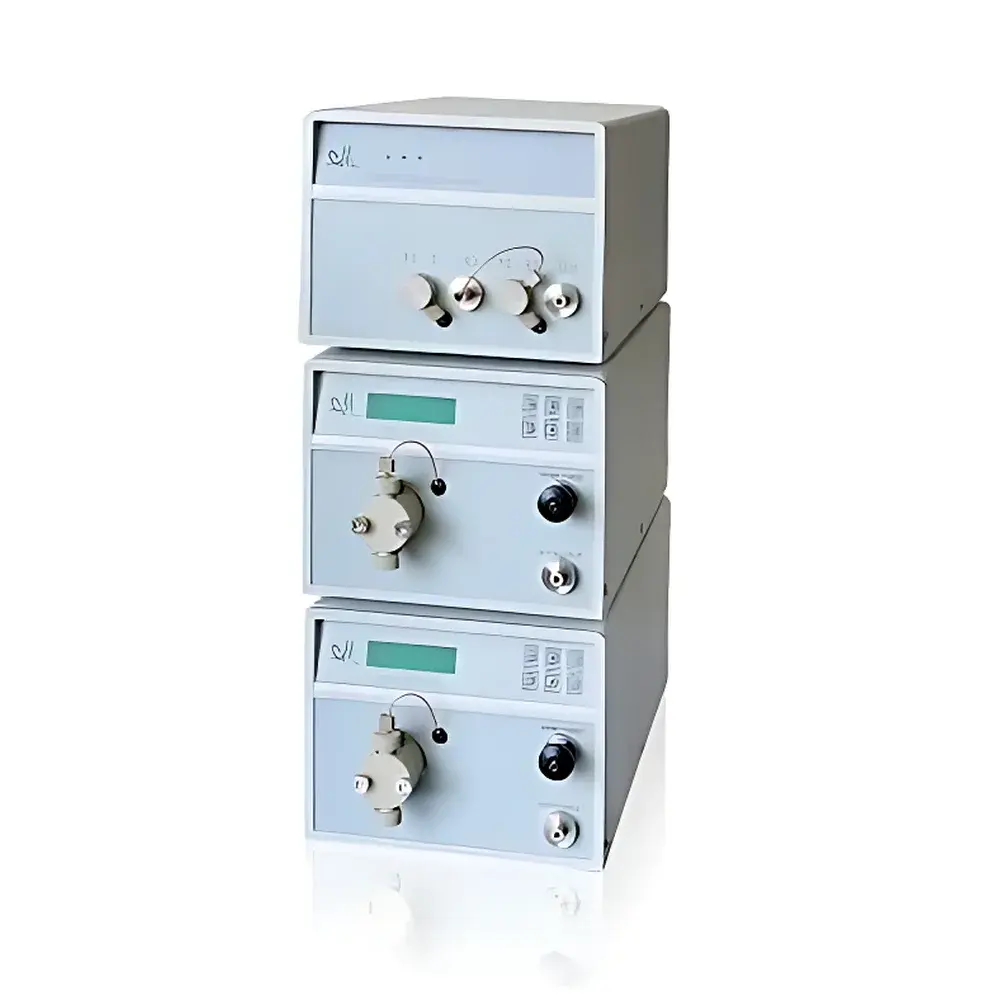
CoMetro 6000 Post-Column Derivatization System
| Brand | CoMetro |
|---|---|
| Model | CoMetro 6000 |
| Temperature Range | 10–150 °C |
| Derivatization Reagent Flow Rate | 0.001–10 mL/min |
| Reaction Coil Material | PEEK |
| Reaction Volume Options | 0.15 / 0.5 / 1.5 mL |
| Temperature Accuracy | ±1 °C |
| Temperature Reproducibility | ±0.4 °C |
| Maximum Pressure | 4000 psi |
| Flow Accuracy | ±1% |
| Flow Precision | 0.2% RSD |
Overview
The CoMetro 6000 Post-Column Derivatization System is an engineered solution for enhancing detection sensitivity and selectivity in high-performance liquid chromatography (HPLC) and ultra-high-performance liquid chromatography (UHPLC) workflows. It operates on the principle of post-column chemical derivatization—introducing a controlled reagent stream downstream of the analytical column to convert non-chromophoric or weakly fluorescent analytes into detectable derivatives immediately prior to detection. This system is particularly critical for compounds lacking native UV absorbance or native fluorescence, such as primary and secondary amines, hydrazides, aldehydes, and certain heterocyclic toxins. Designed for integration into regulated laboratory environments, the CoMetro 6000 supports method compliance with pharmacopeial standards including USP , EP 2.2.46, and ICH Q2(R2) validation requirements for derivatization-based assays.
Key Features
- Modular dual-core reactor architecture enabling simultaneous heated and ambient-temperature derivatization steps—ideal for multi-step reaction schemes (e.g., o-phthalaldehyde followed by mercaptoethanol addition)
- Front-panel digital interface with real-time display of setpoint/actual temperature per reactor zone, reagent flow rate, line pressure, and pressure limits
- PEEK-only fluidic path from reagent reservoir to detector interface—chemically inert, low metal leaching, compatible with aggressive solvents (e.g., TFA, perchloric acid, sodium hydroxide)
- Quick-swap reactor cartridges secured with only two fittings; minimal dead volume design preserves chromatographic peak shape and resolution
- Integrated pressure monitoring and automatic purge cycles reduce seal wear and extend pump lifetime; PEEK-built-in vent valves prevent air entrapment
- RS232 serial interface enables full remote control and data logging via LIMS or third-party acquisition software—supports audit trail generation per FDA 21 CFR Part 11
- Thermal stability validated to reach 150 °C within 30 minutes; over-temperature cutoff at 160 °C ensures hardware protection and method robustness
Sample Compatibility & Compliance
The CoMetro 6000 supports derivatization of diverse compound classes across regulated and research applications. Validated use cases include amino acid profiling (including taurine), carbamate pesticide residues (e.g., carbofuran, methomyl), glyphosate and its metabolites, aflatoxins (B1/B2/G1/G2), deoxynivalenol (DON), domoic acid, aminoglycosides (e.g., gentamicin), macrolides (e.g., erythromycin), voglibose, and biogenic amines (e.g., histamine, tyramine). Its PEEK wetted materials meet USP Class VI and ISO 10993-5 cytotoxicity requirements. The system’s traceable temperature and flow calibration records support GLP and GMP documentation needs, and its deterministic response time (<2 s step change) ensures reproducibility across batch runs required for clinical screening (e.g., phenylketonuria and maple syrup urine disease diagnostics).
Software & Data Management
While the CoMetro 6000 operates autonomously via front-panel controls, its RS232 port provides bidirectional communication for integration with Chromatography Data Systems (CDS) such as Thermo Chromeleon, Waters Empower, or Agilent OpenLab CDS. Command sets allow synchronized start/stop of derivatization pumps with injection events, temperature ramping profiles tied to gradient programs, and real-time pressure/flow telemetry logging. All parameter changes are timestamped and stored in non-volatile memory—enabling full electronic record retention compliant with ALCOA+ principles. Optional firmware updates maintain compatibility with evolving regulatory expectations for electronic signatures and audit trail integrity.
Applications
This system serves laboratories engaged in environmental water analysis (e.g., bromate, Cr(VI), formaldehyde), feed and food safety testing (mycotoxin surveillance, antibiotic residue screening), clinical toxicology (urinary organic acids, neurotransmitter metabolites), pharmaceutical QC (impurity profiling of amine-containing APIs), and forensic chemistry (detection of clandestine drug precursors). Its flexibility in reaction volume selection (0.15–1.5 mL) allows optimization for both narrow-bore UHPLC columns (2.1 mm ID) and conventional HPLC systems (4.6 mm ID), maintaining linear velocity consistency and minimizing band broadening.
FAQ
Can the CoMetro 6000 be integrated with existing HPLC systems from major vendors?
Yes—it features universal 1/16″ PEEK tubing connections and standard RS232 protocol, enabling plug-and-play compatibility with Shimadzu, Agilent, Waters, Thermo Fisher, and Hitachi platforms.
Is the system suitable for use with corrosive derivatization reagents such as o-phthalaldehyde in alkaline medium?
Yes—the entire fluidic path is constructed from PEEK polymer, which exhibits exceptional resistance to strong bases, oxidants, and halogenated solvents commonly used in amine derivatization protocols.
Does the CoMetro 6000 support 21 CFR Part 11 compliance out of the box?
The hardware supports electronic audit trails and user access control when paired with validated CDS software; full Part 11 compliance requires site-specific validation of the integrated workflow, including signature capture and record retention policies.
What maintenance intervals are recommended for pump seals and reactor coils?
Under typical operation (8 h/day, aqueous/organic mobile phases), PEEK pump seals require replacement every 12–18 months; reactor cartridges are consumables with a service life of ≥500 injections per coil, depending on reagent aggressiveness and operating temperature.
Can multiple derivatization reagents be delivered simultaneously?
Yes—configurations with up to three independent PEEK syringe pumps allow precise, programmable mixing of two or more reagents inline prior to the reactor, supporting complex multi-reagent chemistries such as dansylation or naphthoyl chloride derivatization.





