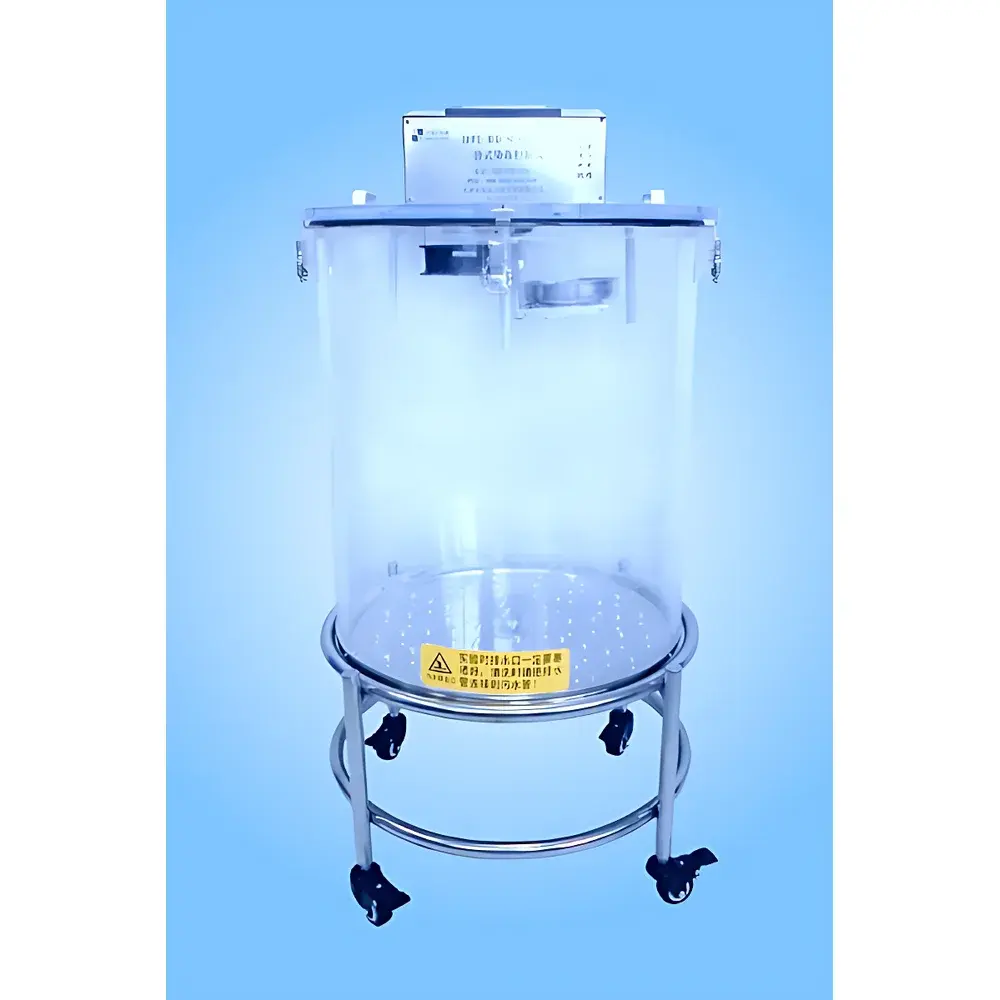
Hope-Med Model 8050 Static Whole-Body Exposure Chamber
| Brand | Hope-Med |
|---|---|
| Origin | Tianjin, China |
| Manufacturer Type | Authorized Distributor |
| Country of Origin | China |
| Model | 8050 |
| Price Range | USD 2,800 – 7,000 |
Overview
The Hope-Med Model 8050 Static Whole-Body Exposure Chamber is an engineered platform for controlled inhalation toxicology studies in small laboratory animals—primarily mice and rats. Designed in alignment with internationally recognized exposure methodology standards—including OECD Test Guideline 412 (Subacute Inhalation Toxicity), ASTM E1936 (Standard Guide for Inhalation Toxicology Studies), and GB/T 16295–2022 (Chinese National Standard for Inhalation Exposure Apparatus)—this chamber implements static exposure principles, wherein test atmospheres are generated externally and introduced into a sealed, volume-calibrated exposure vessel. Unlike dynamic (flow-past) systems, static chambers rely on precise initial dosing and passive atmospheric homogeneity over defined exposure durations (typically 1–6 hours), making them suitable for acute screening, educational demonstrations, and resource-constrained research settings requiring reproducible, concentration-controlled inhalation challenges.
Key Features
- Patented circular airflow mixing geometry ensures uniform distribution of aerosolized, gaseous, or sublimated test agents—minimizing stratification and enhancing intra-chamber homogeneity (CV < 15% across standard rodent cage configurations).
- Integrated environmental monitoring suite: real-time digital readouts for chamber temperature (±0.5 °C accuracy), relative humidity (±3% RH), and oxygen concentration (0–25% O₂ range, electrochemical sensor).
- Full microprocessor-based control via 7-inch color touchscreen HMI—enabling programmable exposure duration, pre-conditioning cycles, and automated safety interlocks (e.g., O₂ < 18% triggers audible/visual alarm and ventilation override).
- Modular design with standardized inlet/outlet ports (¼” NPT) that support future upgrade to dynamic flow-through operation using external mass flow controllers and aerosol generators.
- Chamber body constructed from medical-grade polycarbonate with anti-static coating and autoclavable stainless-steel door gasket—ensuring chemical compatibility with organic solvents, acidic vapors, and particulate aerosols.
Sample Compatibility & Compliance
The Model 8050 accommodates up to 10 adult mice (≤30 g) or 5 rats (≤200 g) per exposure cycle, with adjustable internal partitioning to maintain consistent animal density per OECD-recommended guidelines (≥200 cm³/animal). Chamber volume is calibrated at 25 L (±1%), enabling accurate calculation of nominal concentration (Cn = mass of test agent / chamber volume). The system supports aerosol generation via ultrasonic nebulizers, thermal vaporizers, or solid-substance sublimation modules (not included). All operational parameters—including exposure time, temperature setpoint, and humidity target—are logged with timestamped metadata to support GLP-compliant study documentation. Device firmware complies with ISO/IEC 17025 traceability requirements for measurement instrumentation, and data export formats (CSV, PDF report templates) facilitate integration into regulated environments adhering to FDA 21 CFR Part 11 and EU Annex 11 expectations for audit trails.
Software & Data Management
The embedded control software provides local storage of ≥1,000 exposure sessions with full parameter history, including environmental sensor trends and manual operator annotations. Export options include USB flash drive transfer and optional Ethernet/Wi-Fi module (add-on) for centralized lab network logging. Raw sensor data is sampled at 1 Hz and aggregated into 1-minute averages for reporting. Audit trail functionality records user login events, parameter modifications, and alarm activations—each tagged with operator ID and system timestamp. Software architecture supports multi-user role assignment (Administrator, Technician, Reviewer) and password-protected configuration lockdown during active exposures.
Applications
- Acute and subacute inhalation toxicity screening per OECD 403 and 412 protocols.
- Educational training in inhalation toxicology principles, dose–response modeling, and chamber validation techniques (e.g., ammonia gas homogeneity mapping).
- Preclinical evaluation of respirable drug formulations, nanomaterial aerosols, and combustion-derived particulates (e.g., cigarette smoke condensate, biomass pyrolysis emissions).
- Method development for static-to-dynamic transition studies, leveraging the built-in interface compatibility for downstream integration with cascade impactors or real-time particle sizers (e.g., SMPS, OPS).
- Regulatory submission support for Chinese NMPA and international agencies requiring documented chamber performance qualification (PQ) and operational qualification (OQ) reports.
FAQ
What is the difference between static and dynamic exposure in inhalation toxicology?
Static exposure relies on a single bolus introduction of test atmosphere into a sealed chamber, with concentration decay modeled mathematically; dynamic exposure maintains constant airflow and steady-state concentration via continuous generation and exhaust.
Can the Model 8050 be validated for GCP/GLP studies?
Yes—the system supports IQ/OQ/PQ documentation packages, including temperature/humidity uniformity mapping, aerosol deposition efficiency testing, and sensor calibration certificates traceable to NIST standards.
Is remote monitoring supported out-of-the-box?
Basic remote status viewing requires optional Ethernet/Wi-Fi module; full remote control and real-time data streaming are available via API integration (RESTful endpoints provided under enterprise license).
What maintenance is required for long-term reliability?
Quarterly verification of sensor calibration, biannual replacement of door gasket and filter elements (if used with particulate generators), and annual firmware update recommended.
Does the chamber meet IEC 61000-4 electromagnetic compatibility standards?
Yes—certified to IEC 61000-4-2 (ESD), -4-3 (radiated RF), and -4-4 (electrical fast transients) for laboratory-grade EMC compliance.