
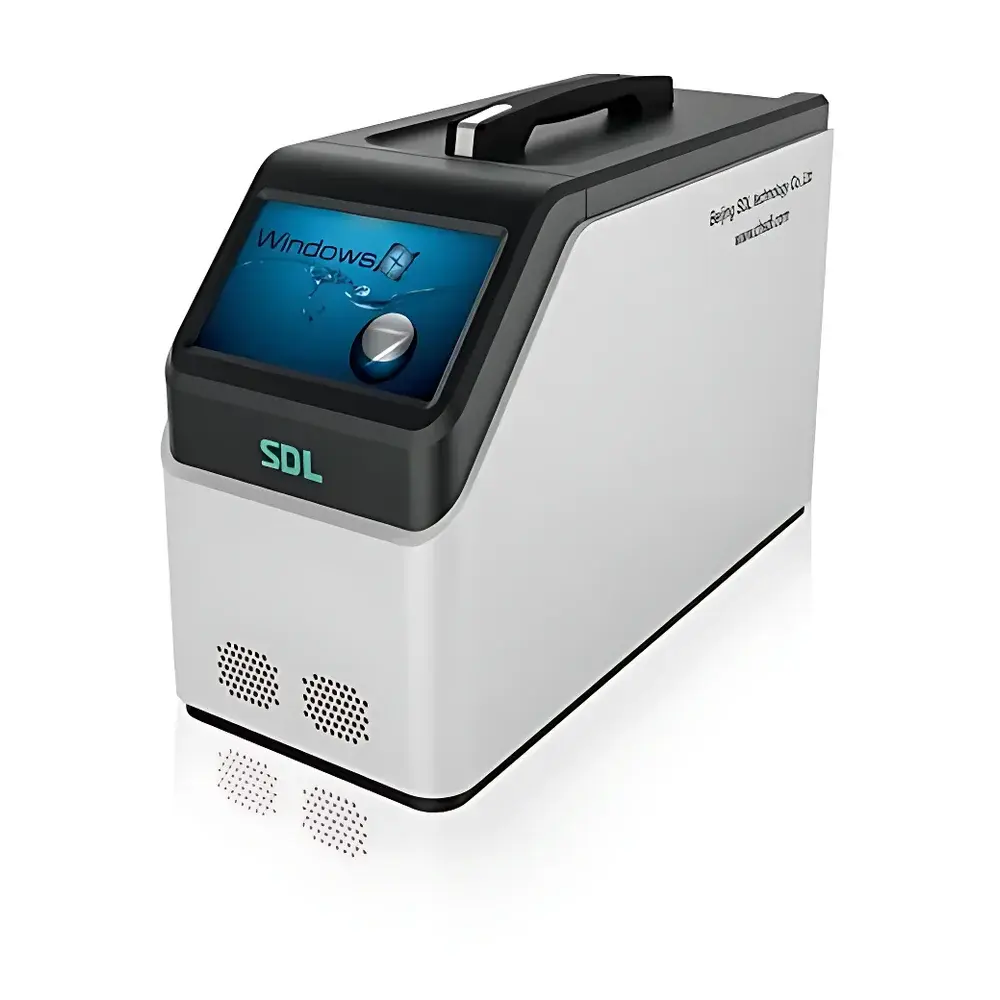
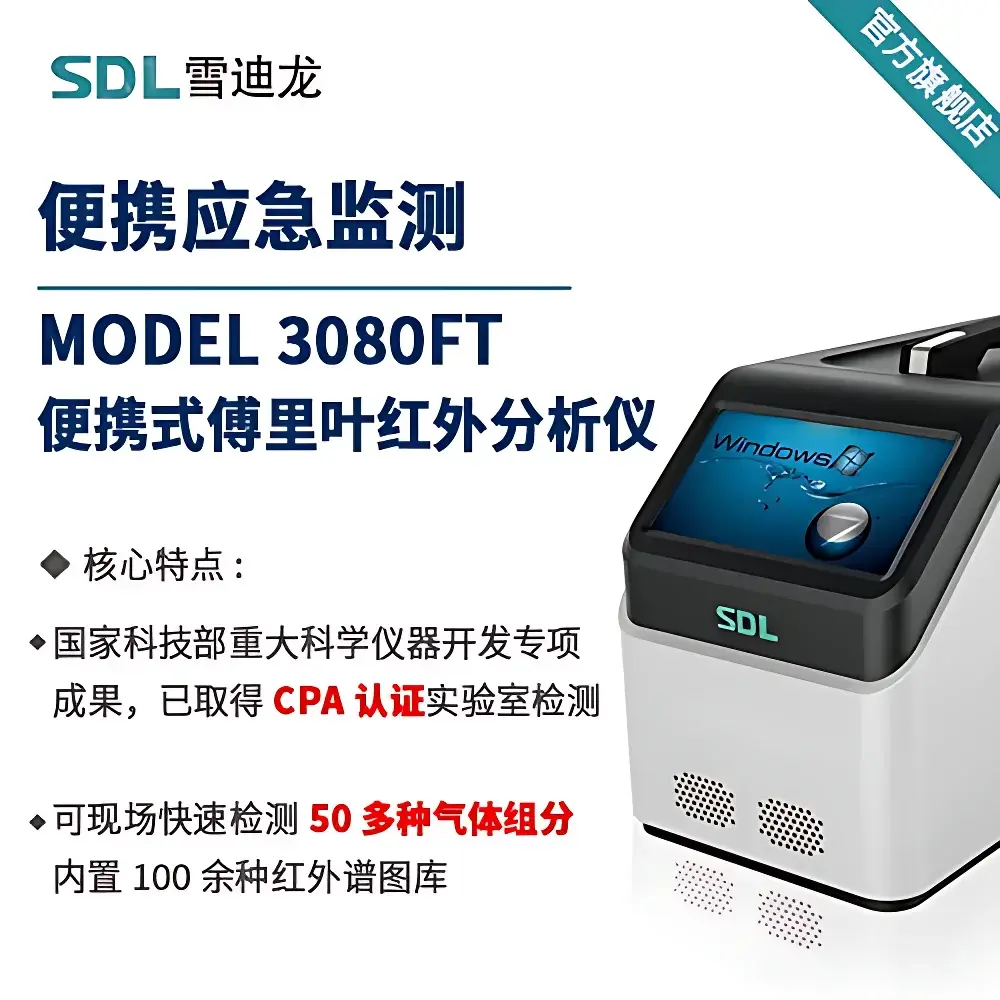
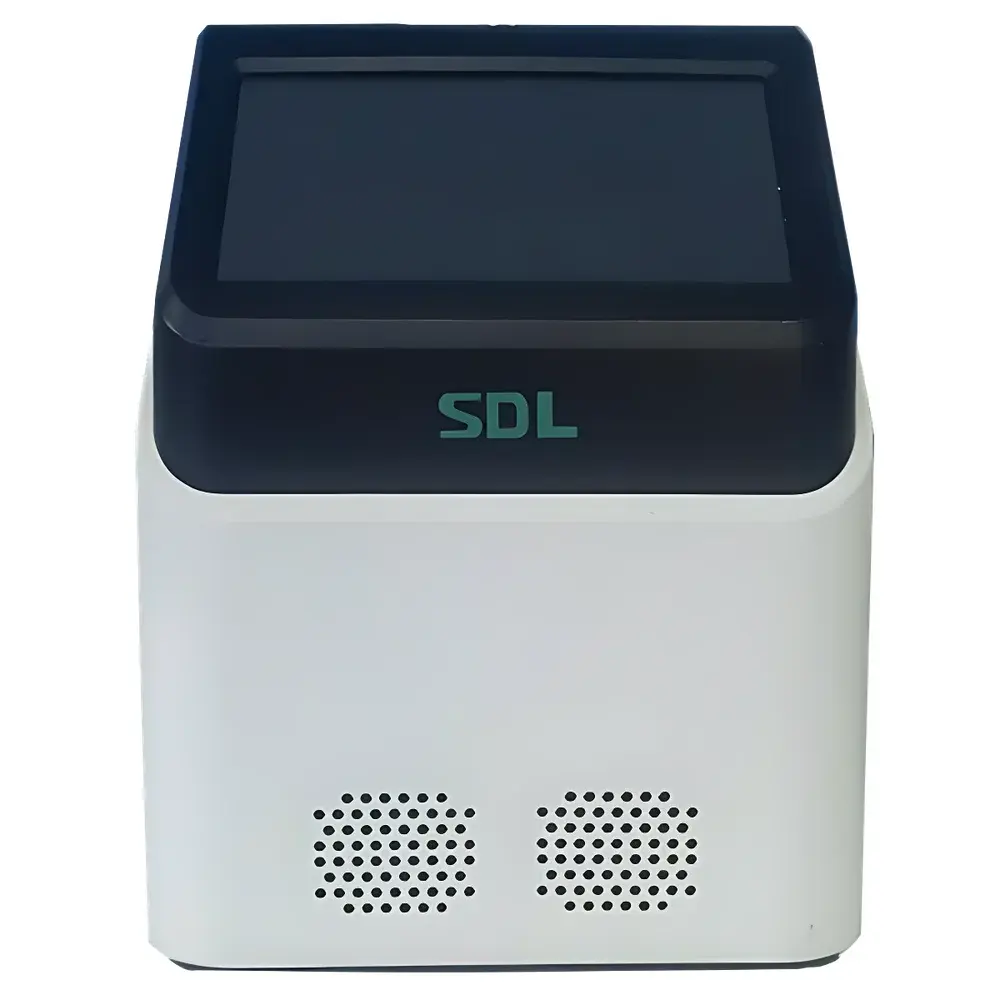
SDL Brookfield MODEL 3080FTIR Portable Fourier Transform Infrared (FTIR) Gas Analyzer
| Brand | SDL |
|---|---|
| Origin | Beijing, China |
| Manufacturer Type | Original Equipment Manufacturer (OEM) |
| Model | MODEL 3080FTIR |
| Instrument Type | Portable Flue Gas & Multi-Gas Analyzer |
| Measurement Principle | Fourier Transform Infrared Spectroscopy (FTIR) |
| Accuracy (Linearity Error) | ≤1% FS |
| Repeatability | ≤1% RSD |
| Response Time | Configurable per gas (T90 < 30 s typical) |
| Baseline Stability | <0.5% drift over 24 h (with thermal stabilization) |
| Detectable Gases | SO₂, NO, NO₂, NH₃, HCl, CO, CO₂, O₂, H₂O, Benzene, Toluene, Xylene (o/m/p), CH₄, N₂O, SF₆, NF₃, and >50 total analytes |
| Operating Temperature Range | 0–45 °C |
| Sample Path Temperature | 180 °C (fully heated optical path & gas cell) |
| Detection Limit | Sub-ppm to low-ppm range (gas-dependent) |
| Spectral Resolution | 0.5 cm⁻¹ (standard), upgradable to 0.25 cm⁻¹ |
| Wavenumber Range | 600–4000 cm⁻¹ |
| Detector | Thermoelectrically Cooled MCT (Mercury Cadmium Telluride) |
| Interferometer | Rock-Solid Dynamic Alignment Michelson with Laser Referencing |
| Data Output | Real-time concentration (ppm/ppb), spectral absorbance, raw interferogram |
| Compliance | CPA Certified (China Metrology Approval), Meets HJ 1223–2021, HJ 1013–2018, and ISO 12039:2000 (Flue Gas Analysis) |
Overview
The SDL Brookfield MODEL 3080FTIR is a field-deployable, high-fidelity Fourier Transform Infrared (FTIR) gas analyzer engineered for quantitative multi-component analysis of complex industrial and environmental gas streams. Unlike dispersive or electrochemical sensors, the MODEL 3080FTIR employs a Michelson interferometer with laser-referenced dynamic alignment and a thermoelectrically cooled MCT detector to acquire full mid-infrared spectra (600–4000 cm⁻¹) in real time. This enables simultaneous, interference-free quantification of over 50 target gases—including regulated pollutants (SO₂, NO, NO₂, HCl, NH₃, CO), greenhouse gases (CO₂, CH₄, N₂O, SF₆, NF₃), volatile organic compounds (benzene, toluene, xylene isomers), and matrix components (O₂, H₂O)—without chemical separation or pre-concentration. Its fully heated optical path (180 °C) and low-adsorption gas cell eliminate condensation and surface losses, making it uniquely suited for hot, humid, and particulate-laden flue gas matrices encountered in waste incineration, coke ovens, sintering plants, and semiconductor process exhausts.
Key Features
- True real-time FTIR spectroscopy: Full spectral acquisition at ≤1-second intervals supports dynamic emission profiling and transient event capture.
- Hot-wet measurement architecture: Integrated 180 °C heated sample cell, beam path, and detector chamber ensure quantitative recovery of highly soluble, reactive, and polar gases—including NH₃ and HCl—without dilution or drying artifacts.
- Pre-loaded spectral library: Contains >100 validated infrared reference spectra, calibrated against NIST-traceable standards, enabling robust multivariate least-squares (MLS) or classical least-squares (CLS) quantification.
- Zero-maintenance baseline stability: Proprietary background compensation algorithm eliminates daily zero-gas calibration; system drift remains <0.5% over 24 hours under continuous operation.
- Field-hardened mechanical design: Shock-absorbing chassis, IP54-rated enclosure, integrated GPS geotagging, and <12 kg total mass enable handheld use, vehicle mounting, or tripod deployment in uncontrolled environments.
- Regulatory-grade metrology: Certified under China’s CPA (China Metrology Approval) scheme and compliant with HJ 1223–2021 (FTIR-based flue gas monitoring), HJ 1013–2018 (VOCs monitoring), and ISO 12039:2000 (performance requirements for flue gas analyzers).
Sample Compatibility & Compliance
The MODEL 3080FTIR accepts raw, unfiltered, and undiluted gas samples directly from stack probes, ambient air intakes, or emergency response sampling bags. It accommodates gas temperatures up to 200 °C (with optional extension probe), relative humidity up to 100% RH, and particulate loading up to 100 mg/m³ (with standard cyclonic pre-filter). All measurements are traceable to national primary standards via on-board reference cell verification. The instrument satisfies data integrity requirements for regulatory reporting under China’s MEP (now MEE) guidelines and supports audit-ready electronic records compliant with GLP principles. Optional 21 CFR Part 11-compliant software modules provide electronic signatures, user access control, and immutable audit trails for QA/QC validation.
Software & Data Management
The embedded Linux-based operating system runs proprietary spectral analysis firmware with dual-mode operation: autonomous field mode (touchscreen GUI with real-time concentration plots and alarm thresholds) and laboratory mode (PC-connected via Ethernet/USB for advanced chemometric modeling). Raw interferograms and processed spectra are stored in HDF5 format with embedded metadata (GPS coordinates, timestamp, ambient pressure/temperature, operator ID). Export options include CSV, XML, and PDF reports conforming to HJ 75–2017 data formatting standards. Remote diagnostics, firmware updates, and spectral library expansion are supported via secure TLS-encrypted OTA (over-the-air) channels.
Applications
- Continuous emissions monitoring (CEMS) verification and QA/QC audits at waste-to-energy plants, iron & steel sintering lines, and coke oven batteries.
- Rapid-response emergency assessment during chemical spills, fire incidents, or fugitive VOC releases—enabling on-site identification and concentration mapping within minutes.
- Third-party compliance testing for environmental inspection agencies and certification bodies requiring multi-analyte, non-destructive verification.
- Process optimization in semiconductor fabrication, coating lines, and printing facilities where real-time NH₃, solvent vapors, or acid gas profiles inform abatement control logic.
- Laboratory-based method development and reference analysis for validating sensor networks, DOAS systems, or GC-MS workflows.
FAQ
Does the MODEL 3080FTIR require external calibration gases during routine operation?
No. Its self-referencing interferometer and adaptive baseline correction eliminate daily zero/span calibration. Periodic verification (e.g., quarterly) using certified gas standards is recommended for regulatory compliance.
Can it quantify isomeric VOCs such as ortho-, meta-, and para-xylene separately?
Yes. With 0.5 cm⁻¹ resolution and library matching against high-fidelity reference spectra, it resolves key vibrational band separations sufficient for isomer-specific quantification under typical flue gas conditions.
Is the instrument suitable for ambient air monitoring at ppb-level concentrations?
It achieves low-ppb detection limits for select gases (e.g., NH₃, benzene) when configured with extended pathlength cells and signal averaging—though its primary design focus is ppm-range flue gas analysis.
How is data integrity ensured for regulatory submissions?
All measurements include cryptographic hash stamps, GPS-tagged location metadata, and immutable timestamps. Optional software modules support 21 CFR Part 11–compliant electronic records with role-based access control and full audit trail logging.
What maintenance is required in harsh field environments?
Only periodic cleaning of the inlet filter and visual inspection of the heated sample line. No optical alignment, detector cooling refills, or consumables are needed—the MCT detector is thermoelectrically stabilized for indefinite service life.







