
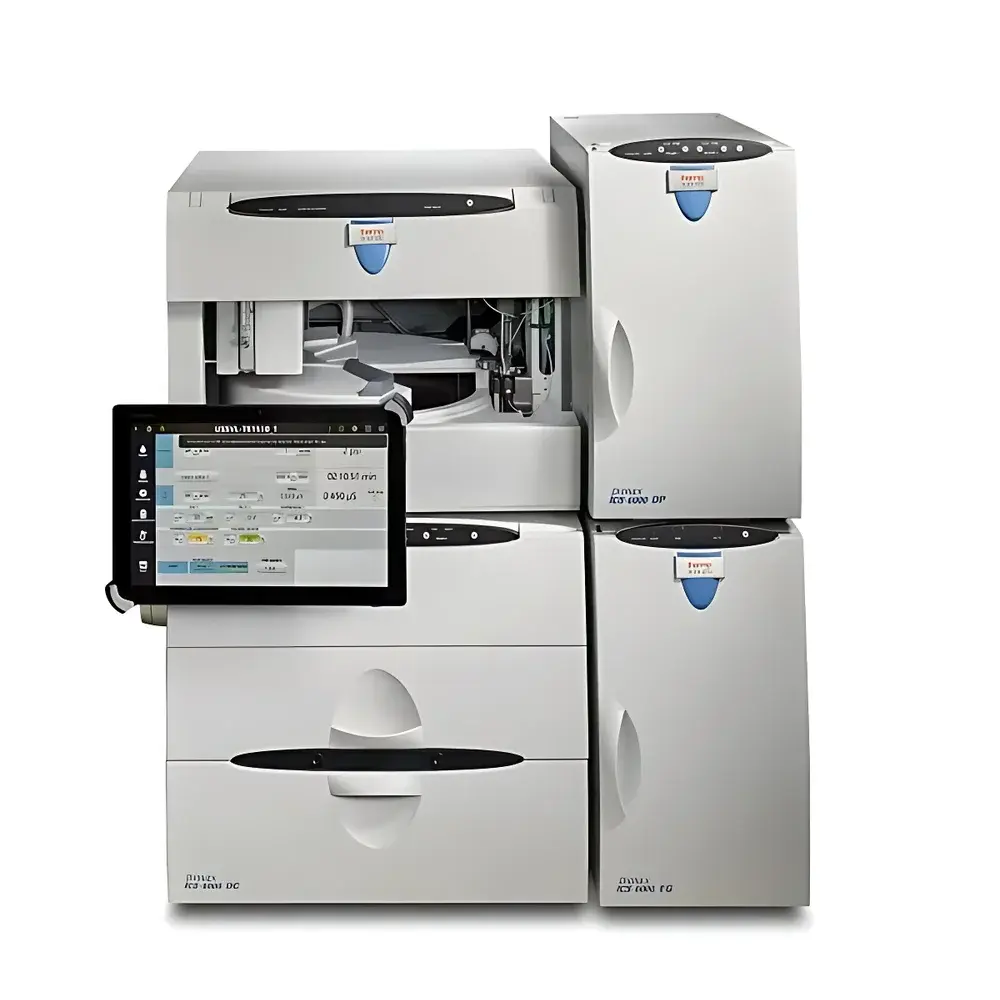
Thermo Scientific Dionex ICS-6000 High-Pressure Ion Chromatography System
| Brand | Thermo Fisher |
|---|---|
| Origin | USA |
| Model | Dionex™ ICS-6000 Standard-Bore and Microbore HPIC™ System |
| Maximum Operating Pressure | 5000 psi |
| Configuration | Modular Laboratory IC System |
| Column Compatibility | Standard-bore (1–3 mm ID) and microbore (3–7 mm ID) |
| Supported Particle Size | 4 µm columns |
| Regulatory Compliance | Designed for GLP/GMP environments |
Overview
The Thermo Scientific Dionex ICS-6000 High-Pressure Ion Chromatography (HPIC™) System represents the first commercially available modular ion chromatograph engineered to operate continuously at up to 5000 psi. This pressure capability enables deployment of sub-5 µm particle-packed columns—particularly 4 µm stationary phases—thereby expanding resolution, peak capacity, and analysis speed beyond conventional low-pressure IC platforms. The system implements suppressed conductivity detection as its primary quantification method, with optional integration of electrochemical (ED), UV/Vis (VWD/PDA), or mass spectrometric (ICP-MS, ESI-MS) detection for multi-modal analyte characterization. Its architecture is purpose-built for laboratories requiring high reproducibility in routine anion/cation analysis—including environmental monitoring (e.g., nitrate, sulfate, fluoride in drinking water per EPA Method 300.1), pharmaceutical counterion profiling (USP /), and semiconductor-grade ultrapure water testing (ASTM D8099).
Key Features
- Modular high-pressure pumping platform supporting both standard-bore (1–3 mm ID) and microbore (3–7 mm ID) column formats
- Sustained operation at 5000 psi enables use of 4 µm particle columns for enhanced resolution and kinetic efficiency
- Reagent-Free IC (RFIC™) architecture with integrated electrolytic eluent generation (EG) eliminates manual eluent preparation and improves baseline stability
- Dual-pump (DP) and single-pump (SP) configurations available for isocratic or gradient elution—including electrolytic gradient generation
- Temperature-controlled conductivity cell (±0.01 °C stability) and precision flow control (<0.1% RSD) ensure long-term baseline integrity and low detection limits
- Compatible with Thermo Scientific Dionex AS-AP and AS-DC autosamplers for unattended operation, dilution, loop injection, and online sample pretreatment
- Expandable detector ecosystem: ICS-6000 CD (conductivity), ED (pulsed amperometric detection), VWD/PDA (UV absorbance), and MS-coupled interfaces
Sample Compatibility & Compliance
The ICS-6000 accommodates aqueous matrices across diverse regulatory domains—including environmental extracts, pharmaceutical formulations, food leachates, and electronic-grade process waters. It supports column chemistries for separation of common inorganic anions (F⁻, Cl⁻, NO₂⁻, Br⁻, NO₃⁻, PO₄³⁻, SO₄²⁻), cations (Li⁺, Na⁺, NH₄⁺, K⁺, Mg²⁺, Ca²⁺), organic acids, amines, and transition metal ions. All hardware components comply with IEC 61010-1 safety standards. When operated with Chromeleon CDS under validated configuration, the system meets audit requirements for GLP studies and GMP manufacturing support. Electronic records and signatures adhere to FDA 21 CFR Part 11 criteria, including secure user authentication, full audit trail, and immutable data archiving.
Software & Data Management
Chromeleon Chromatography Data System (CDS) v7.3 or later provides unified instrument control, sequence management, peak integration, reporting, and compliance tools. The software natively supports RFIC workflow automation—including automatic eluent concentration adjustment, pump priming, and suppressor regeneration cycles. Integrated calibration curve generation, custom report templates (PDF/Excel), and LIMS connectivity (via ASTM E1384 or HL7) facilitate laboratory-wide data interoperability. Raw data files (.cdf) are stored in vendor-neutral format compliant with ISO/IEC 17025 documentation requirements.
Applications
- Environmental analysis: Quantification of regulated anions in wastewater, groundwater, and atmospheric precipitation per ISO 10304-1, EPA Methods 300.0/300.1, and DIN EN ISO 14911
- Pharmaceutical quality control: Counterion verification in APIs and excipients; residual acetate or chloride in biologics formulations
- Food & beverage safety: Nitrite/nitrate in cured meats; sulfite in wines; phosphate additives in dairy products
- Power generation: Anion contamination monitoring in boiler feedwater and nuclear reactor coolant streams
- Academic research: Speciation analysis of arsenic, chromium, or iodine using ICP-MS hyphenation
FAQ
What column formats does the ICS-6000 support?
Standard-bore (1–3 mm internal diameter) and microbore (3–7 mm internal diameter) columns, including Thermo Scientific Dionex IonPac series with 4 µm particle technology.
Is RFIC operation mandatory?
No—systems may be configured with bottled eluents; however, RFIC mode delivers superior baseline stability, reduced carryover, and lower operational cost over time.
Can the ICS-6000 interface with mass spectrometers?
Yes—via electrospray ionization (ESI) or inductively coupled plasma (ICP) sources, enabling elemental speciation and molecular identification.
Does the system support automated sample preparation?
Yes—when paired with the AS-AP autosampler and optional inline dilution, filtration, or matrix elimination modules.
What validation documentation is provided?
Factory-installed IQ/OQ protocols, electronic calibration certificates, and Chromeleon CDS 21 CFR Part 11 implementation guides are included with each shipment.
Related Products




