
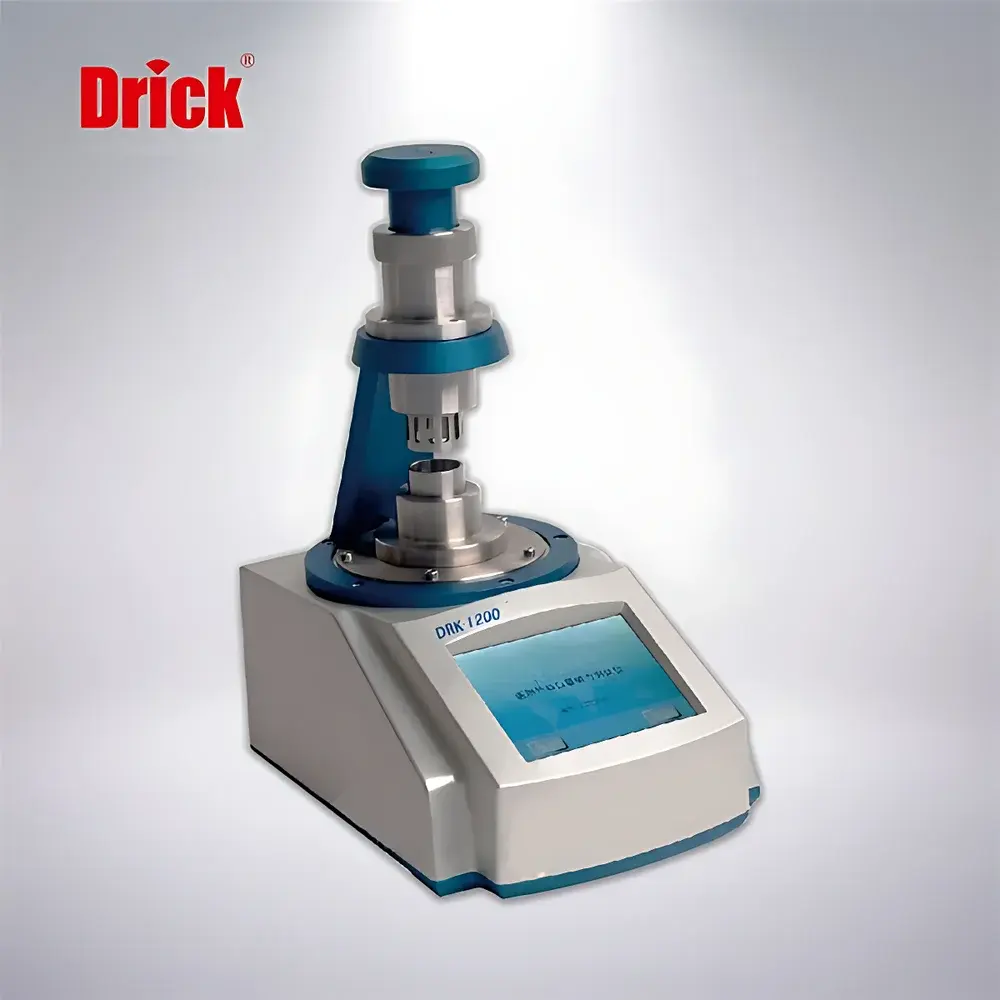
Drick DRK EN 14683:2014 Medical Face Mask Air Permeability and Pressure Differential Tester
| Brand | Drick |
|---|---|
| Origin | Shandong, China |
| Manufacturer Type | Direct Manufacturer |
| Regional Classification | Domestic (China) |
| Model | DRK |
| Price | USD 7,000 (FOB Qingdao) |
| Air Flow Rate | 8 L/min ± 0.1 L/min |
| Test Area Diameter | Ø25 mm |
| Pressure Differential Range | 0–500 Pa |
| Sensor Accuracy | ±0.5% FS |
| Power Supply | 220 V AC, 50 Hz |
| Sealing Method | End-face sealing |
| Vacuum Source | Integrated suction-type air pump |
| Display | Digital LCD with real-time ΔP readout |
Overview
The Drick DRK EN 14683:2014 Medical Face Mask Air Permeability and Pressure Differential Tester is a precision-engineered instrument designed to quantify the pressure differential across medical face mask materials under controlled airflow conditions—directly aligned with the gas exchange resistance requirements specified in EN 14683:2014 Annex C. This test method evaluates the breathability of surgical and procedural masks by measuring the resistance to airflow at a standardized volumetric flow rate of 8 L/min across a defined circular test area (Ø25 mm), expressed as pressure difference (ΔP) in pascals per square centimeter (Pa/cm²). The instrument operates on the principle of constant-flow differential pressure measurement: an integrated suction-type vacuum source generates stable airflow through the specimen, while a high-stability piezoresistive pressure sensor captures the static pressure drop across the material surface. Results are critical for compliance verification against regulatory thresholds—e.g., ≤40 Pa/cm² for Type I masks and ≤60 Pa/cm² for Type II and Type IIR masks per EN 14683:2014—and serve as objective input for ISO 13485 quality system documentation and CE marking technical files.
Key Features
- Integrated suction-driven air supply ensures consistent 8 L/min flow without dependency on external compressed air infrastructure or laboratory space constraints.
- High-accuracy differential pressure transducer (0–500 Pa range, ±0.5% full-scale accuracy) provides traceable, repeatable ΔP measurements compliant with EN 14683:2014 Annex C calibration requirements.
- Custom-machined end-face sealing fixture with precision-ground contact surfaces guarantees leak-free clamping of flat, non-woven, and multi-layer mask specimens (Ø25 mm test area).
- Digital LCD display delivers real-time, unit-calibrated pressure differential readout in Pa, eliminating analog interpolation errors and supporting immediate pass/fail assessment.
- Robust industrial-grade chassis and EMI-shielded electronics ensure operational stability in shared QC laboratories and production-line environments.
- Compliance-ready mechanical design supports routine verification per ISO/IEC 17025:2017 clause 6.4 (equipment validation) and internal SOPs for periodic performance checks.
Sample Compatibility & Compliance
The DRK tester accommodates standard medical face mask materials—including melt-blown polypropylene, spunbond nonwovens, and laminated composites—as well as textile substrates used in reusable barrier fabrics. Specimens are mounted flat without stretching or compression bias, preserving native pore structure integrity during testing. The instrument satisfies mandatory test method alignment with EN 14683:2014 (Annex C), YY 0469-2011 (Clause 4.2.2), and YY/T 0969-2013 (Section 5.2). All mechanical components, airflow path geometry, and sensor placement conform to dimensional tolerances specified in EN 14683:2014 Figure C.1. Calibration certificates (NIST-traceable where applicable) and user-accessible verification protocols support audit readiness for FDA premarket submissions, EU Notified Body assessments, and GLP-compliant testing labs.
Software & Data Management
While the base DRK model operates via embedded firmware with local digital display, optional RS232/USB interface enables direct data logging to external PCs using Drick’s validated CSV export utility (v3.1). Exported datasets include timestamp, test ID, measured ΔP (Pa), calculated ΔP/cm², operator ID, and environmental temperature/humidity metadata (when paired with optional external sensors). Audit trail functionality complies with FDA 21 CFR Part 11 requirements for electronic records when deployed with password-protected user roles and immutable log generation. Raw data files are structured for seamless import into LIMS platforms or statistical process control (SPC) software such as Minitab or JMP.
Applications
- Final product release testing of surgical masks per EN 14683:2014 Type I/II/IIR classification criteria.
- In-process quality control of melt-blown filter media during nonwoven manufacturing.
- Comparative evaluation of electrostatic charge retention effects on breathability after aging or alcohol decontamination cycles.
- Raw material qualification for ISO 13485-certified medical device manufacturers supplying mask OEMs.
- Regulatory submission support for Health Canada, TGA, and ANVISA dossier packages requiring documented permeability test methodology.
- Research into structure–permeability relationships in novel biodegradable mask substrates (e.g., PLA-based nanofibers).
FAQ
What standards does the DRK tester fully support?
EN 14683:2014 Annex C, YY 0469-2011 Clause 4.2.2, and YY/T 0969-2013 Section 5.2—with mechanical and procedural fidelity verified against normative figures and tolerances.
Is the 8 L/min airflow rate adjustable?
No—the system is fixed-flow calibrated to 8 L/min ±0.1 L/min per EN 14683:2014 requirements; no user adjustment is permitted to maintain metrological integrity.
Can the instrument measure ΔP for larger sample areas?
No—test area is strictly Ø25 mm (4.91 cm²) as mandated by EN 14683:2014 Annex C; alternative configurations invalidate compliance with the standard.
Does the DRK require annual third-party calibration?
Yes—users must perform annual calibration using NIST-traceable pressure standards per ISO/IEC 17025:2017 clause 6.5; Drick provides certified calibration kits and accredited service partners in APAC and EMEA.
How is leakage prevented during clamping?
Through precision-machined end-face sealing with elastomeric gasket integration and torque-controlled clamping force (12 ±1 N·m), validated to achieve <0.5% volumetric leakage at 500 Pa differential pressure.



