
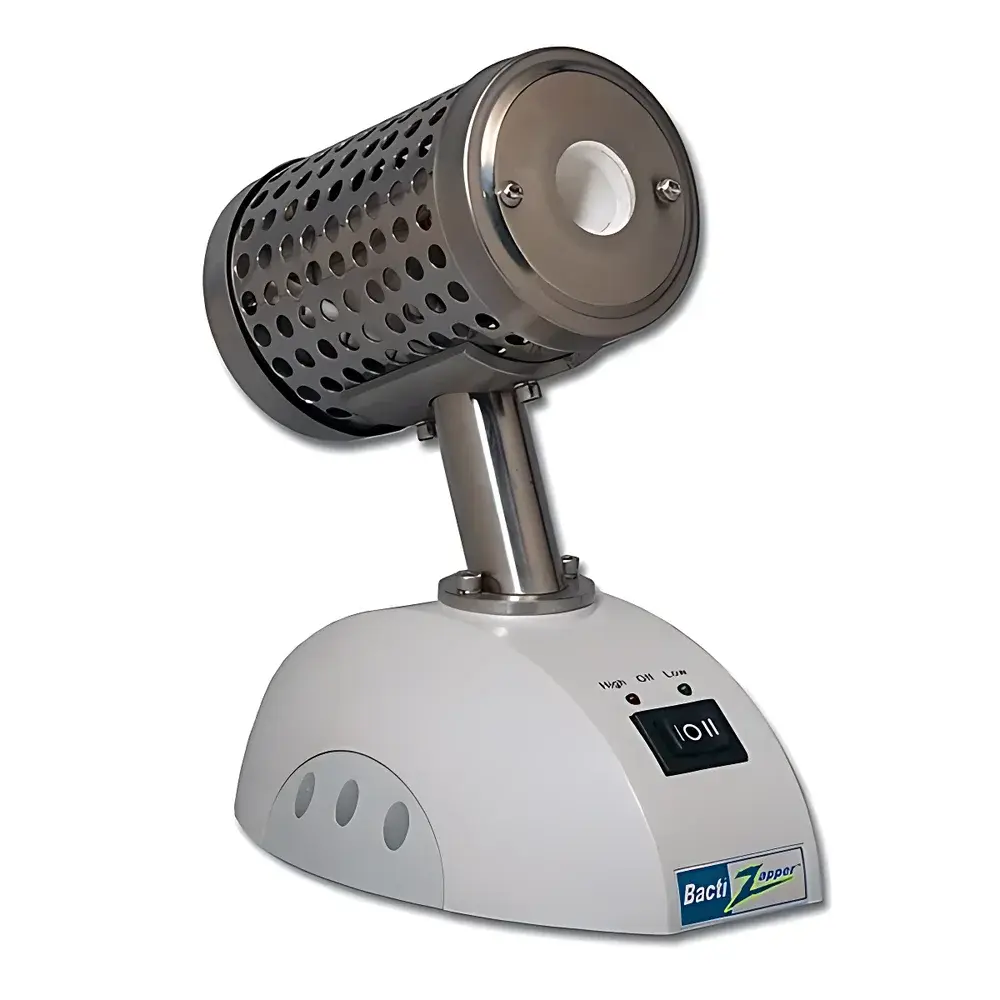
BactiZapper™ B1000 Infrared Inoculation Loop Sterilizer
| Brand | EMS/Electron Microscopy Sciences |
|---|---|
| Origin | USA |
| Model | B1000 |
| Sterilization Temperature Range | 500–815 °C |
| Chamber Diameter | 14 mm |
| Chamber Length | 100 mm |
| Overall Dimensions (W×D×H) | 10.2 × 15.2 × 16.5 cm |
| Power Supply | 230 V, 50 Hz, 50 W |
| Weight | 1.3 kg |
| Sterilization Time | 5–7 s |
Overview
The BactiZapper™ B1000 Infrared Inoculation Loop Sterilizer is a compact, high-efficiency dry-heat sterilization device engineered for rapid, residue-free decontamination of microbiological tools in biosafety level 1 and 2 laboratories. Unlike conventional flame-based or autoclave methods, it employs focused short-wave infrared radiation to achieve instantaneous thermal inactivation of microorganisms—including bacterial spores, vegetative cells, fungi, and viruses—on metal surfaces. The heating element reaches operational temperatures within seconds and maintains precise thermal stability across its calibrated range (500–815 °C), enabling consistent sterility assurance without open flame, volatile emissions, or consumables. Its all-metal chamber design eliminates asbestos or ceramic fiber insulation, complying with modern occupational health and safety standards for laboratory equipment.
Key Features
- Instantaneous sterilization cycle: 5–7 seconds per instrument, minimizing workflow interruption during serial plating or subculturing procedures.
- Dual-temperature operation: Selectable high-temperature mode (815 °C) for complete microbial eradication or low-temperature mode (500 °C) for extended heater longevity and reduced thermal stress on platinum or nickel-chromium loops.
- Asbestos-free construction: Fully compliant with OSHA and EU REACH directives; no hazardous particulate release during operation or maintenance.
- Precision-engineered sterilization chamber: 14 mm internal diameter × 100 mm depth accommodates standard inoculation loops, straight/angled needles, forceps tips, and micro-spatulas up to 100 mm in length.
- Energy-efficient design: Low-power (50 W) operation with automatic standby mode after 30 seconds of inactivity, reducing standby energy consumption by >90% compared to continuously heated units.
- Robust industrial housing: Anodized aluminum chassis with integrated heat-shielded base ensures stable placement on benchtops and compatibility with laminar flow hoods or biosafety cabinets.
Sample Compatibility & Compliance
The BactiZapper™ B1000 is validated for sterilizing metallic microbiological tools including platinum, nichrome, stainless steel, and tungsten wire loops and needles. It is not intended for plastic, coated, or temperature-sensitive instruments. The device conforms to ISO 13485:2016 requirements for medical device manufacturing environments and supports GLP-compliant documentation when integrated into laboratory quality management systems. While not classified as a Class II medical device under FDA 21 CFR Part 820, its performance aligns with ASTM E2871–13 (Standard Practice for Validation of Dry Heat Sterilization Processes) for non-porous surface decontamination. No regulatory submission is required for research-use-only applications in academic or industrial R&D settings.
Software & Data Management
The BactiZapper™ B1000 operates as a standalone analog device with no embedded firmware or digital interface. All operational parameters are fixed at factory calibration; no software updates, configuration files, or data logging capabilities are included. This architecture eliminates cybersecurity risks, avoids validation overhead associated with electronic records, and ensures full compliance with FDA 21 CFR Part 11 requirements for paper-based or manually recorded sterilization logs. Users may integrate usage timestamps and operator IDs into existing LIMS or ELN platforms via manual entry or barcode-scanned log sheets.
Applications
- Routine sterilization of inoculation loops and needles between streaking steps in bacterial isolation workflows.
- Decontamination of micro-manipulation tools in cell culture suites where flame use is prohibited due to flammable gas presence or HEPA-filter integrity concerns.
- Pre-sterilization of transfer instruments prior to aseptic handling in anaerobic chambers or glove boxes.
- High-throughput microbiology labs performing >200 daily plate inoculations, where cumulative time savings over flame-based methods exceed 1.5 hours per shift.
- Teaching laboratories requiring fail-safe, low-training-barrier sterilization tools for undergraduate microbiology courses.
FAQ
Is the BactiZapper™ B1000 suitable for sterilizing plastic or coated instruments?
No. Only metallic instruments with continuous thermal conductivity (e.g., platinum, stainless steel, nichrome) are compatible. Plastic, rubber, or polymer-coated tools will melt or degrade upon insertion.
Does this unit require periodic recalibration or preventive maintenance?
No scheduled recalibration is needed. The infrared emitter is factory-calibrated for lifetime accuracy. Routine cleaning of the chamber interior with lint-free alcohol wipes every 48 hours is recommended to prevent carbon buildup.
Can the B1000 be used inside a biosafety cabinet?
Yes—its compact footprint, absence of convective airflow disturbance, and zero-emission operation make it fully compatible with Class II A2 and B2 biosafety cabinets.
What is the expected service life of the infrared heating element?
Under normal usage (≤100 cycles/day), the emitter maintains stable output for ≥5 years or 10,000 operational cycles, as verified by accelerated life testing per IEC 60068-2-2.
Is CE marking or UKCA certification available for this model?
Yes—the B1000 carries CE marking under the EU Machinery Directive 2006/42/EC and EMC Directive 2014/30/EU. UKCA marking is provided for shipments to Great Britain post-Brexit.



