
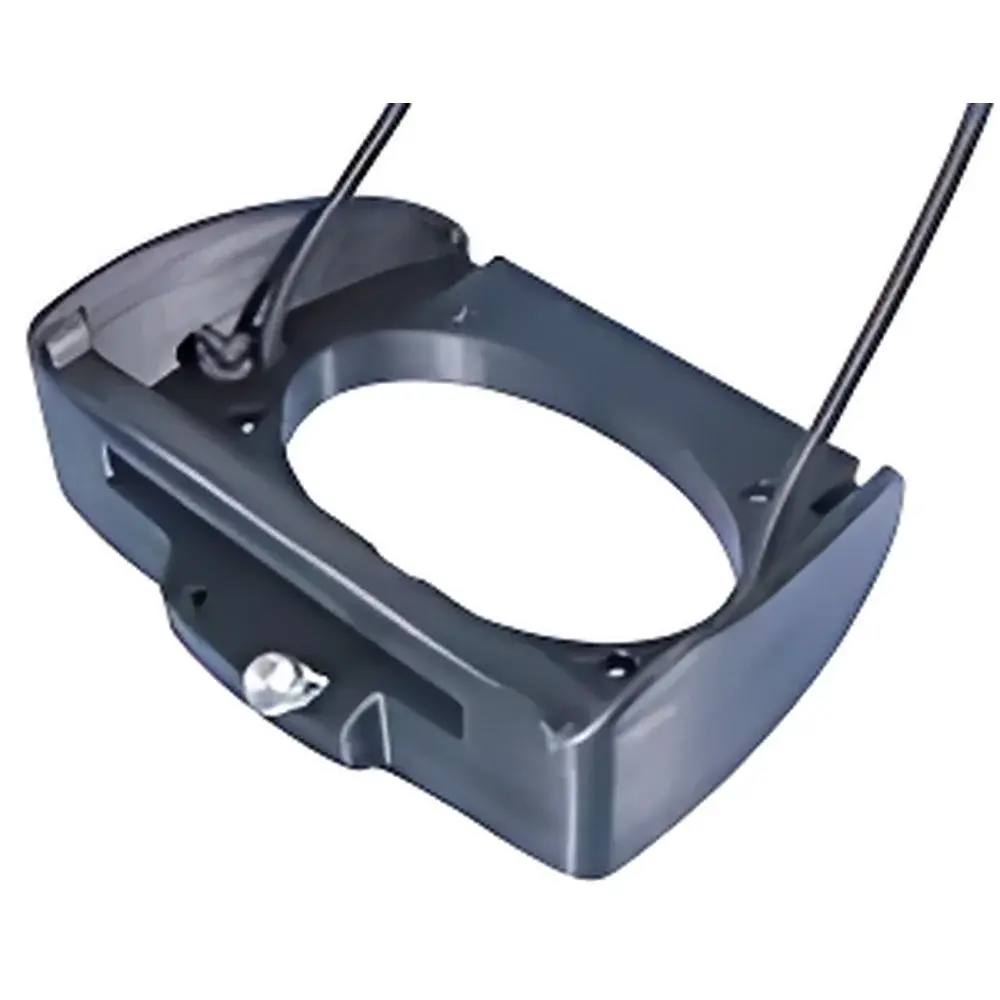
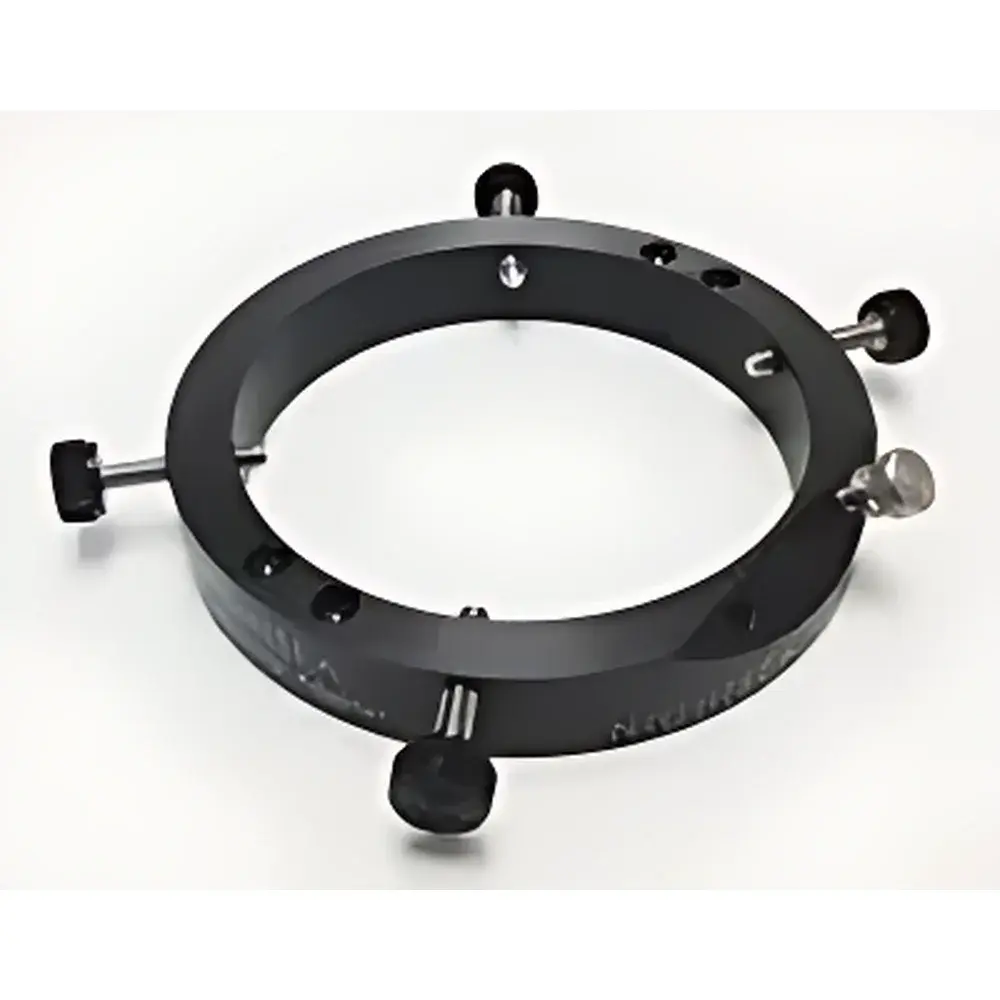
Microscope Ring Adapter for Leica EZ4 and Universal Stereo Microscopes
| Brand | EMS (Electron Microscopy Sciences) |
|---|---|
| Origin | USA |
| Adapter Types | Standard (up to 67 mm), Oversize (up to 84 mm), Leica EZ4-Specific |
| Component Category | Optical Element |
| Compliance | Designed for ISO/IEC 17025-aligned optical integration workflows |
| Mounting Interface | Threaded + set-screw mechanical coupling with radial tolerance compensation |
Overview
The EMS Microscope Ring Adapter is a precision-engineered optical mounting interface designed to enable seamless integration of fluorescence illumination modules—particularly EMS fluorescence adapter kits—with stereo (dissecting) microscopes. It operates on a mechanical coupling principle: the adapter forms a rigid, coaxially aligned transition between the microscope’s objective turret or lower optical housing and the external fluorescence light path assembly. Unlike optical couplers relying on lens-based relay systems, this ring adapter functions purely as a passive, alignment-stable mechanical interface—ensuring zero optical path deviation while maintaining critical working distance and parfocality. Its design adheres to fundamental optical bench principles where mechanical registration directly governs illumination uniformity and signal-to-noise ratio in epifluorescence configurations. The adapter is not an optical element per se (i.e., it contains no lenses, filters, or coatings), but serves as a foundational compliance component enabling traceable, repeatable setup across GLP- and GMP-regulated imaging environments.
Key Features
- Mechanically robust aluminum alloy construction with black anodized finish for corrosion resistance and ESD-safe handling in cleanroom-grade labs
- Three standardized variants: SFA-AD (Standard, max 67 mm outer diameter fit), SFA-XL-AD (Oversize, max 84 mm OD), and SFAZ-AD (Leica EZ4-specific geometry with proprietary thread pitch and centering flange)
- Radial clamping system with dual M3 stainless steel set screws—engineered to accommodate cylindrical housings from Ø50 mm to Ø67 mm (Standard) or Ø50 mm to Ø84 mm (Oversize) without deformation or slippage
- Centering accuracy ≤ ±0.15 mm under 5 N·cm torque, verified per ASTM E29-23 rounding conventions for dimensional reporting
- Compatible with industry-standard fluorescence filter cube turrets and LED-based excitation sources (e.g., CoolLED pE-300, Lumencor Sola SE)
Sample Compatibility & Compliance
The EMS Ring Adapter demonstrates broad compatibility across major stereo microscope platforms—including Leica (M3C, MZ6, MZ8, MZ12, S4, S6, ES8), Nikon (SMZ-1B, SMZ-2B, SMZ-2T, SMZ-10A, SMZ445–SMZ1500), Olympus (SZ40–SZX16), Zeiss (Discovery V8, Stemi 2000, SV6, SV11), Meiji (EMZ), Motic (SMZ168), and Fisher (Stereomaster Zoom 12-562-1). All variants are manufactured to ISO 9001:2015 certified processes and undergo dimensional inspection per ISO 1101 geometric tolerancing standards. While not a medical device, the adapter supports configurations compliant with FDA 21 CFR Part 11 when used within validated fluorescence imaging workflows requiring audit-trail-capable acquisition software (e.g., NIS-Elements, ZEN Blue, or LAS X).
Software & Data Management
As a passive mechanical component, the adapter requires no firmware, drivers, or software integration. However, its precise mechanical registration directly impacts metadata integrity: consistent adapter installation ensures reproducible illumination geometry, which is essential for quantitative fluorescence intensity calibration (per ISO 17025 Clause 5.9.1). When paired with camera-based acquisition systems, the adapter’s stability eliminates positional drift artifacts—enabling reliable frame-to-frame intensity normalization and time-lapse quantification. Lab managers may document adapter type and serial batch in instrument logs to satisfy internal QA traceability requirements for microscopy SOPs.
Applications
- Epifluorescence imaging of live or fixed biological specimens (e.g., GFP-tagged zebrafish embryos, immunolabeled tissue sections)
- Fluorescent particle tracking in materials science (e.g., quantum dot dispersion analysis on polymer substrates)
- Forensic fiber identification using UV-excited autofluorescence
- Pharmaceutical tablet coating uniformity assessment via fluorescent tracer incorporation
- Educational lab setups requiring modular, interchangeable fluorescence capability across shared microscope fleets
FAQ
Does this adapter alter optical magnification or introduce chromatic aberration?
No. The ring adapter contains no optical elements and does not intersect the primary imaging path—it only secures auxiliary illumination hardware.
Can I use the Standard (SFA-AD) adapter on a microscope with a 72 mm housing diameter?
No. For housings exceeding 67 mm, the Oversize variant (SFA-XL-AD) must be selected to ensure mechanical integrity and concentricity.
Is the Leica EZ4-specific adapter (SFAZ-AD) compatible with older Leica M-series stands?
No. SFAZ-AD is dimensionally optimized for the EZ4’s unique lower housing geometry and mounting thread specification; use SFA-AD or SFA-XL-AD for M-series models.
Do you provide calibration certificates or dimensional test reports?
Yes—certified conformance reports (per ISO/IEC 17025-accredited third-party metrology) are available upon request for batch-qualified orders.
What torque value should be applied to the set screws during installation?
Maximum recommended torque is 0.5 N·m per screw; over-tightening may deform soft-anodized surfaces and compromise long-term repeatability.




