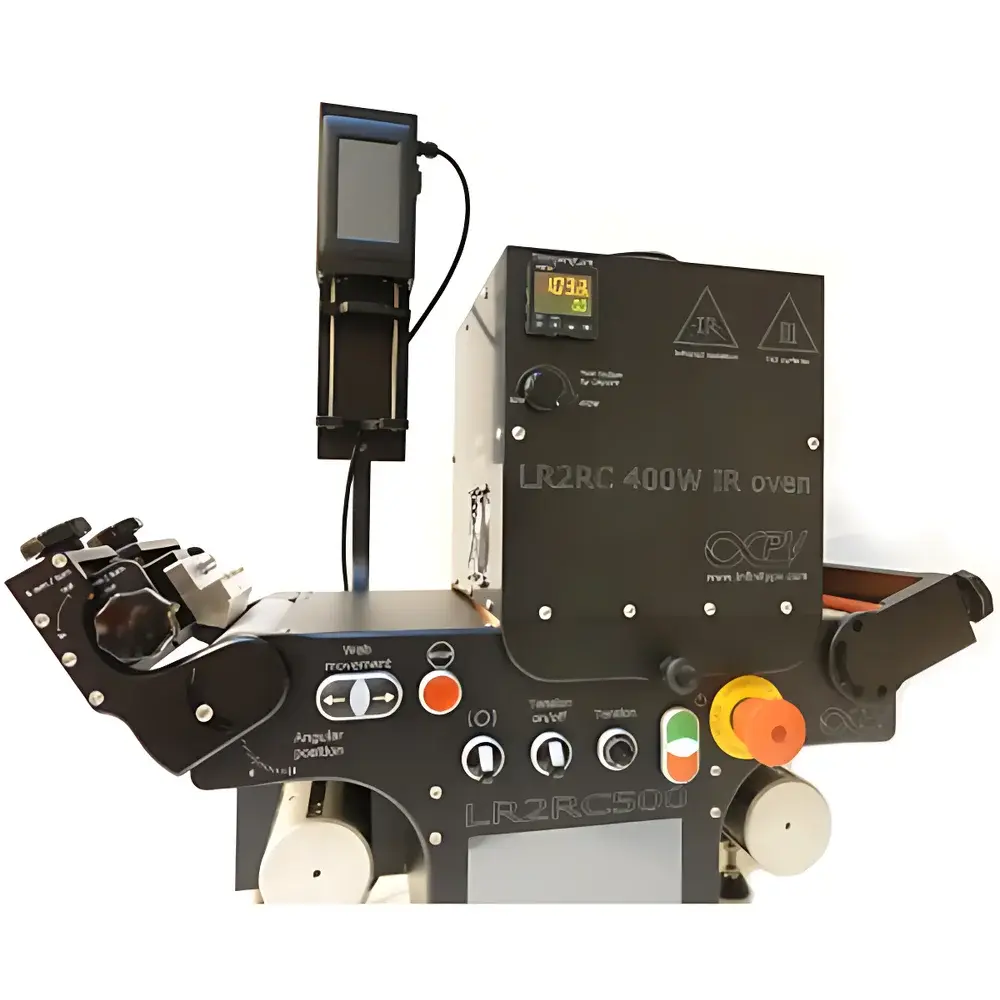
InfinityPV LR2RC Laboratory-Scale Roll-to-Roll Coating System
| Brand | InfinityPV |
|---|---|
| Origin | Denmark |
| Model | LR2RC |
| Type | Benchtop R2R Coating Platform |
| Application Scope | Research & Development of Printed Electronics and Functional Thin Films |
| Compliance Context | Designed for GLP-aligned lab environments, compatible with ISO/IEC 17025 traceability workflows |
Overview
The InfinityPV LR2RC is a precision-engineered laboratory-scale roll-to-roll (R2R) coating system developed by InfinityPV ApS—a Danish deep-tech spin-off founded by Professor Frederik C. Krebs at Technical University of Denmark (DTU). Engineered specifically for academic and industrial R&D in printed electronics, the LR2RC enables controlled, repeatable deposition of functional inks—including conductive polymers, perovskite precursors, organic photovoltaic (OPV) blends, and electrolyte formulations—onto flexible substrates such as PET, PEN, PI, and metal foils. Its core architecture implements gravure, slot-die, and doctor blade coating modules (configurable per application), operating under ambient or inert atmosphere conditions. Unlike production-line R2R tools, the LR2RC prioritizes experimental flexibility: variable web speed (0.01–1.5 m/min), precise tension control (±0.1 N), and real-time gap adjustment enable systematic process mapping across coating parameters critical to film uniformity, morphology, and interfacial adhesion.
Key Features
- Modular coating head design supporting rapid interchange between slot-die, gravure, and doctor blade configurations
- Motorized web transport with encoder-based speed feedback and closed-loop tension regulation
- Substrate width capacity up to 300 mm, with unwind/rewind shafts accommodating 150 mm core diameters
- Integrated environmental enclosure option for nitrogen or argon glovebox integration (O₂/H₂O < 1 ppm)
- Programmable motion control via EtherCAT interface, synchronized with external sensors (e.g., in-line spectroscopy, laser profilometry)
- Tooling-free substrate threading path with guided edge alignment and optical web tracking
- Compliance-ready architecture: all firmware logs timestamped and user-accessible for audit trails; supports optional 21 CFR Part 11-compliant electronic signature module
Sample Compatibility & Compliance
The LR2RC accommodates a broad spectrum of low- to medium-viscosity functional inks (1–5000 mPa·s), including aqueous dispersions, halogenated solvents (e.g., chlorobenzene, o-dichlorobenzene), and green solvent systems (e.g., anisole, cyclopentyl methyl ether). Substrates range from 12–250 µm thick polymer films to ultrathin metal foils (e.g., 25 µm Al, 50 µm Cu) and pre-patterned ITO/PEDOT:PSS-coated webs. The system meets mechanical safety standards per EN ISO 12100 and electrical compliance per EN 61000-6-2/6-4. For regulated research environments, its data acquisition framework aligns with GLP principles—supporting metadata tagging (operator ID, ambient T/RH, ink batch number), version-controlled recipe storage, and exportable CSV/JSON logs suitable for ISO/IEC 17025 accreditation documentation.
Software & Data Management
Control is executed via InfinityPV’s proprietary R2R LabSuite software (Windows 10/11, 64-bit), featuring a deterministic real-time kernel for sub-millisecond command execution. The GUI provides simultaneous visualization of web speed, tension, coating gap, and motor currents, with configurable alarm thresholds and automated shutdown protocols. All operational parameters—including actuator positions, encoder counts, and analog sensor inputs—are logged at ≥10 Hz with nanosecond-precision timestamps. Data exports support HDF5 format for MATLAB/Python post-processing and include embedded schema definitions for FAIR (Findable, Accessible, Interoperable, Reusable) data management. Optional integration with LabArchives ELN or Benchling enables direct protocol linking and metadata synchronization.
Applications
The LR2RC serves as a translational platform bridging materials discovery and pilot-scale manufacturing. It is routinely deployed in studies of: organic and perovskite photovoltaic active layers (e.g., PM6:Y6, CsFA-based perovskites); solid-state electrolytes for thin-film Li-metal batteries; microfluidic channel patterning via sacrificial ink printing; stretchable bioelectrode fabrication using PEDOT:PSS–elastomer composites; and anti-reflective/low-emissivity coatings for smart glazing. Its reproducibility has enabled peer-reviewed benchmarking across institutions—including MIT, Stanford, Cambridge, and Fraunhofer ISE—supporting cross-laboratory validation of coating process–structure–property relationships under standardized R2R conditions.
FAQ
What coating techniques are natively supported on the LR2RC?
Slot-die, gravure, and doctor blade coating heads are available as factory-configured options; additional modules (e.g., spray, flexographic) may be integrated upon request.
Can the system operate inside a nitrogen glovebox?
Yes—the base frame is designed for seamless integration into Class 1000+ gloveboxes; optional feedthroughs for power, data, and pneumatic lines are available.
Is remote operation and monitoring supported?
R2R LabSuite includes secure VNC-based remote access with role-based permissions; telemetry streaming to cloud dashboards (e.g., Grafana) is configurable via MQTT.
Does InfinityPV provide application support for ink formulation optimization?
Yes—customers receive initial process commissioning support, including wet-film thickness modeling, meniscus stability analysis, and defect root-cause diagnostics.
What maintenance intervals are recommended for long-term reliability?
Preventive maintenance is scheduled every 500 operational hours; consumables (e.g., doctor blades, slot-die lips) are field-replaceable with calibrated torque tools supplied.