
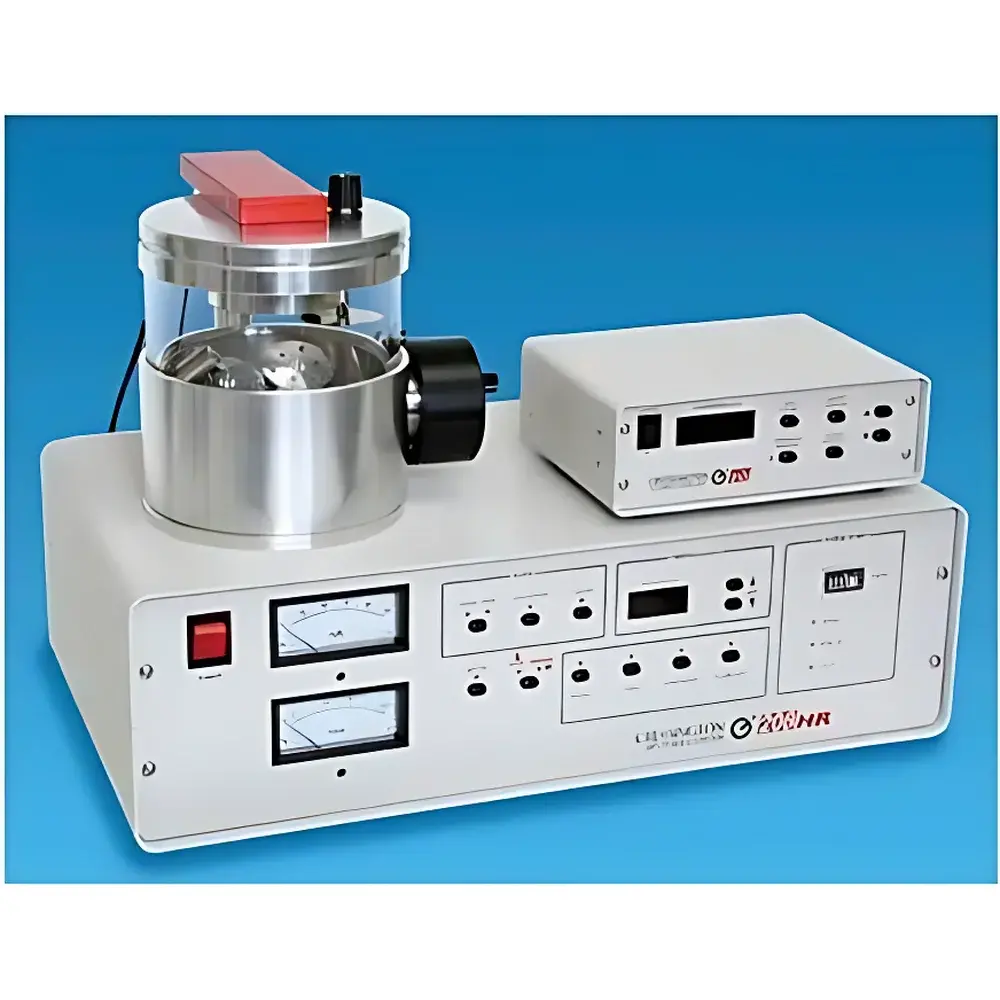
Cressington 108Auto and 208HR Ion Sputter Coaters
| Brand | Cressington |
|---|---|
| Origin | United Kingdom |
| Model | 108Auto / 208HR |
| Target Material Options | Au, Pt, Ag, Ir |
| Target Diameter | 57 mm |
| Control System | Fully Automated |
| Chamber Dimensions | 120 × 120 mm or 150 × 150 mm (depending on model) |
| Stage Diameter | 63 mm or 100 mm |
| Sputtering Gas | Argon or Air |
| Vacuum System | Integrated turbomolecular pump (208HR) or dual-stage rotary vane pump (108Auto) |
Overview
The Cressington 108Auto and 208HR Ion Sputter Coaters are compact, high-precision vacuum coating systems engineered for reproducible, low-damage metallization of non-conductive specimens prior to scanning electron microscopy (SEM), energy-dispersive X-ray spectroscopy (EDS), and electron probe microanalysis (EPMA). Based on magnetron sputtering physics—where energetic argon ions bombard a conductive target to eject atoms that condense uniformly onto the sample surface—these instruments deliver sub-nanometer thickness control and exceptional lateral uniformity. Unlike thermal evaporation methods, cold sputtering avoids specimen heating, eliminating thermal deformation, carbon migration, or polymer melting in sensitive biological, polymeric, or hydrated samples. The 208HR integrates a turbomolecular pumping system for ultimate base pressure (<5 × 10⁻⁷ mbar), enabling ultra-thin, fine-grained coatings ideal for high-resolution field emission SEM (FE-SEM) and low-kV imaging. The 108Auto employs a robust dual-stage rotary vane pump configuration optimized for routine lab throughput and ease of maintenance.
Key Features
- Automated process control via intuitive touchscreen interface with pre-programmed protocols for Au, Pt, Ir, Ag, and Cr targets
- Cold sputtering architecture minimizes thermal load—critical for beam-sensitive materials including cryo-sections, polymers, and soft tissues
- Patented current-loop design ensures radial current homogeneity across the target, yielding ±2% thickness variation over 63 mm substrates (±3% over 100 mm)
- Interchangeable sample stages (63 mm and 100 mm diameter) compatible with standard SEM stubs, TEM grids, and custom holders
- Modular chamber design: 120 × 120 mm (108Auto) and 150 × 150 mm (208HR) internal dimensions support multi-sample batches and large-area substrates
- Integrated vacuum monitoring with Pirani and cold cathode gauges; full pressure logging and event-triggered alarms
- CE-marked, RoHS-compliant construction with ESD-safe grounding and interlocked safety shielding
Sample Compatibility & Compliance
The Cressington 108Auto and 208HR accommodate diverse sample geometries—from bulk rock sections and fractured metals to delicate pollen grains, bacterial colonies, and freeze-fractured membranes. Their low-energy ion bombardment preserves topographic fidelity and prevents preferential sputtering artifacts common in reactive materials. Both models comply with ISO 14644-1 Class 5 cleanroom operational guidelines when installed in controlled environments. Process repeatability meets ASTM E1558–22 requirements for SEM specimen preparation, and audit trails generated by the 208HR’s firmware support GLP/GMP documentation needs under FDA 21 CFR Part 11 when paired with validated networked data archiving.
Software & Data Management
The embedded controller records all critical process parameters—including sputtering time, working pressure, discharge current, voltage, gas flow rate (if equipped with mass flow controller), and real-time chamber pressure history—for each run. Data export is supported via USB 2.0 to CSV format for integration into LIMS or laboratory QA databases. Optional Ethernet connectivity (208HR only) enables remote monitoring, centralized protocol management, and secure user-access tiering (administrator, technician, operator). Firmware updates are delivered through Cressington’s secure portal and include traceable version logs compliant with IEC 62304 software lifecycle standards.
Applications
- Routine SEM sample preparation for geological thin sections, semiconductor cross-sections, and forensic fibers
- High-resolution FE-SEM imaging of nanomaterials requiring sub-2 nm continuous Au/Pt films
- EDS quantification workflows where coating uniformity directly impacts X-ray absorption correction accuracy
- Electron channeling contrast imaging (ECCI) of crystalline alloys requiring stress-free, epitaxy-compatible Ir coatings
- Preparation of TEM lift-out lamellae using FIB-SEM, where minimal redeposition and no carbon contamination are mandatory
- Coating of biosensors and microfluidic devices requiring conformal, pinhole-free metallic layers on complex 3D topographies
FAQ
What sputtering gases are supported, and why is argon preferred over air?
Argon is the primary sputtering gas due to its inertness, high sputter yield, and predictable plasma characteristics. Air may be used for rapid, low-resolution carbon-free coatings on robust samples but introduces oxygen-related oxidation and reduced film density.
Can the same unit coat both Au and Ir targets without cross-contamination?
Yes—the target holder accepts standardized 57 mm diameter targets with mechanical isolation between positions. Cross-contamination is prevented by sequential venting, bake-out cycles, and optional plasma cleaning between material changes.
Is vacuum pump oil change required regularly, and how often?
The 108Auto’s dual-stage rotary vane pump requires oil replacement every 500 operating hours or annually, whichever occurs first. The 208HR’s turbomolecular pump is oil-free and maintenance-free for ≥15,000 hours under typical lab conditions.
Does the system support thickness monitoring during deposition?
Neither model includes integrated quartz crystal microbalance (QCM); thickness is controlled empirically via calibrated time–current–pressure relationships validated per ASTM F1197–20. Optional external QCM integration is available via analog I/O port.
How is compliance with ISO/IEC 17025 laboratory accreditation addressed?
Cressington provides factory calibration certificates traceable to NPL (UK) for pressure and current sensors. Full validation packages—including IQ/OQ documentation templates, performance qualification protocols, and uncertainty budgets—are available upon request for accredited labs.



