
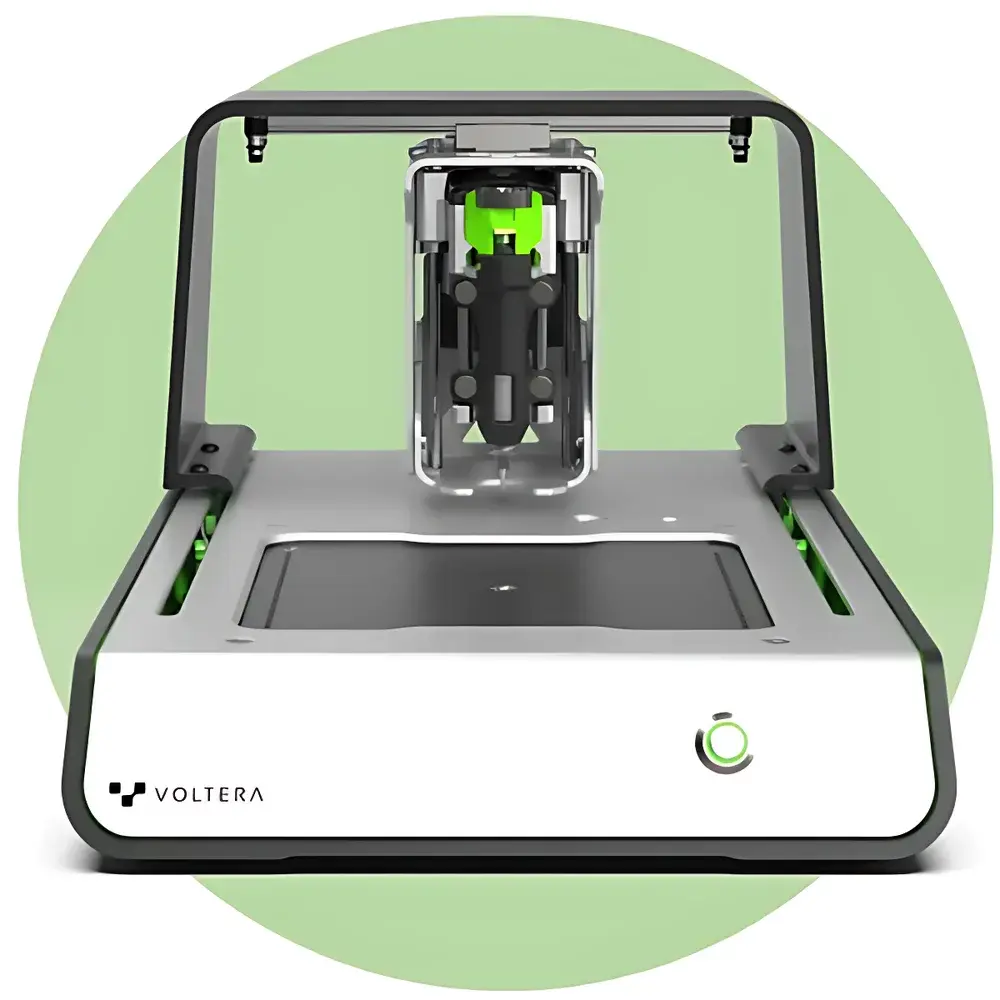
Voltera V-One High-Viscosity Flexible Microelectronics Direct-Write Printer
| Brand | Voltera |
|---|---|
| Origin | Canada |
| Model | V-One |
| Price Range | USD 7,000 – 14,000 (FOB) |
| Target Application | Maskless Additive Manufacturing of Functional Inks on Nonplanar & Flexible Substrates |
Overview
The Voltera V-One is a benchtop direct-write printer engineered for precision additive manufacturing of functional electronic materials—specifically formulated conductive inks, dielectric pastes, and high-viscosity polymer-based slurries—onto nonplanar, flexible, or low-adhesion substrates. Unlike conventional photolithography or screen printing systems, the V-One employs a closed-loop extrusion architecture grounded in piezoelectric-driven microdispensing and real-time pressure regulation. Its core measurement and control paradigm relies on continuous feedback from integrated capacitive proximity sensors and optical layer registration, enabling sub-100 µm feature fidelity even on curved, textured, or compliant surfaces (e.g., PET, PI, PDMS, textile composites). Designed for R&D laboratories in printed electronics, stretchable sensor development, and rapid prototyping of hybrid microsystems, the V-One bridges the gap between lab-scale ink formulation validation and functional device fabrication—without requiring cleanroom infrastructure or mask alignment.
Key Features
- Closed-Loop Pressure Control System: Integrated pneumatic regulator with digital pressure transducer enables dynamic adjustment of extrusion force across viscosity ranges from 100 mPa·s (low-viscosity silver nanoparticle inks) to >500,000 mPa·s (high-loading carbon-black elastomer pastes), ensuring consistent line width and layer thickness.
- Optical Layer Registration & Path Tracking: Dual-camera vision system performs real-time substrate surface mapping and iterative path correction during printing, compensating for thermal drift, mechanical flexure, and manual placement error—critical for multilayer interconnect stacking.
- Smart Substrate Sensing: Capacitive height-sensing probe auto-calibrates Z-axis offset prior to each print job, allowing robust operation on warped PCBs, bent glass, or soft elastomers without mechanical leveling.
- Modular Toolhead Architecture: Supports interchangeable nozzles (100–500 µm stainless steel or ruby-tipped) and optional dual-material dispensing modules for co-printing conductive/dielectric inks in a single pass.
- Benchtop Footprint & Safety Compliance: CE-marked enclosure with interlocked access doors, HEPA-filtered exhaust, and solvent-compatible material handling pathways—meets ISO 14644-1 Class 8 ambient requirements for low-particulate microfabrication.
Sample Compatibility & Compliance
The V-One accommodates a broad spectrum of commercially available and custom-formulated functional inks—including silver nanowire dispersions, PEDOT:PSS derivatives, UV-curable dielectrics, and silicone-based conductive composites—without nozzle clogging or shear-induced particle aggregation. All motion control firmware and hardware comply with IEC 61000-6-2 (EMC immunity) and IEC 61000-6-4 (EMC emission) standards. Data logging and user authentication protocols support GLP-compliant documentation per ISO/IEC 17025:2017 Annex A.2 for accredited testing laboratories.
Software & Data Management
Voltera’s proprietary V-Suite software (v4.3+) provides CAD-to-print workflow integration via DXF/SVG import, automatic trace routing optimization, and G-code generation with variable extrusion rate mapping. The software enforces audit-trail functionality—including timestamped operator login, parameter change history, and print log export (CSV/JSON)—to satisfy FDA 21 CFR Part 11 requirements for electronic records in regulated R&D environments. Remote monitoring and firmware updates are delivered over TLS-encrypted HTTPS connections; local data storage adheres to NIST SP 800-171 controls for sensitive research data.
Applications
- Rapid prototyping of flexible antennas, RFID tags, and strain-sensitive interconnects on polyimide foils
- On-demand fabrication of electrochemical biosensor electrodes using enzyme-loaded hydrogel inks
- Multi-material deposition for monolithic integration of resistors, capacitors, and passive RF components on ceramic or LTCC substrates
- Functionalization of medical catheters and wearable patches with conformal electrode arrays
- Academic validation of novel conductive ink rheology models under controlled shear-thinning conditions
FAQ
What is the minimum printable feature width achievable with the V-One?
Typical line widths range from 120 µm to 350 µm depending on ink rheology, nozzle diameter, and substrate adhesion—validated per ASTM D7927-15 for printed electronics resolution assessment.
Does the V-One support multi-layer alignment accuracy?
Yes—optical registration achieves ≤ ±8 µm overlay tolerance between successive layers when using fiducial markers printed in situ.
Is the system compatible with volatile organic solvent-based inks?
Yes—enclosure includes solvent-rated seals and optional activated carbon filtration upgrade for IPA-, terpineol-, or DMSO-based formulations.
Can the V-One be integrated into automated lab workflows?
It supports RS-232 and Ethernet-based command-line interface (CLI) for integration with LIMS or robotic sample handling platforms.
What maintenance intervals are recommended for long-term reliability?
Nozzle cleaning after every 8–10 hours of active printing; pressure regulator calibration annually or after 500 print cycles—documented in the ISO 9001-certified service manual.




