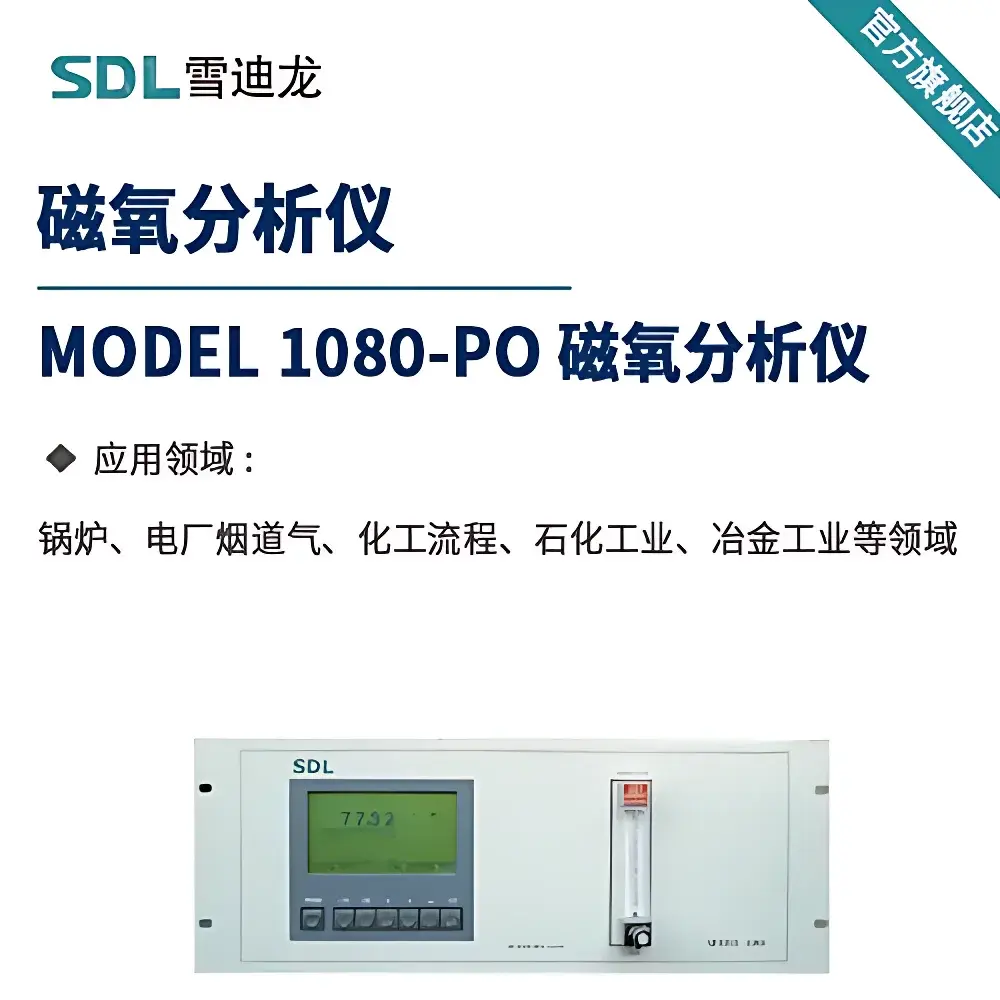
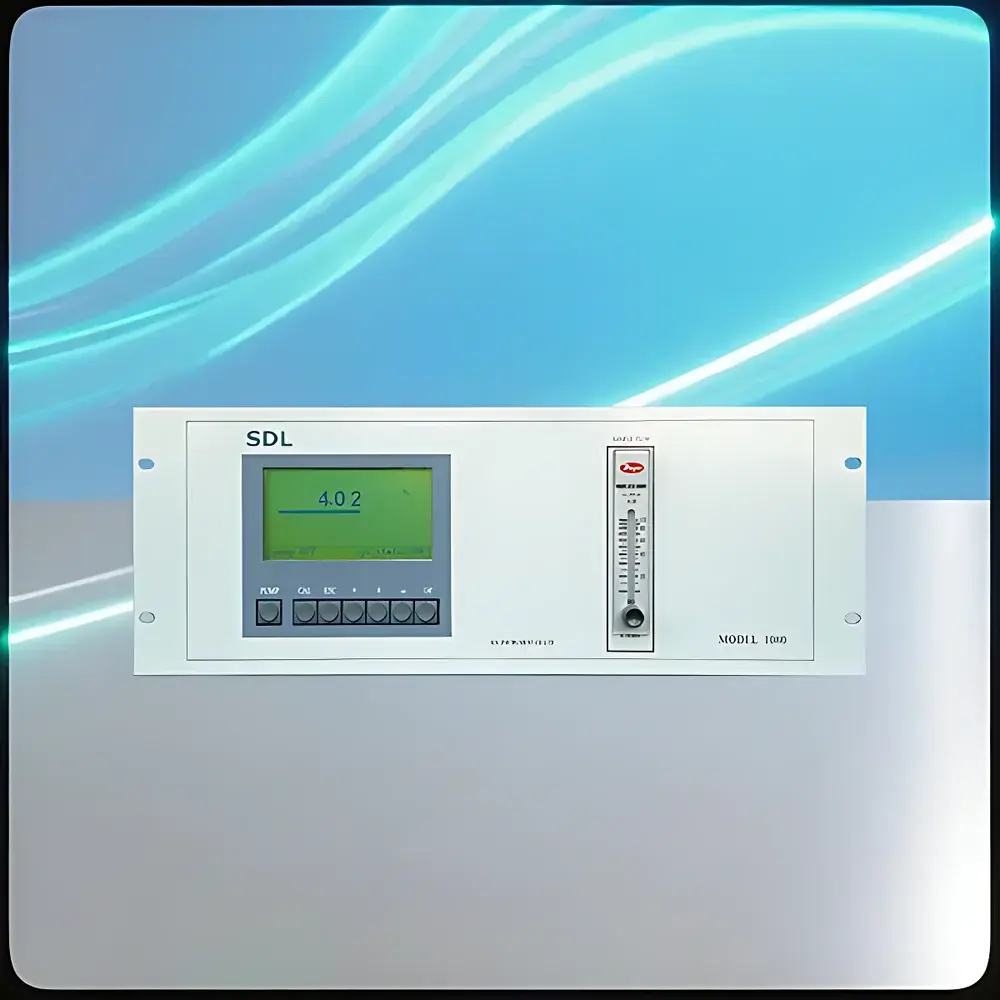
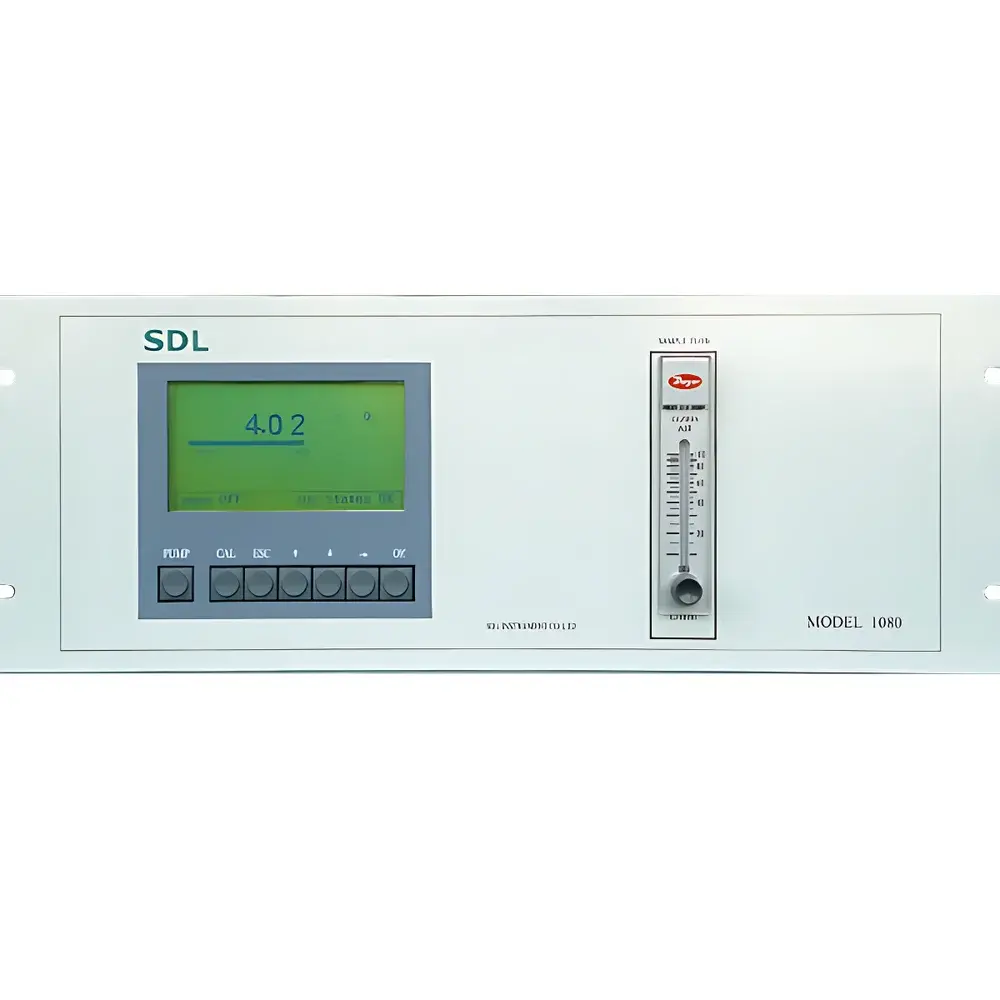
SDL 1080-PO Paramagnetic Oxygen Analyzer for Environmental Monitoring
| Brand | SDL |
|---|---|
| Origin | Beijing, China |
| Manufacturer | SDL (Shuey-Di Long Co., Ltd.) |
| Model | 1080-PO |
| Output | 4–20 mA analog signal + relay contact outputs |
| Detection Principle | Paramagnetic oxygen sensing |
| Certifications | CE-marked, compliant with GB/T 17626 (EMC), applicable to ATEX/IECEx Zone 2 (optional explosion-proof variant) |
| Operating Environment | –10 °C to +50 °C, ≤90% RH (non-condensing) |
| Gas Inlet Pressure | 0.05–0.3 MPa |
| Response Time (T90) | <15 s |
| Zero Drift | <±0.1% O₂/year |
| Span Drift | <±0.5% O₂/year |
| Accuracy | ±0.1% O₂ (full scale) |
| Measurement Range | 0–25% O₂ (standard), optional 0–100% O₂ |
| Power Supply | 220 VAC ±10%, 50/60 Hz |
| Enclosure Rating | IP65 (standard), IP66 (explosion-proof version) |
Overview
The SDL 1080-PO Paramagnetic Oxygen Analyzer is a fixed-installation, process-grade gas analyzer engineered specifically for continuous oxygen monitoring in environmental compliance, combustion control, and industrial safety applications. It leverages the fundamental physical property of molecular oxygen—its strong paramagnetism—to deliver highly selective, drift-stable, and interference-resistant measurement without consumables or catalytic surfaces. Unlike electrochemical or zirconia-based sensors, the 1080-PO employs a precision-balanced dumbbell-type paramagnetic detector, where oxygen’s magnetic susceptibility induces measurable torque on a suspended test body within a non-uniform magnetic field. This principle ensures inherent specificity to O₂ and eliminates cross-sensitivity to CO₂, CO, NOₓ, SO₂, hydrocarbons, and water vapor—critical for flue gas, biogas, and stack emission monitoring per EPA Method 3A and ISO 14687-2 requirements.
Key Features
- True paramagnetic detection core with dual-chamber temperature-compensated design for long-term baseline stability
- Intelligent gas matrix compensation algorithm—automatically corrects for background gas composition shifts (e.g., varying CO₂/N₂ ratios in flue gas)
- Dual output interface: isolated 4–20 mA analog output (HART-compatible) plus two programmable SPDT relay contacts for alarm or control signaling
- Onboard self-diagnostic suite—including detector zero verification, magnetic field integrity check, and flow-path obstruction detection—with event logging and status LED indicators
- Modular architecture supporting hot-swappable sensor modules and field-upgradable firmware via RS-485 (Modbus RTU) or Ethernet (optional)
- Robust mechanical construction: stainless steel sample chamber, ceramic-coated internal surfaces, and corrosion-resistant gas path materials suitable for acidic flue gas condensate exposure
Sample Compatibility & Compliance
The 1080-PO is validated for use with dry or conditioned sample streams containing up to 20% H₂O (v/v), ≤100 ppm SO₂, ≤50 ppm HCl, and particulate loading <1 mg/m³ (when paired with an integrated heated probe and particulate filter). It meets EN 15267-3 certification requirements for automated measuring systems (AMS) under EU Industrial Emissions Directive (IED) monitoring frameworks. Optional ATEX-certified housing (II 2G Ex db IIB T4 Gb) enables deployment in Zone 2 hazardous areas per IEC 60079-0/11. The analyzer supports GLP/GMP-aligned operation through audit-trail-enabled configuration changes and time-stamped calibration records—fully traceable for regulatory submissions under US EPA 40 CFR Part 60, Annex A, and China’s HJ 75–2017 technical specification for CEMS.
Software & Data Management
Configuration, calibration, and diagnostics are managed via the SDL ConfigTool desktop application (Windows), which enforces role-based access control (operator/engineer/administrator levels) and logs all user actions with timestamps and IP addresses. Raw measurement data, diagnostic flags, and calibration history are stored internally for ≥30 days and exportable via USB or Modbus TCP. For enterprise integration, the 1080-PO supports OPC UA server functionality (IEC 62541), enabling seamless connectivity to DCS, SCADA, or cloud-based EMS platforms. All firmware updates undergo cryptographic signature verification to ensure integrity and prevent unauthorized modification—aligned with NIST SP 800-53 RA-5 and FDA 21 CFR Part 11 electronic record/electronic signature (ERES) expectations.
Applications
- Continuous emissions monitoring systems (CEMS) for coal-fired, biomass, and waste-to-energy boilers
- Oxygen trim control in natural gas-fired furnaces and thermal oxidizers
- Process safety interlocks in nitrogen-inerted chemical reactors and storage vessels
- Biogas upgrading plants—monitoring O₂ ingress into anaerobic digesters and membrane separation units
- Environmental laboratory reference analyzers for method validation against ASTM D3176 and ISO 10723
- Stack testing support for third-party compliance audits per EN 14181 QAL1/QAL2 protocols
FAQ
What is the recommended calibration frequency for the 1080-PO in continuous stack monitoring?
For EPA- or EU-compliant CEMS installations, zero and span calibration must be performed at least once per 24-hour period using certified NIST-traceable gases; automated calibration cycles can be scheduled via the onboard scheduler.
Does the 1080-PO require periodic replacement of consumable components?
No—the paramagnetic detector contains no electrolytes, membranes, or catalysts; only routine maintenance includes filter replacement (every 3–6 months depending on sample cleanliness) and annual verification of magnetic field strength.
Can the 1080-PO measure oxygen in high-CO₂ environments such as cement kiln exhaust?
Yes—its paramagnetic principle is intrinsically immune to CO₂ interference; however, accurate measurement requires sample conditioning to remove particulates and condensable acids prior to analysis.
Is remote firmware update supported over Modbus RTU?
Firmware updates require secure authenticated transfer via USB or Ethernet; Modbus RTU supports only operational parameter read/write, not binary image upload.
How does the instrument handle transient pressure fluctuations in duct sampling lines?
An integrated pressure-regulated flow controller maintains constant sample flow (1.2 L/min ±5%) across inlet pressures from 0.05 to 0.3 MPa, minimizing dynamic measurement artifacts.