
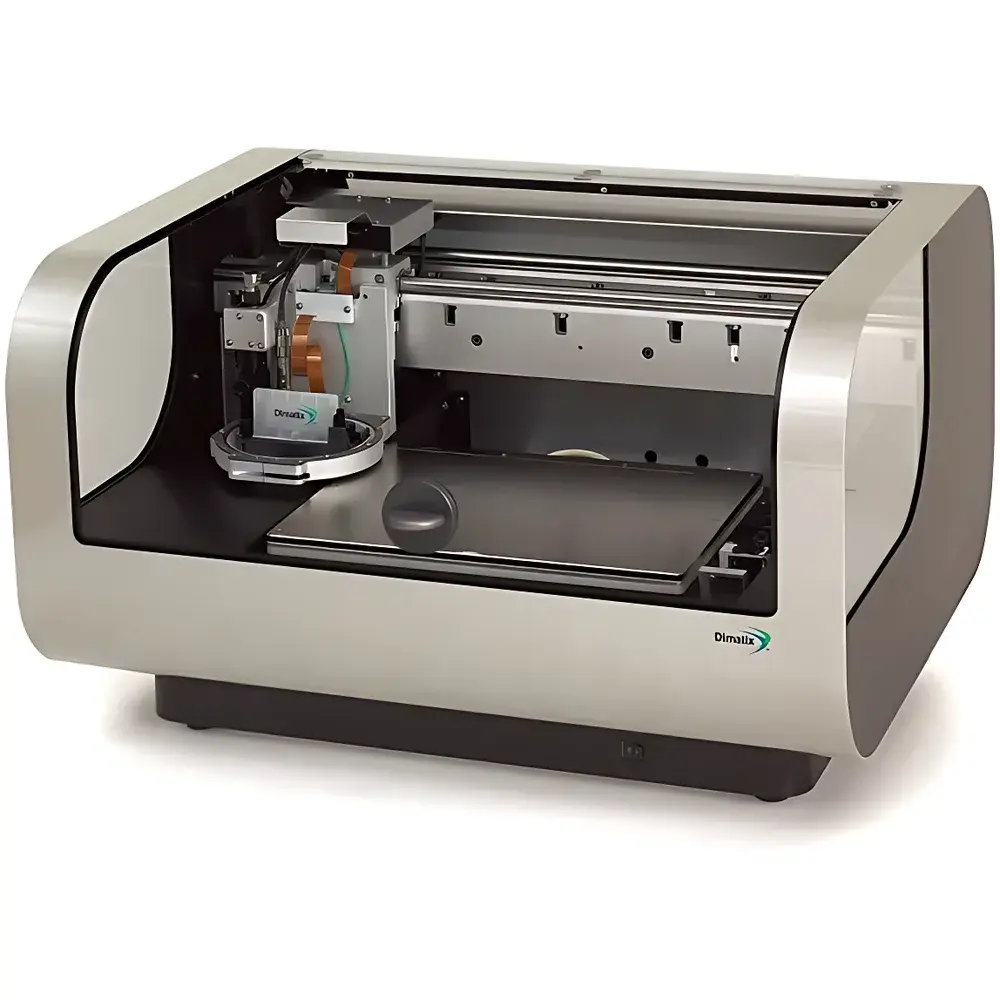
Fujifilm Dimatix DMP-2831 & DMP-2850 Piezoelectric Inkjet Materials Deposition Printer
| Brand | Fujifilm Dimatix |
|---|---|
| Origin | USA |
| Model | DMP-2831, DMP-2850 |
| Print Area | 210 mm × 315 mm (8.27 in × 12.4 in) |
| Stage Repeatability | ±25 µm |
| Heated Stage | Up to 60 °C |
| Operating Environment | 15–40 °C, 5–80% RH, No Chiller Required |
Overview
The Fujifilm Dimatix DMP-2831 and DMP-2850 are precision-engineered piezoelectric inkjet materials deposition systems designed for non-contact, digital patterning of functional nanomaterials in R&D and pilot-scale manufacturing environments. Built upon the industry-proven Dimatix Samba printhead architecture, these platforms leverage drop-on-demand (DOD) piezoelectric actuation to deliver controlled, repeatable ejection of low-volume droplets—down to 3 pL (with Samba heads) or 10 pL (with DMC-11610)—enabling high-resolution, maskless direct-write fabrication. Unlike thermal inkjet or continuous jet systems, the Samba-based DMP platform operates without solvent boiling or nozzle clogging risks, making it uniquely suited for suspensions containing nanoparticles, conductive polymers, quantum dots, metal precursors, and biological macromolecules. Its core function is quantitative, spatially resolved material delivery onto substrates ranging from silicon wafers and ITO glass to flexible polyimide and PET films—supporting applications where layer thickness uniformity, feature fidelity, and process traceability are critical under GLP or pre-GMP conditions.
Key Features
- Precision motion control with ±25 µm stage repeatability over a 210 mm × 315 mm print envelope, enabling sub-50 µm line width deposition (typical target: 20–50 µm)
- Integrated high-resolution CCD alignment camera with real-time fiducial recognition for automated substrate registration and multi-layer overlay accuracy
- Motorized printhead rotation (±15°) and programmable sample stage rotation (±180°) for angular compensation and anisotropic pattern alignment
- Heated vacuum chuck platform (up to 60 °C) for solvent evaporation control, film morphology tuning, and improved adhesion on temperature-sensitive substrates
- Printhead health monitoring suite: real-time droplet velocity imaging, individual nozzle status feedback, and waveform parameter optimization per channel
- Glovebox-compatible mechanical design with feedthroughs for inert-atmosphere operation (N₂ or Ar), supporting air-sensitive inks such as perovskite precursors or reduced graphene oxide dispersions
Sample Compatibility & Compliance
The DMP-2831/2850 accommodates substrates up to 10 mm thick and 330 mm diagonal, including rigid wafers (≤8″), flexible foils, and irregularly shaped devices mounted on carriers. It supports viscosity ranges from 1–20 mPa·s (depending on printhead configuration) and surface tension compatibility from 20–35 mN/m. All fluidic pathways are chemically inert (stainless steel, PTFE, Kalrez® seals), enabling compatibility with polar solvents (e.g., DMF, NMP), aqueous bioinks, and halogenated processing media. The system meets CE marking requirements for electromagnetic compatibility (EMC Directive 2014/30/EU) and low-voltage safety (LVD Directive 2014/35/EU). While not certified for ISO 13485 or FDA 21 CFR Part 11 out-of-the-box, its audit-ready log structure—including timestamped waveform settings, nozzle firing history, and environmental sensor records—supports validation protocols required for regulated development workflows in medical device prototyping or pharmaceutical sensor R&D.
Software & Data Management
Operation is managed via Dimatix’s proprietary FireJet™ software, which provides full parametric control over waveform shape, voltage amplitude, delay timing, and fire frequency per nozzle group. The software includes built-in pattern libraries (G-code, SVG, DXF import), layer stacking tools for multilayer device assembly, and real-time droplet visualization using integrated stroboscopic imaging. All print jobs generate structured metadata logs (.csv/.xml) compliant with FAIR data principles—capturing ambient temperature/humidity, stage position history, printhead temperature, and ink batch ID (user-defined). Optional integration with LabVIEW or Python APIs enables custom automation, statistical process control (SPC) charting, and linkage to LIMS or ELN systems for traceability in ISO/IEC 17025-accredited labs.
Applications
- Printed electronics: Direct-write electrodes for OTFTs, interconnects for RFID tags, and patterned transparent conductors (AgNW, PEDOT:PSS)
- Optoelectronics: Pixelated deposition of QD emitters for micro-LED color conversion, emissive layers for OLED test structures
- Energy devices: Catalytic ink patterning for dye-sensitized solar cells (DSSCs), perovskite precursor layers for photovoltaic research
- Biosensors & diagnostics: Spotting of antibody arrays on nitrocellulose membranes, microfluidic channel priming with hydrophilic/hydrophobic inks
- Advanced materials: Spatially graded thin films for thermoelectric property mapping, localized CNT/graphene dispersion for strain-sensing skins
- Maskless microfabrication: Rapid prototyping of MEMS proof-mass coatings, piezoresistive element definition on cantilevers
FAQ
What printhead options are supported beyond the standard Samba array?
The DMP-2831/2850 accepts interchangeable Dimatix printheads including the 128-nozzle Samba (3 pL), DMC-11610 (10 pL), and high-frequency DMC-11620 (15 pL), each with configurable nozzle grouping and independent waveform tuning.
Can the system operate inside a nitrogen-purged glovebox?
Yes—the base frame is modular, with optional sealed cable glands and feedthroughs for power, USB, and pneumatic lines; full integration requires coordination with glovebox OEMs for dimensional and interface alignment.
Is real-time droplet monitoring available during printing?
The system includes a synchronized strobe illumination module and high-speed CMOS sensor for in-flight droplet imaging at up to 100 kHz, enabling offline trajectory analysis and satellite detection.
Does the platform support closed-loop feedback based on post-deposition metrology?
While no integrated in-line profilometer is included, the CCD camera supports post-print inspection; third-party optical profilometers (e.g., Zygo, Keyence) can be triggered via TTL signals for automated thickness correlation and adaptive re-printing logic.
What level of user training and technical documentation is provided?
Fujifilm Dimatix delivers comprehensive installation qualification (IQ) documentation, operator SOP templates, and a 3-day on-site application workshop covering ink formulation screening, waveform optimization, and multilayer registration calibration.






