
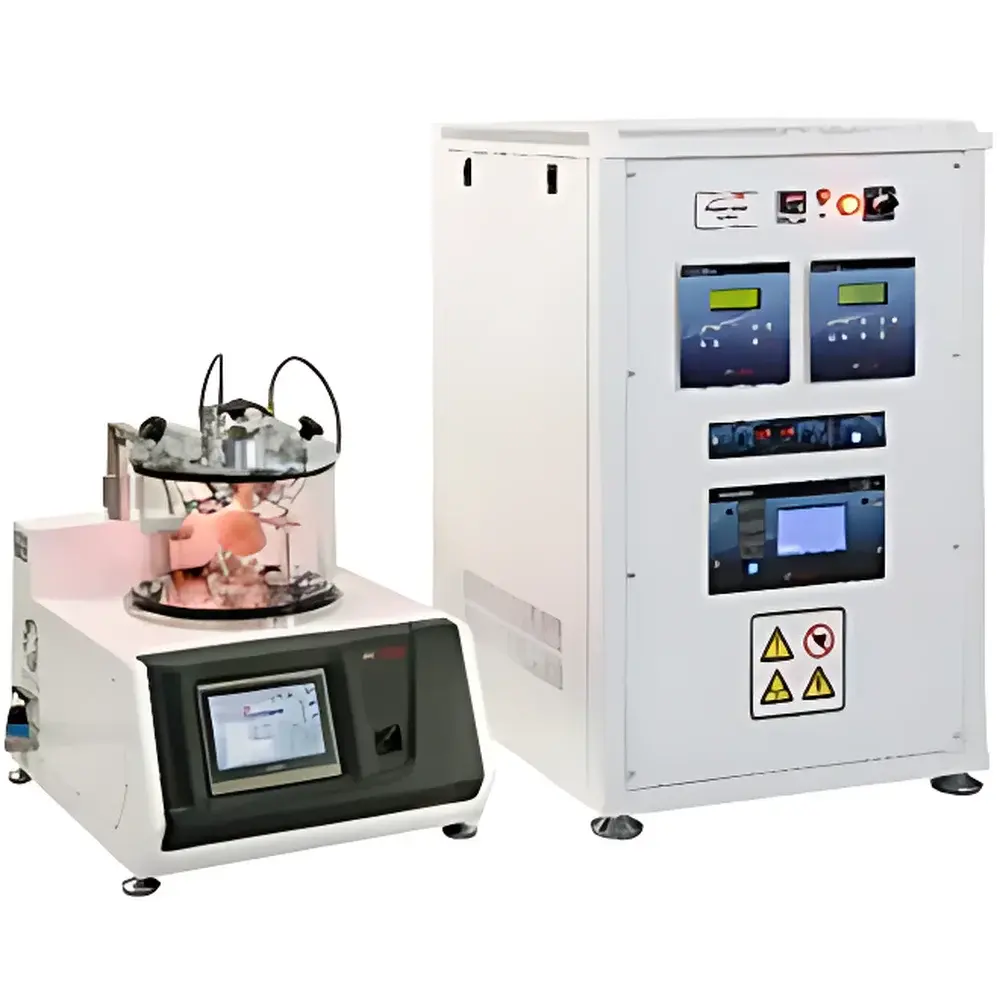
Vac Coat DST Multi-Target Magnetron Sputtering Thin-Film Deposition System
| Brand | Vac Coat |
|---|---|
| Origin | United Kingdom |
| Manufacturer Type | Authorized Distributor |
| Import Status | Imported |
| Model | DST |
| Price Range | USD 42,000 – 70,000 |
Overview
The Vac Coat DST Multi-Target Magnetron Sputtering Thin-Film Deposition System is a high-vacuum, modular physical vapor deposition (PVD) platform engineered for precise, reproducible thin-film synthesis in academic research laboratories and advanced materials development facilities. Operating on the principle of DC/RF magnetron sputtering, the DST system utilizes crossed-field plasma confinement to generate stable, high-density argon plasma at pressures typically between 1 × 10⁻³ and 5 × 10⁻¹ mbar. This enables controlled ejection of atoms from multiple conductive or insulating target materials—mounted on independently powered, water-cooled magnetron cathodes—onto substrates held on a heated, rotationally adjustable stage. Designed with UHV-compatible stainless steel chambers (base pressure ≤ 5 × 10⁻⁸ mbar with turbomolecular pumping), the DST integrates vacuum integrity, process repeatability, and multi-technique expandability into a single footprint.
Key Features
- Modular multi-target configuration: Up to six 2-inch or four 3-inch magnetron sources, each with independent power supply (DC, RF, or pulsed DC options), enabling sequential or co-sputtering of metals, oxides, nitrides, and compound targets.
- Integrated substrate handling: Motorized planetary rotation, resistive heating up to 600 °C (±1 °C stability), and optional bias voltage control (–200 V to +200 V) for ion-assisted growth and stress modulation.
- High-precision vacuum architecture: Dual-stage pumping system comprising a dry scroll backing pump and a 1200–2000 L/s turbomolecular pump, coupled with full-panel capacitance manometer and cold cathode gauge for real-time pressure monitoring across dynamic ranges.
- Programmable process control: PLC-based automation with recipe-driven operation, supporting ramp-and-hold temperature profiles, timed source activation, gas flow sequencing (Ar, N2, O2, reactive mixtures), and interlocked safety protocols.
- UHV-compliant construction: All-welded 316L stainless steel chamber with metal-sealed CF flanges, demountable viewports, and bake-out capability (up to 150 °C) to ensure low outgassing and long-term base pressure stability.
Sample Compatibility & Compliance
The DST accommodates substrates ranging from 10 mm to 100 mm in diameter—including silicon wafers, glass slides, flexible polymer foils, and ceramic coupons—with customizable fixture kits for non-planar geometries. Chamber geometry supports both front-side and backside deposition configurations. The system complies with CE marking requirements under the EU Machinery Directive 2006/42/EC and Electromagnetic Compatibility Directive 2014/30/EU. Vacuum components conform to ISO 3529-3:2018 (vacuum technology — vocabulary — part 3: vacuum gauges). When operated with validated SOPs and calibrated mass flow controllers, the DST supports GLP-aligned experimental documentation and is compatible with audit-ready data logging for ISO/IEC 17025-accredited labs.
Software & Data Management
Vac Coat’s proprietary ControlSuite™ software provides a Windows-based interface for system commissioning, real-time parameter visualization (voltage, current, pressure, temperature, gas flow), and automated log-file generation in CSV and XML formats. Each deposition run generates timestamped metadata including pump-down history, plasma ignition events, power delivery profiles, and interlock status flags. Data export supports traceability per FDA 21 CFR Part 11 requirements when deployed with user authentication, electronic signature modules, and audit trail configuration. Optional integration with LabArchives or Electronic Lab Notebook (ELN) platforms enables direct ingestion of process logs into institutional research records.
Applications
- Development of multilayer optical coatings (e.g., anti-reflective stacks, distributed Bragg reflectors) for photonic devices and laser optics.
- Synthesis of transition metal oxide heterostructures (e.g., La0.7Sr0.3MnO3/SrTiO3) for spintronics and oxide electronics.
- Deposition of biocompatible thin films (e.g., TiN, hydroxyapatite) for implant surface functionalization and in vitro cell adhesion studies.
- Fabrication of transparent conducting oxides (ITO, AZO) on flexible PET substrates for roll-to-roll compatible optoelectronic prototyping.
- Combinatorial library synthesis via masked substrate arrays or gradient target arrangements for rapid materials screening.
FAQ
What vacuum level can the DST achieve, and what pumping configuration is used?
The system achieves a base pressure of ≤ 5 × 10⁻⁸ mbar using a combination of a dry scroll backing pump and a 1200–2000 L/s turbomolecular pump, with all-metal seals and bake-out capability.
Can the DST be upgraded to include PLD or thermal evaporation sources?
Yes—the DST chassis is mechanically and electrically pre-configured for hybrid integration with Vac Coat’s PLD-100 pulsed laser deposition module or DTT-series thermal evaporation sources, requiring only additional feedthroughs and controller firmware updates.
Is remote monitoring supported, and how is cybersecurity addressed?
ControlSuite™ supports secure remote access via TLS-encrypted VNC over local networks; no internet-facing services are enabled by default, and firewall rules are documented in the installation manual per IEC 62443-3-3 guidelines.
What calibration and maintenance documentation is provided?
Each system ships with a factory calibration certificate for pressure gauges and thermocouples, a preventive maintenance schedule aligned with ISO 13374-1, and traceable spare parts lists compliant with ISO 9001:2015 quality management systems.
Related Products



