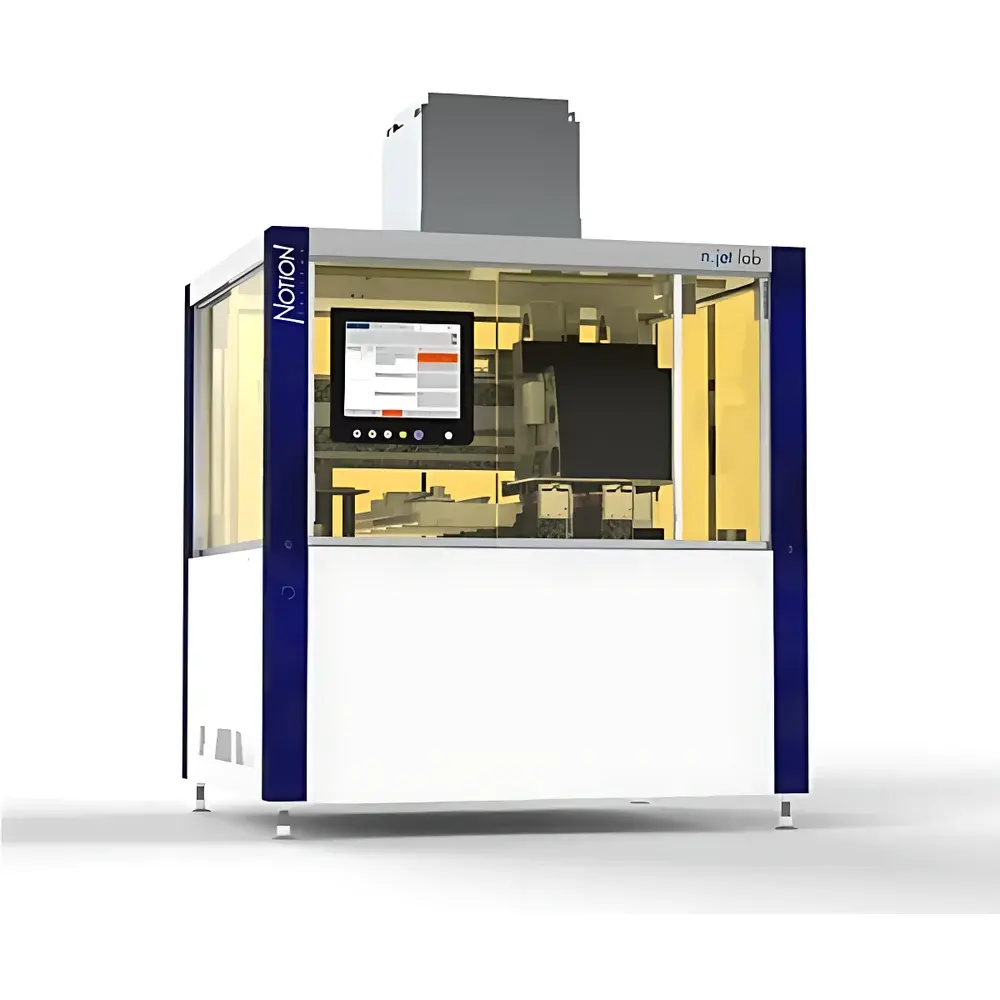
Notion n.jet lab Industrial-Grade High-Precision Inkjet Printing System
| Brand | Notion |
|---|---|
| Origin | Germany |
| Manufacturer Type | Authorized Distributor |
| Origin Category | Imported |
| Model | n.jet lab |
| Pricing | Upon Request |
Overview
The Notion n.jet lab is an industrial-grade, high-precision inkjet printing system engineered for R&D-to-production transition in advanced functional material deposition. Built upon decades of German engineering expertise and precision fluid dynamics research, the platform operates on non-contact, digital droplet-on-demand (DOD) inkjet technology—leveraging piezoelectric actuation to deliver picoliter-scale droplets with sub-10 µm positional accuracy and nanoliter-level volume repeatability. Unlike thermal or continuous inkjet approaches, the n.jet lab’s DOD architecture ensures minimal thermal stress on sensitive functional inks (e.g., metal nanoparticle suspensions, polymer precursors, quantum dot dispersions), preserving material integrity and enabling direct patterning on temperature-sensitive substrates including flexible polyimide, ultra-thin glass, and bare silicon wafers. Its modular design supports integration into cleanroom environments (ISO Class 5–7 compatible) and aligns with industry requirements for traceable, repeatable, and scalable additive manufacturing processes in optoelectronics and microelectronics.
Key Features
- Modular, open-architecture platform supporting multi-head configurations (up to 8 printheads) with independent Z-axis height adjustment and real-time gap monitoring.
- Integrated nozzle calibration suite featuring automated dropwatch imaging, jetting uniformity mapping, and closed-loop nozzle compensation algorithms—including Mura-free pattern correction and spatial distortion compensation for large-area substrates.
- High-stability motion control system with granite base, air-bearing XY stages, and laser interferometer feedback (±0.1 µm repeatability over 300 × 300 mm travel range).
- Environmental control module for humidity (30–60% RH, ±2% stability) and temperature (22 ± 0.5 °C) regulation—critical for consistent ink drying kinetics and film morphology.
- Compliance-ready firmware architecture supporting audit trails, user access levels, and electronic signature functionality aligned with FDA 21 CFR Part 11 and ISO 9001 quality management systems.
Sample Compatibility & Compliance
The n.jet lab accommodates substrates up to 450 × 450 mm (customizable to 600 × 600 mm), with thickness ranging from 0.05 mm (flexible foils) to 20 mm (ceramic carriers). It accepts a broad spectrum of functional inks—including aqueous and solvent-based metal nanoparticle inks (Ag, Cu, Ni), conductive polymers (PEDOT:PSS), dielectric pastes, photoresists, and UV-curable optical adhesives—with viscosities spanning 2–25 mPa·s and surface tensions from 20–35 mN/m. All hardware and software components comply with CE marking directives (EMC 2014/30/EU, Machinery Directive 2006/42/EC) and meet IEC 61000-6-2/6-3 immunity/emission standards. System validation documentation—including IQ/OQ protocols and metrology reports—is provided per customer request to support GLP/GMP audits.
Software & Data Management
The proprietary n.jet Control Suite provides deterministic real-time print job execution via deterministic timing engine (sub-millisecond scheduling resolution). The software includes a Python-based API for custom algorithm integration (e.g., halftoning, error diffusion, topology-aware rasterization), native support for Gerber, GDSII, and SVG input formats, and built-in spectral analysis tools for post-print uniformity assessment. All print parameters—including waveform profiles, voltage ramping, firing frequency, and environmental logs—are stored with time-stamped metadata in SQLite-based local databases. Export options include CSV, HDF5, and vendor-neutral ASAM MDF4 formats for traceability and cross-platform data exchange in multi-site development workflows.
Applications
- Prototyping and low-volume production of OLED and microLED display backplanes, including pixel-defining banks, TFT interconnects, and encapsulation barriers.
- Direct-write fabrication of printed circuit boards (PCBs) with fine-line resolution (<30 µm line/space), embedded antennas, and RF shielding layers.
- Deposition of catalytic and sensing layers for MEMS-based gas sensors and lab-on-chip microfluidic devices.
- Functional coating of optical components—anti-reflective, beam-splitting, and diffractive optical elements—using sol-gel and hybrid organic-inorganic inks.
- Maskless patterning of semiconductor-grade resist layers for rapid prototyping of photomasks and wafer-level packaging structures.
FAQ
What substrate materials are supported by the n.jet lab?
Standard compatibility includes silicon wafers, glass (including soda-lime and fused silica), polyimide, PET, PEN, stainless steel, and ceramic substrates. Surface energy modification (e.g., plasma treatment) may be required for optimal wetting of low-energy surfaces.
Does the system support multi-layer registration?
Yes—the n.jet lab features integrated vision-based alignment with sub-pixel registration accuracy (≤±0.5 µm) using fiducial markers or edge detection, enabling precise overlay of up to 12 functional layers.
Can the system be integrated into existing factory automation infrastructure?
It offers SECS/GEM and OPC UA interfaces for seamless integration with MES and SCADA systems, supporting standard industrial Ethernet protocols (EtherCAT, Profinet) and PLC-triggered job initiation.
Is remote diagnostics and preventive maintenance supported?
The system includes secure TLS-encrypted remote access with role-based permissions, predictive printhead health monitoring via acoustic emission analysis, and automated log aggregation for root-cause analysis.
What level of technical support is available post-installation?
Notion-certified field application engineers provide on-site commissioning, operator training, and process qualification support. Extended service contracts include quarterly calibration verification and firmware update management.