
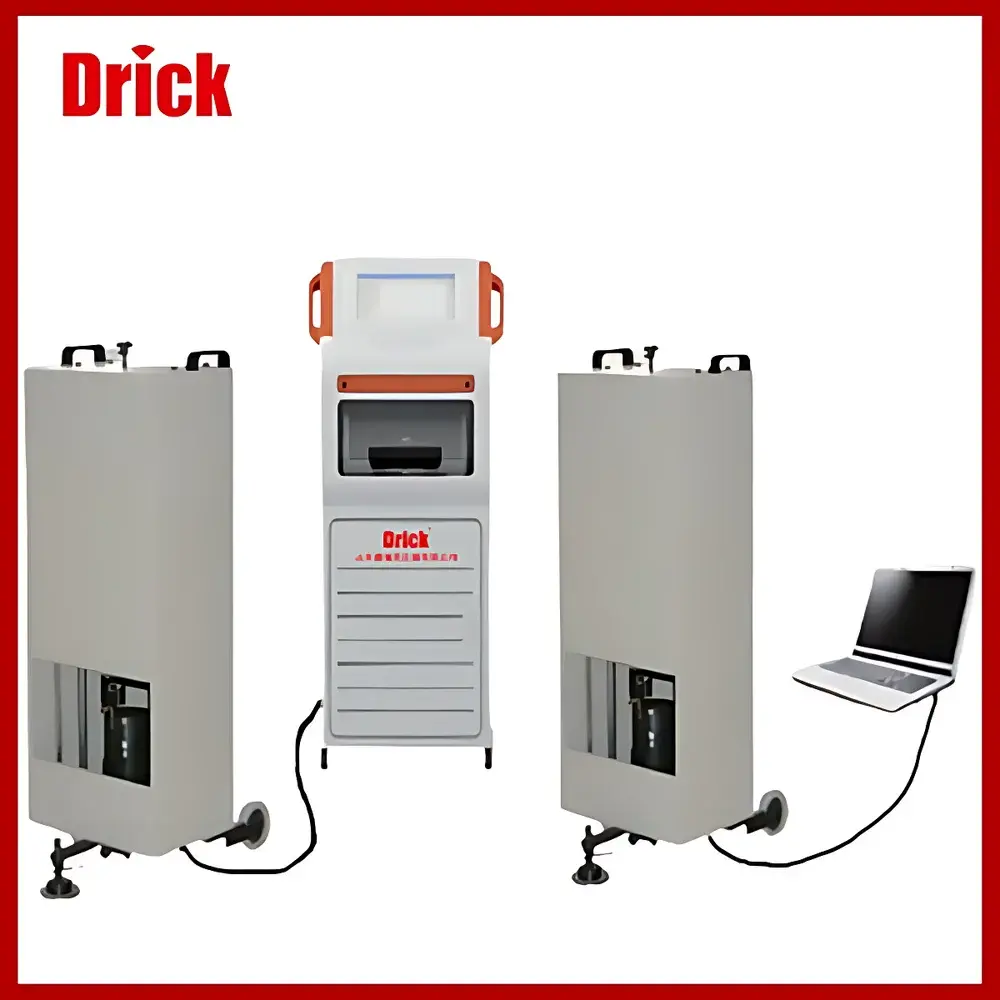
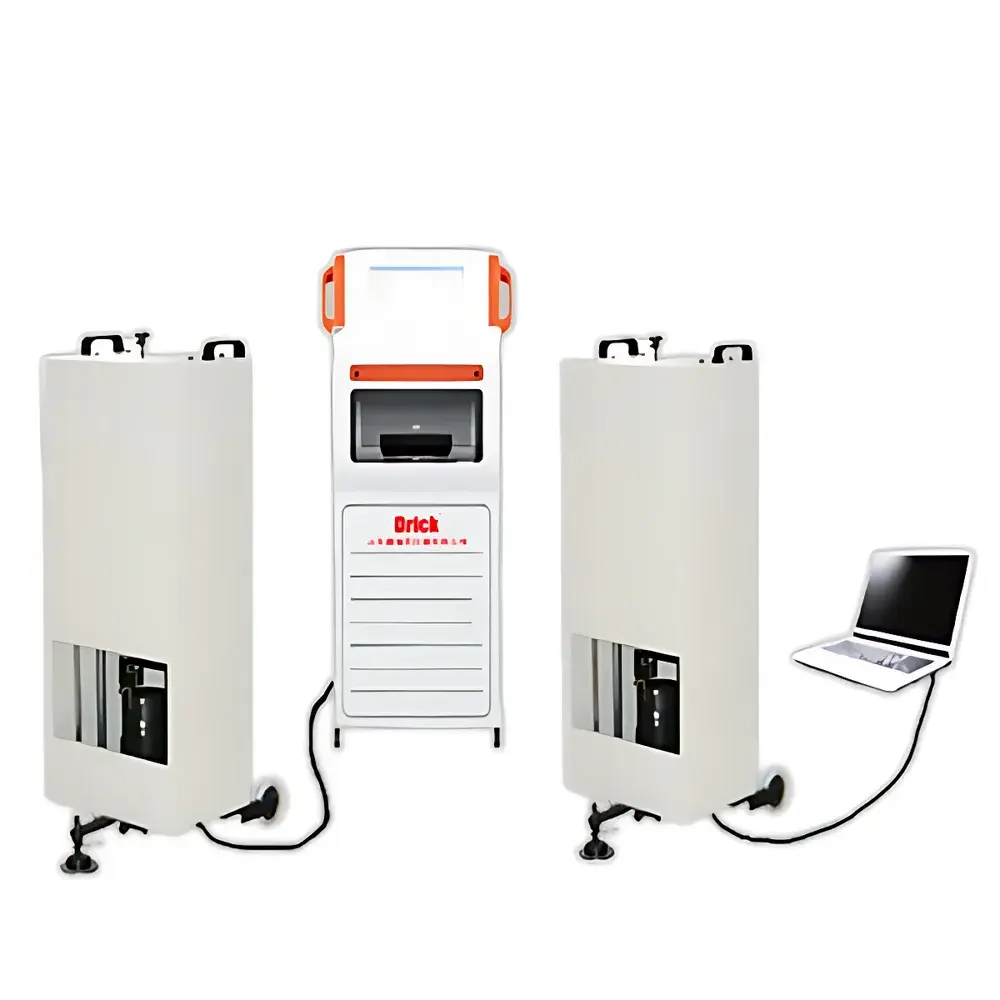
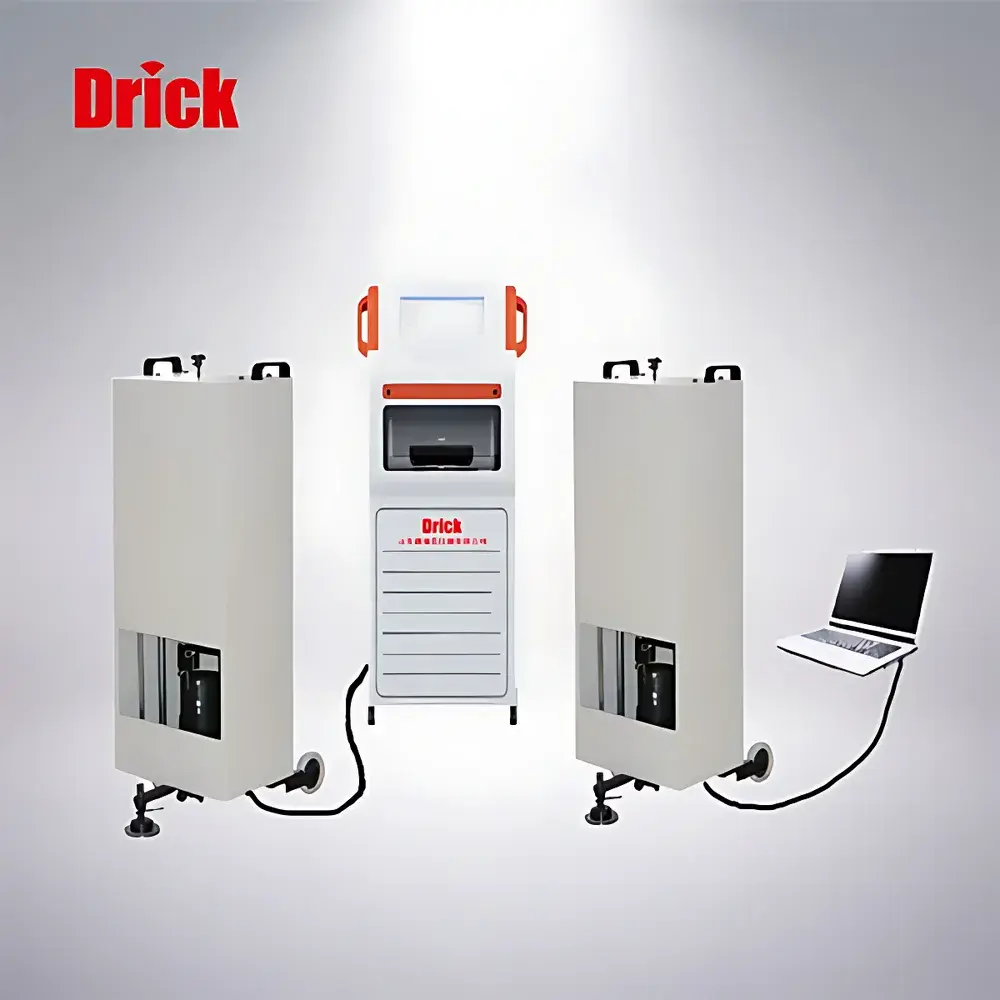
Drick DRK Vertical Deformation Tester for Synthetic Athletic Surfaces
| Brand | Drick |
|---|---|
| Origin | Shandong, China |
| Manufacturer Type | Direct Manufacturer |
| Product Origin | Domestic (China) |
| Model | DRK |
| Price | USD 7,000 (approx.) |
| Impact Mass | 20.0 kg ± 0.1 kg |
| Impact Pin Diameter | ≥ 20 mm |
| Force Measurement Accuracy | ≤ ±0.5% FS |
| Anvil Surface Hardness | ≥ HRC 60 |
| Guiding Column Friction Resistance | < 0.1 kg equivalent force |
| Force Response Time | ≤ 0.3 ms |
| Pin-to-Anvil Gap | 1 mm |
| Load Cell Platform | Ø70 mm, concave base radius 500 mm |
| Effective Spring Stiffness Range | 300–400 N/mm (calibration correction required if outside range) |
| Displacement Measurement Accuracy | ≤ ±0.01 mm |
| Displacement Response Time | ≤ 0.3 ms |
| Power Supply | 220 V ± 10%, 50 Hz |
Overview
The Drick DRK Vertical Deformation Tester is a precision-engineered instrument designed to quantify the dynamic mechanical response of synthetic athletic surfacing materials—specifically impact absorption and vertical deformation—under standardized drop-weight impact conditions. It operates on the principle of controlled free-fall impact: a 20.0 kg mass is released from a defined height onto a calibrated impact pin, which transmits force through the test specimen to a hardened anvil. High-speed force and displacement transducers simultaneously capture the time-resolved load–deflection curve during the 10–15 ms contact event. The system computes two critical performance parameters per ASTM/EN/GB-compliant protocols: (1) vertical deformation (Δh, in mm), defined as the maximum compression depth of the surface under impact; and (2) impact absorption (%), calculated as the ratio of energy dissipated (area under the force–displacement curve) to total impact energy (m·g·h). This dual-parameter evaluation directly informs safety compliance, injury mitigation potential, and long-term resilience of running tracks, playgrounds, and multi-sport synthetic surfaces.
Key Features
- Dual-test capability: Configurable execution of both EN 14809 (vertical deformation) and EN 14808 (impact absorption) protocols within a single test sequence—no hardware reconfiguration required.
- High-fidelity metrology: Integrated industrial-grade load cell (≤ ±0.5% full-scale accuracy) and non-contact linear variable differential transformer (LVDT) displacement sensor (≤ ±0.01 mm resolution), both with ≤ 0.3 ms dynamic response time to resolve transient impact events.
- Dedicated embedded acquisition architecture: ARM9-based real-time data acquisition system with 500 kHz sampling rate, dual hardware buffering, and clock-synchronized analog-to-digital conversion—ensuring zero data loss during repetitive 4-impact (absorption) or 3-impact (deformation) test cycles.
- Self-contained operational interface: Ruggedized industrial touchscreen PC preloaded with ISO/IEC 17025-aligned test software—eliminates dependency on external computers, supports offline operation, and provides audit-ready digital test records.
- Portable robust frame: Modular steel chassis with leveling feet and integrated transport handles enables rapid deployment across field sites, QA labs, and third-party certification facilities without recalibration.
- Traceable calibration support: All force and displacement channels comply with ISO 376 and ISO 9513 requirements; optional NIST-traceable calibration certificates available upon request.
Sample Compatibility & Compliance
The DRK tester accommodates flat, cured synthetic surfaces ≥ 500 mm × 500 mm, including polyurethane (PU), thermoplastic elastomer (TPE), and styrene–butadiene rubber (SBR) granule systems bonded with reactive binders. Specimens must be installed on rigid, non-yielding substrates (e.g., concrete) per EN 14808 Annex A and GB 36246-2018 Clause 6.2. The instrument meets mandatory verification requirements for national and international standards including: EN 14808:2003, EN 14809:2003, GB 36246–2018, GB/T 14833–2011, GB/T 22517.6–2011, GB/T 19851.11–2005, and GB/T 19995.2–2005. Its measurement uncertainty budget aligns with ILAC-P10:2023 guidelines for sports surface testing laboratories seeking CNAS or UKAS accreditation.
Software & Data Management
The embedded Windows Embedded Standard OS runs Drick TestSuite v3.2—a GxP-ready application validated per ICH GCP and FDA 21 CFR Part 11 Annex 11 principles. Software features include: automated pass/fail evaluation against configurable limits per standard clause; export of raw time-series data (CSV, ASCII) and summary reports (PDF, XLSX); electronic signature workflow with role-based access control; and immutable audit trail logging all user actions, parameter changes, and calibration events. All test records retain full traceability to sensor serial numbers, calibration dates, environmental logs (optional ambient temperature/humidity input), and operator ID—supporting GLP/GMP audits and ISO/IEC 17025 clause 7.8 documentation requirements.
Applications
This instrument is deployed by national sports infrastructure authorities (e.g., China’s General Administration of Sport), independent testing laboratories (CNAS-accredited), synthetic material manufacturers, and school district facilities departments to verify conformance prior to installation or periodic in-service inspection. Primary use cases include: pre-commissioning validation of new track installations; post-installation quality assurance per GB 36246-2018 Clause 7.3; forensic analysis of surface degradation after 3–5 years of service; R&D formulation optimization for shock-absorbing infill systems; and inter-laboratory proficiency testing under APAC MLAR schemes. Its field-portable design also supports on-site verification at Olympic training centers and FIFA-certified football academies.
FAQ
What standards does the DRK tester fully support for certification reporting?
It is configured to execute EN 14808:2003, EN 14809:2003, GB 36246–2018, GB/T 14833–2011, and GB/T 22517.6–2011 test methods—including all specified setup geometry, impact mass tolerances, and calculation algorithms.
Is third-party calibration certification included with purchase?
A factory calibration certificate (traceable to Chinese NIM standards) is provided. Optional UKAS/NIST-traceable calibration with uncertainty statement is available at additional cost.
Can the system store historical test data locally without network connectivity?
Yes—the internal 64 GB SSD retains ≥ 10,000 complete test records with full metadata, accessible via USB export or direct query using the built-in database viewer.
Does the instrument require annual recalibration?
Per ISO/IEC 17025 Section 6.4, we recommend annual functional verification and sensor recalibration—especially after transportation or exposure to temperatures outside 10–30 °C.
How is compliance with data integrity regulations ensured?
The software enforces ALCOA+ principles: Attributable (electronic signatures), Legible (PDF reports), Contemporaneous (real-time timestamps), Original (raw binary storage), Accurate (checksum-verified exports), Complete (full audit trail), Consistent (locked report generation), Enduring (encrypted SSD), and Available (searchable archive).



