
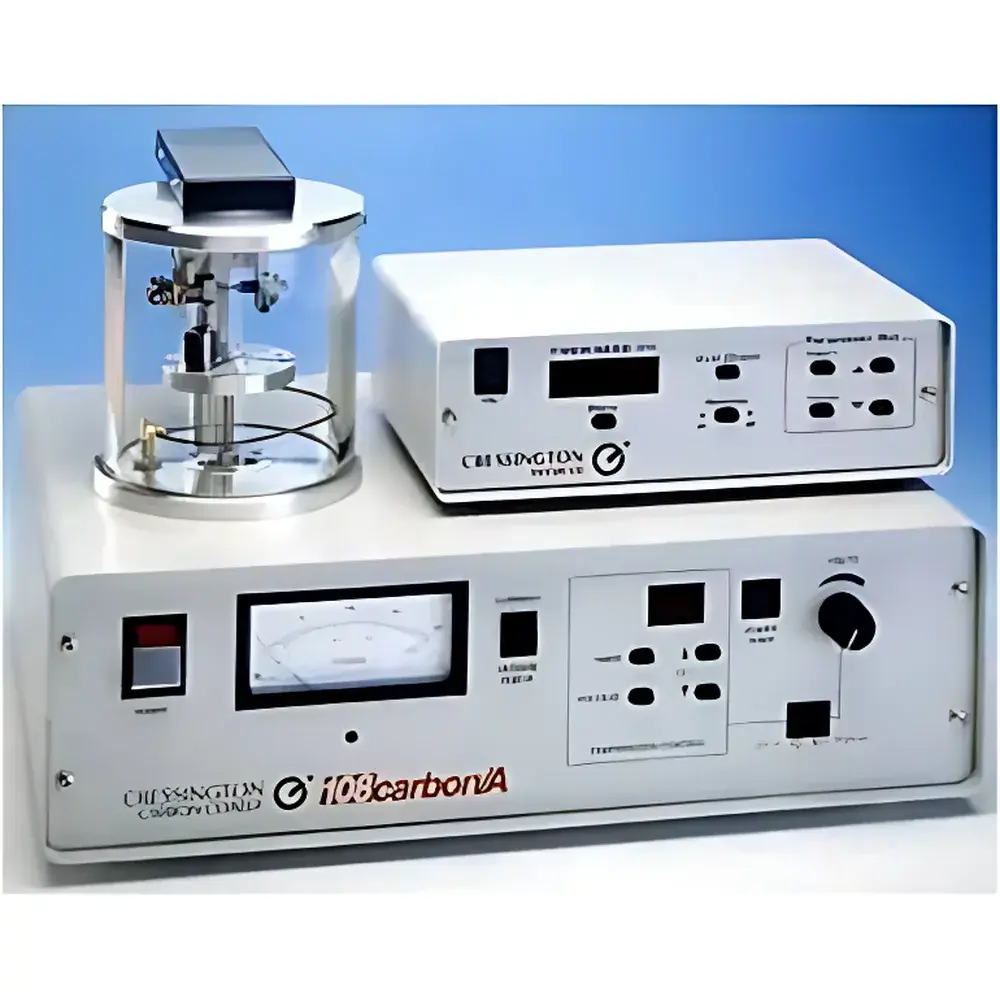
Cressington 108C Carbon Coater
| Brand | Cressington |
|---|---|
| Origin | United Kingdom |
| Model | 108C |
| Target Material | High-Purity Carbon Rod |
| Target Dimensions | Standard Carbon Rod (6.35 mm diameter × 76 mm length) |
| Control Mode | Manual and Semi-Automatic (Timer-Based Deposition) |
| Chamber Dimensions | 120 mm × 120 mm (square cross-section) |
| Sample Stage Diameter | 63 mm |
| Sputtering Atmosphere | High Vacuum (Base Pressure ≤ 5 × 10⁻² mbar) |
| Cooling | Passive (Cold-Stage Design, No Active Cooling Required) |
| Power Supply | DC Bias, Fixed-Voltage Operation (No Adjustable Current Regulation) |
Overview
The Cressington 108C Carbon Coater is a compact, high-reliability thermal evaporation system engineered for consistent, low-damage carbon film deposition onto electron microscopy (EM) specimens. Unlike ion sputtering or magnetron-based systems, the 108C employs resistive heating of high-purity carbon rods under high vacuum to generate uniform, amorphous carbon films—ideal for enhancing conductivity and reducing charging artifacts in SEM, TEM, and EPMA sample preparation. Its cold-stage architecture eliminates thermal distortion of temperature-sensitive specimens such as polymers, biological tissues, and hydrated or beam-labile materials. Designed and manufactured in the UK by Cressington Scientific Instruments Ltd—a pioneer in EM-compatible vacuum coating since the 1960s—the 108C reflects decades of refinement in vacuum engineering, chamber geometry optimization, and process repeatability. It operates without reactive gases or complex plasma control, making it inherently stable, operator-friendly, and compliant with routine laboratory GLP workflows.
Key Features
- High-purity carbon rod evaporation source (99.99% C), pre-aligned and replaceable without breaking vacuum
- Cold-stage sample holder (63 mm Ø) with passive thermal isolation—no external coolant required
- Robust stainless-steel vacuum chamber (120 mm × 120 mm internal cross-section) with borosilicate viewport and O-ring sealed lid
- Integrated two-stage vacuum system: rotary vane pump + turbomolecular pump (base pressure ≤ 5 × 10⁻² mbar typical)
- Semi-automatic operation via analog timer (0–300 s range) with visual deposition endpoint indication (via integrated current meter and glow intensity observation)
- No RF or DC sputtering circuitry—eliminates arcing risks and simplifies maintenance
- Compact footprint (< 0.4 m² floor space) suitable for shared EM labs and cleanroom-adjacent environments
Sample Compatibility & Compliance
The 108C accommodates standard EM stubs (e.g., 12.7 mm, 25 mm), planchets, TEM grids (up to 3.05 mm), and custom substrates within its 63 mm stage diameter. Its low-thermal-load evaporation process preserves structural integrity of cryo-prepared, wax-embedded, or resin-infiltrated sections. The system complies with ISO 14644-1 Class 8 (ISO 8) cleanroom compatibility when installed with appropriate venting protocols. While not certified to FDA 21 CFR Part 11, its manual/timer-based operation supports audit-ready documentation when paired with lab-specific SOPs and logbook entries per GLP/GMP requirements. All vacuum components meet EU PED 2014/68/EU pressure equipment directives; electrical safety conforms to IEC 61010-1:2010.
Software & Data Management
The 108C operates without proprietary software or digital controllers—its interface consists solely of mechanical vacuum gauges, analog timer, and front-panel power switch. This design minimizes firmware dependencies, cybersecurity exposure, and obsolescence risk. Process parameters (deposition time, pump-down duration, observed glow intensity) are recorded manually in laboratory notebooks or integrated into LIMS via user-defined templates. For labs requiring electronic traceability, optional RS-232 output (via third-party vacuum gauge upgrade kits) enables basic data logging. No cloud connectivity, remote access, or automated report generation is provided—consistent with Cressington’s philosophy of deterministic, hardware-first instrumentation.
Applications
- Conductive carbon coating for non-conductive SEM specimens (ceramics, composites, geological samples)
- TEM support film reinforcement (e.g., carbon-on-formvar grids)
- EPMA (electron probe microanalysis) standard substrate preparation
- Low-dose imaging workflows where metal contamination must be avoided
- Preparation of calibration standards for X-ray fluorescence (XRF) and energy-dispersive spectroscopy (EDS)
- Routine QA/QC in materials science, geology, pharmaceutical particulate analysis, and failure analysis labs
FAQ
Is the 108C suitable for coating insulating samples prior to SEM imaging?
Yes—it deposits continuous, conductive carbon films at thicknesses between 5 nm and 30 nm, effectively suppressing surface charging without introducing elemental interference in EDS spectra.
Can I use graphite or tungsten targets in the 108C?
No—the 108C is mechanically and electrically optimized exclusively for cylindrical high-purity carbon rods (6.35 mm Ø); alternative targets require different power delivery and thermal management and are incompatible.
Does the system include vacuum pump oil and carbon rods?
The base configuration includes one set of carbon rods and pump oil for initial operation; consumables are available through authorized distributors with batch-certified purity documentation.
What maintenance intervals are recommended?
Chamber cleaning every 50–100 depositions; O-ring inspection and replacement annually or after 500 pump cycles; turbomolecular pump service per manufacturer schedule (typically every 12,000 operating hours).



