
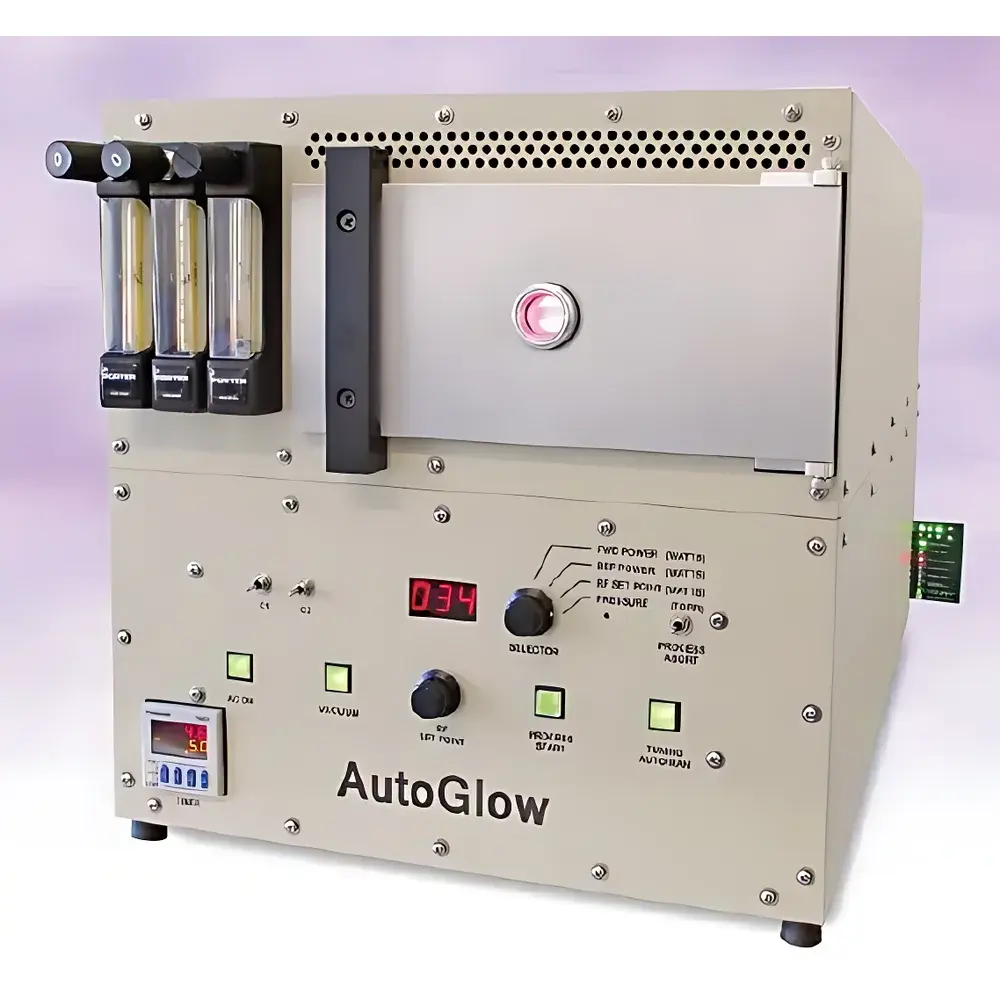
AutoGlow Advanced Multi-Function Plasma Surface Treatment System
| Origin | USA |
|---|---|
| Manufacturer Type | Authorized Distributor |
| Origin Category | Imported Equipment |
| Model | AutoGlow |
| Instrument Type | Imported Plasma Surface Treater |
| RF Frequency | 13.56 MHz |
| Power Output | 300 W or 600 W (selectable) |
| Dimensions | 254 mm × 101.6 mm × 254 mm |
| Chamber Volume | 254 mm × 101.6 mm × 254 mm |
| Chamber Material | High-Purity Aluminum or Fused Quartz |
| Process Gases | 3–4 Independent Mass Flow Controlled Gas Lines |
| Control Mode | Fully Automated |
Overview
The AutoGlow Advanced Multi-Function Plasma Surface Treatment System is a compact, benchtop-capable capacitively coupled plasma (CCP) platform engineered for precision surface engineering in R&D and pilot-scale environments. Operating at the industrial standard 13.56 MHz radio frequency, it generates stable, low-pressure glow discharge plasmas in controlled atmospheres—enabling reproducible physical sputtering, reactive chemical etching, surface functionalization, and thin-film deposition. Unlike wet chemical processes, AutoGlow delivers anisotropic, directional processing essential for micro- and nanofabrication workflows—including photolithography residue removal, MEMS release, biofunctionalization of polymers, and pre-bonding activation of glass, silicon, and PDMS. Its modular architecture supports both standard CCP mode and optional inductively coupled plasma (ICP) enhancement for high-density RIE (Reactive Ion Etching), making it suitable for demanding applications such as deep silicon etching, fluorocarbon-based polymer removal, and surface amine grafting per ISO 15197 and ASTM F2519 protocols.
Key Features
- Fully automated process sequencing with vacuum interlock, pressure monitoring, and real-time gas flow regulation via three independent thermal mass flow controllers (MFCs)
- Two power configurations: 300 W (standard) and 600 W (AutoGlow 200 variant), both offering continuous 10–600 W adjustable RF output for fine-tuned process control
- Interchangeable chamber options: high-purity aluminum (for general-purpose etching/cleaning) or fused quartz (for UV-transparent applications and OES endpoint detection)
- Integrated nitrogen purge line and auto-calibrating pressure sensor (0.1–100 mTorr range) compliant with ISO 27427 vacuum instrumentation standards
- CE-marked design with built-in safety interlocks, overpressure relief, and RF emission shielding meeting IEC 61000-6-3 and FCC Part 18 requirements
- Single-button operation with programmable recipe storage (up to 99 profiles), supporting GLP/GMP-compliant audit trails when paired with optional data logging software
Sample Compatibility & Compliance
AutoGlow accommodates substrates up to 200 mm in diameter (8-inch wafers) and handles diverse material classes: silicon, fused silica, quartz, alumina, stainless steel, titanium, polyimide, PDMS, PET, PTFE, and SU-8 photoresist. It supports multi-gas chemistries—including O2, Ar, N2, CF4, SF6, and air—with precise blending ratios controlled by dual-MFC mixing valves. All process parameters comply with ASTM D2197 (plasma cleaning efficacy), ISO 10993-5 (biocompatibility surface preparation), and USP particulate matter testing prerequisites. The system meets FDA 21 CFR Part 11 requirements for electronic records and signatures when used with validated software modules.
Software & Data Management
The AutoGlow control interface runs on embedded Linux with a 7-inch capacitive touchscreen and intuitive graphical workflow navigation. Process logs—including chamber pressure, forward/reflected RF power, gas flow rates, treatment time, and endpoint detection signals—are timestamped and exportable in CSV or XML format. Optional software packages provide remote monitoring via Ethernet/Wi-Fi, integration with LabVIEW™ and Python APIs, and full compliance with 21 CFR Part 11 through electronic signature capture, user role-based access control, and immutable audit trail generation. Data integrity is further ensured via automatic backup to external USB drives and network-attached storage (NAS).
Applications
- Plasma Cleaning: Removal of organic contaminants, hydrocarbons, and native oxides from metal, ceramic, and semiconductor surfaces prior to bonding or coating
- Surface Activation: Generation of polar functional groups (e.g., –OH, –COOH, –NH2) on polymeric substrates to improve adhesion for printing, metallization, or cell culture
- RIE Etching: Anisotropic patterning of SiO2, SiNx, and silicon using CF4/O2 or SF6/O2 chemistries—validated for sub-100 nm feature transfer in MEMS/NEMS fabrication
- Photoresist Stripping: Low-damage ashing of positive/negative resists without undercutting or substrate degradation, widely adopted in academic cleanrooms (e.g., MIT Microsystems Technology Labs, Harvard Gordon McKay Lab)
- Plasma-Enhanced Deposition: Precursor-assisted formation of SiOx, SiNx, or DLC films via downstream plasma polymerization
FAQ
What vacuum level is required for stable plasma ignition?
The system initiates plasma discharge reliably at pressures between 10–100 mTorr, with optimal uniformity achieved at 20–50 mTorr depending on gas composition and power setting.
Can AutoGlow be integrated into existing cleanroom automation systems?
Yes—RS-232, Ethernet, and digital I/O ports support SECS/GEM protocol integration and PLC-level handshake signaling for inline process coordination.
Is quartz chamber necessary for all applications?
Quartz is recommended for optical endpoint detection (OES), UV-sensitive photochemistry, or fluoride-based etching where aluminum corrosion resistance is insufficient; aluminum chambers are preferred for high-throughput O2/Ar cleaning due to superior thermal stability.
Does the system support custom gas mixtures beyond the standard three lines?
Up to four independently controlled gas lines are available; additional gases (e.g., H2, NH3) may be added via optional MFC expansion module with full software calibration support.
How is process repeatability verified across multiple users?
Each recipe includes traceable parameter sets with checksum validation; hardware-level calibration of MFCs and pressure sensors is performed annually per ISO/IEC 17025 guidelines, and certificate documentation is provided with each service visit.



