
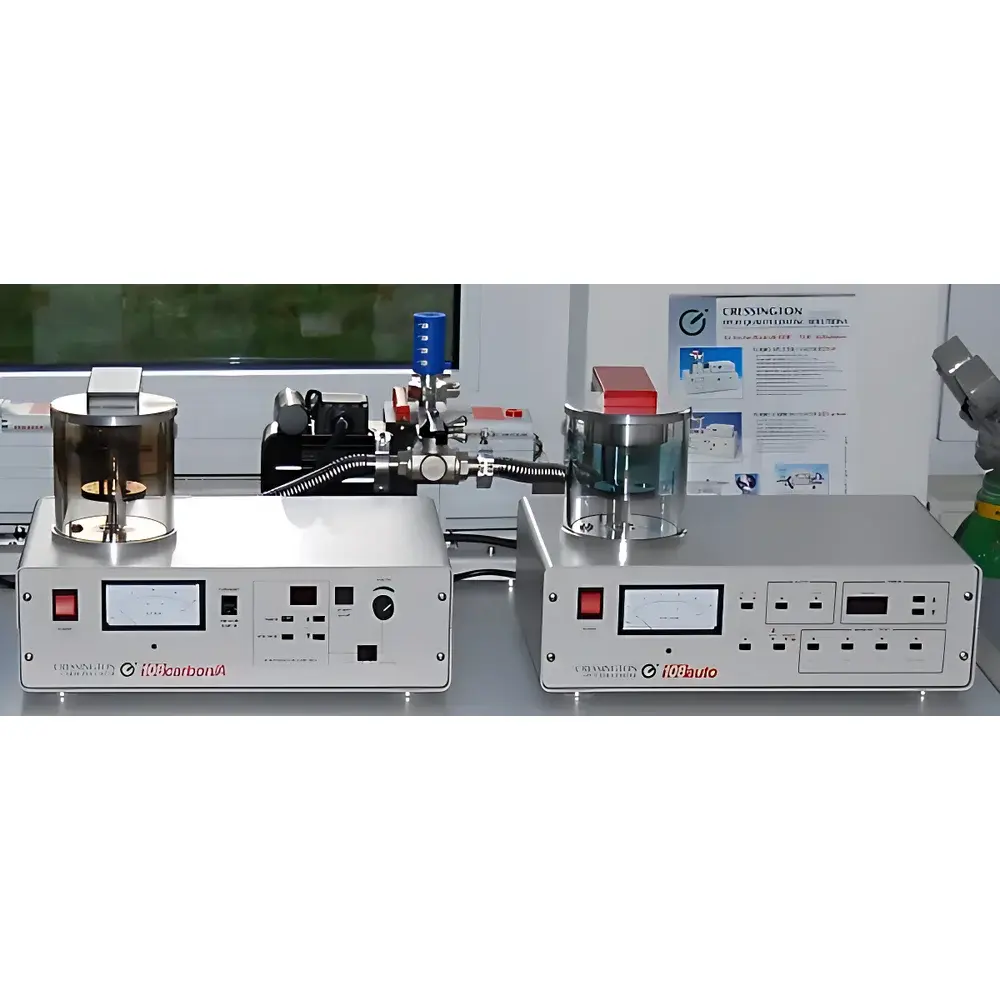
Cressington 108Auto+108C Dual-Mode Sputter and Carbon Coater
| Brand | Cressington |
|---|---|
| Origin | United Kingdom |
| Model | 108Auto+108C |
| Vacuum System | Integrated dual-chamber configuration (sputter + carbon evaporation) |
| Power Supply | Fully automated DC sputtering with adjustable current (0–100 mA), high-stability carbon filament evaporation |
| Chamber Material | Stainless steel with quartz viewport |
| Base Pressure | ≤5 × 10⁻² mbar (standard turbomolecular pump option) |
| Sample Stage | Motorized, height-adjustable, tilt-capable (0–90°), cooled or ambient operation |
| Dimensions (W×D×H) | 420 × 460 × 380 mm |
| Weight | 32 kg |
Overview
The Cressington 108Auto+108C is a compact, dual-mode vacuum coater engineered for high-fidelity sample preparation in electron microscopy and surface analysis laboratories. It integrates two complementary thin-film deposition techniques—magnetron sputtering (for conductive metal coatings such as gold, platinum, and chromium) and thermal carbon evaporation (for ultra-thin, amorphous carbon support films)—within a single, space-efficient stainless-steel vacuum chamber architecture. The system operates on a robust cold-sputtering principle, eliminating resistive heating of the target and minimizing thermal stress on beam-sensitive specimens—including biological tissues, polymers, and nanomaterials. This design ensures sub-nanometer thickness control, excellent film uniformity (<±3% across 30 mm diameter), and reproducible conductivity enhancement without structural distortion. Its modular vacuum train supports both rotary vane and turbomolecular pumping configurations, enabling base pressures down to 5 × 10⁻² mbar for optimized sputter yield and carbon film purity.
Key Features
- Fully automated DC sputtering control with real-time current regulation (0–100 mA range), ensuring consistent film growth rate and stoichiometric fidelity across multiple runs.
- Dual-source capability: simultaneous or sequential use of sputter cathode (Au, Pt, Cr, Pd, Ir targets) and carbon filament evaporation source—enabling hybrid coating strategies (e.g., Au/Pd underlayer + C overlayer).
- Motorized, programmable sample stage with vertical lift (±15 mm), tilt (0–90°), and optional liquid nitrogen cooling for cryo-compatible deposition.
- Integrated quartz crystal microbalance (QCM) option for real-time thickness monitoring during carbon evaporation (resolution: 0.1 nm).
- Intuitive touchscreen interface with preloaded coating protocols compliant with ASTM E1558 (SEM specimen preparation) and ISO 27208 (thin-film metrology standards).
- Compact footprint (420 × 460 × 380 mm) designed for benchtop integration in shared microscopy suites or cleanroom-adjacent prep labs.
Sample Compatibility & Compliance
The 108Auto+108C accommodates standard SEM stubs (12.7–25.4 mm), TEM grids (200–400 mesh), and custom substrates up to Ø30 mm. Its low-thermal-load sputtering process preserves delicate morphology in hydrated or frozen-hydrated samples, making it suitable for cryo-SEM workflows when paired with appropriate transfer systems. All vacuum components meet EU PED 2014/68/EU pressure equipment directives, and electrical safety complies with IEC 61010-1:2010. Optional GLP/GMP-compliant audit trail logging (via USB export) supports regulated environments requiring traceability per FDA 21 CFR Part 11 and ISO/IEC 17025 accreditation requirements.
Software & Data Management
The embedded firmware supports protocol-based operation with up to 20 user-defined methods stored locally. Each method includes sputter time/current setpoints, carbon evaporation ramp profiles, stage position parameters, and optional QCM endpoint triggering. Data logs—including vacuum status, power delivery history, and stage motion timestamps—are exportable as CSV files for LIMS integration or QA documentation. No proprietary software installation is required; all configuration and diagnostics are accessible via the front-panel HMI. Firmware updates are delivered via secure USB key with version-controlled release notes aligned with Cressington’s ISO 9001-certified development lifecycle.
Applications
- Conductive coating of non-conductive specimens prior to SEM imaging—reducing charging artifacts and improving secondary electron yield.
- Preparation of ultrathin carbon films for TEM grid support, including holey carbon and continuous carbon membranes.
- Deposition of high-Z contrast layers (e.g., Ir, Pt) for EDS quantification calibration and backscattered electron imaging enhancement.
- Routine maintenance coating of field emission tips and electron gun components in analytical electron microscopes.
- Research-scale fabrication of model electrodes for in situ electrochemical SEM studies.
FAQ
What vacuum pumps are compatible with the 108Auto+108C?
Standard configuration includes a two-stage rotary vane pump (base pressure ~5 × 10⁻² mbar); optional turbomolecular pump upgrade achieves ≤1 × 10⁻⁴ mbar for high-purity carbon films.
Can the system deposit alloys or multi-layer films?
Yes—sequential sputtering using interchangeable targets enables bilayer structures (e.g., Cr/Au adhesion layers); carbon evaporation may follow immediately without venting.
Is remote monitoring supported?
No Ethernet or Wi-Fi interface is built-in; however, status LEDs and digital display provide real-time operational feedback, and all logs are manually exportable via USB.
What maintenance intervals are recommended?
Chamber cleaning every 50 coating cycles; filament replacement after ~200 carbon depositions; sputter target refurbishment based on erosion depth (typically >100 µm depletion).
Does Cressington provide application-specific SOPs?
Yes—validated protocols for biological tissue, polymer nanocomposites, and battery electrode materials are available upon request through authorized distributors.



