
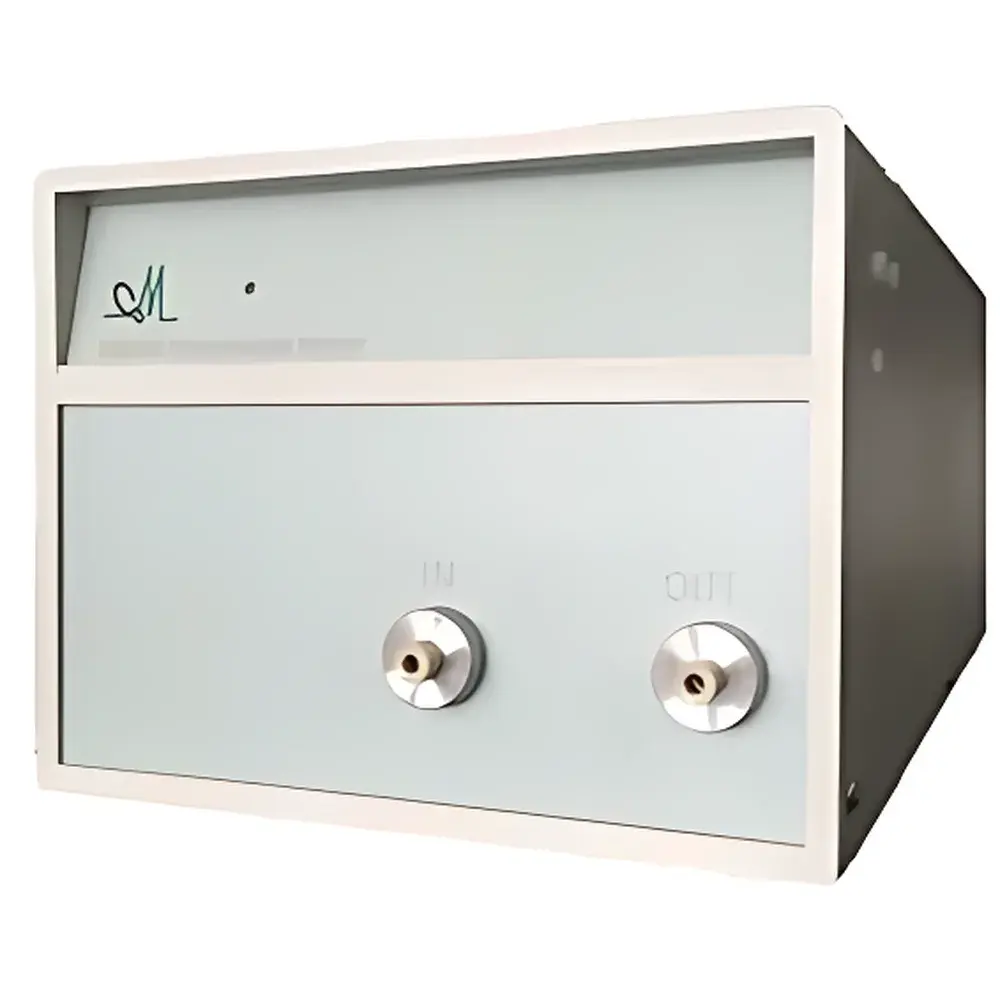
CoMetro 6000PER Koller-Ring Photochemical Post-Column Derivatization System
| Brand | CoMetro |
|---|---|
| Origin | Imported |
| Model | Koller-Ring |
| Derivatization Flow Rate | 3 mL/min |
| Light Source | Cold UV LED |
| Wavelength | 254 nm |
| Output Power | 8 mW |
| Reactor Type | Koller-Ring Optical Cell |
| Temperature Control | Forced-Air Cooling |
| Operating Temperature | Ambient |
Overview
The CoMetro 6000PER Koller-Ring Photochemical Post-Column Derivatization System is an engineered solution for enhancing detection sensitivity in high-performance liquid chromatography (HPLC) analysis of naturally occurring mycotoxins and sulfonamide antibiotics. It operates on the principle of on-line, post-column photochemical derivatization—utilizing ultraviolet radiation at 254 nm to induce structural modification of analytes immediately after elution from the chromatographic column but prior to fluorescence detection. This physical derivatization mechanism eliminates reliance on reactive chemical reagents, thereby avoiding complications associated with reagent stability, mixing dynamics, backpressure fluctuations, and carryover contamination. The system integrates seamlessly into existing HPLC workflows without altering column selection, mobile phase composition, or gradient programming, making it particularly suitable for regulated laboratories requiring method robustness and long-term reproducibility.
Key Features
- Koller-Ring optical reactor design ensures uniform photon flux distribution across the entire flow path, maximizing photochemical conversion efficiency while minimizing band broadening and peak distortion.
- Cold UV LED light source (254 nm, 8 mW output) delivers stable, low-heat irradiation—eliminating thermal degradation risks for thermolabile analytes such as aflatoxin B1 and G1.
- No chemical reagents required: Derivatization is achieved solely through controlled UV exposure, removing the need for pump-driven reagent delivery, T-piece mixing, or post-reaction quenching steps.
- Forced-air cooling maintains ambient thermal stability within the reactor housing, ensuring consistent photoreaction kinetics independent of laboratory environmental fluctuations.
- Minimal dead volume (<50 µL) preserves chromatographic resolution and peak shape integrity, especially critical for narrow-bore and UHPLC applications.
- Modular, tool-free reactor cartridge design enables rapid replacement and cleaning—supporting routine maintenance under GLP-compliant laboratory practices.
Sample Compatibility & Compliance
The 6000PER system is validated for use in quantitative determination of aflatoxins (B1, B2, G1, G2) and sulfonamides in food, feed, and pharmaceutical matrices per AOAC Official Method 2005.08, EU Commission Regulation (EC) No. 401/2006, and USP . Its reagent-free operation supports compliance with ICH Q2(R2) guidelines for analytical procedure validation, particularly in specificity and robustness assessments. The absence of chemical reagents simplifies audit trails and reduces documentation burden related to reagent lot traceability and expiration management. All wetted components are constructed from UV-resistant PEEK and fused silica, ensuring compatibility with common HPLC solvents including acetonitrile, methanol, and aqueous buffers across pH 2–8.
Software & Data Management
While the 6000PER operates as a standalone hardware module, its integration with third-party HPLC data systems (e.g., Waters Empower, Thermo Chromeleon, Agilent OpenLab CDS) is fully supported via standard analog/digital I/O interfaces. Device status—including lamp operational hours, airflow sensor feedback, and temperature monitoring—is accessible through front-panel LED indicators and optional RS-232 serial output. For laboratories operating under FDA 21 CFR Part 11 requirements, full electronic record integrity is maintained when used in conjunction with compliant chromatography data systems that enforce user authentication, audit trail logging, and electronic signature controls. Firmware updates are performed via USB interface, with version history and checksum verification embedded in each release.
Applications
- Regulatory testing of aflatoxin contamination in cereals, nuts, spices, and dairy products per ISO 16050 and GB 5009.22.
- Multi-residue screening of sulfonamide antibiotics in animal tissues and honey using LC-FLD, where photochemical enhancement improves limit of quantitation (LOQ) by 3–5× compared to underivatized analysis.
- Method transfer between laboratories where chemical derivatization protocols suffer from inter-laboratory variability due to reagent purity or mixing inefficiency.
- Stability-indicating assays for photolabile drug substances where conventional chemical derivatization introduces degradation artifacts.
- Research applications involving oxidative or cyclization-prone heterocyclic compounds amenable to UV-mediated activation prior to fluorescence or electrochemical detection.
FAQ
Does the 6000PER require calibration or periodic lamp intensity verification?
Yes—CoMetro recommends quarterly verification of UV output intensity using a NIST-traceable radiometer. Lamp lifetime is rated at ≥5,000 hours under continuous operation.
Can the system be used with gradient elution methods?
Yes—the Koller-Ring reactor exhibits no pressure sensitivity or flow-dependent dispersion; it has been validated for gradients ranging from 0.2 to 3.0 mL/min across C18, phenyl-hexyl, and HILIC columns.
Is the reactor compatible with UHPLC systems operating above 1000 bar?
The Koller-Ring optical cell is rated to 1200 bar; however, maximum recommended flow rate remains 3 mL/min to maintain optimal residence time (≈1.2 s at 254 nm) for complete derivatization.
How does the system handle carryover between high-concentration and low-concentration injections?
Zero chemical reagent involvement eliminates cross-contamination pathways; carryover is governed solely by standard HPLC tubing wash protocols and is typically <0.05% under validated conditions.
What safety certifications does the device hold?
The unit complies with IEC 61010-1:2010 for electrical safety and IEC 62471:2006 for UV radiation hazard classification (Risk Group 1—exempt from labeling requirements).





