
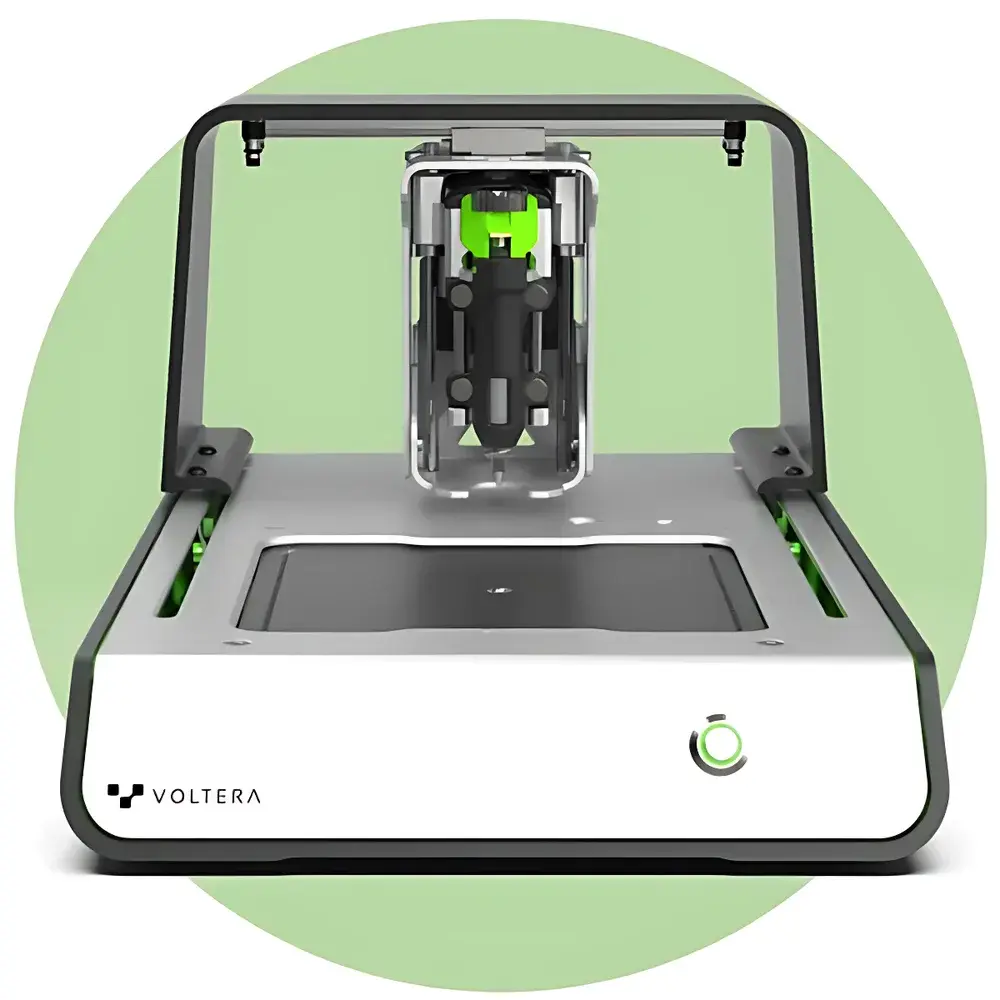
VOLTERA V-ONE Desktop PCB Prototyping System
| Brand | VOLTERA |
|---|---|
| Origin | Canada |
| Model | V-ONE |
| Print Materials | Conductive ink, dielectric ink, solder paste |
| Integrated Functions | Inkjet-based conductive trace printing, dielectric layer deposition, solder paste dispensing, hot-air reflow, mechanical micro-drilling |
| Substrate Compatibility | FR-4, Kapton (polyimide), PET, polyimide (PI), PDMS, and other rigid/flexible substrates |
| Form Factor | Benchtop, desktop-integrated system |
Overview
The VOLTERA V-ONE is a benchtop, integrated PCB prototyping system engineered for rapid, in-lab fabrication of functional printed circuit boards—both rigid and flexible—without reliance on external fabrication services. Unlike conventional additive manufacturing systems classified as 3D printers, the V-ONE operates on a hybrid digital manufacturing principle: it combines precision piezoelectric inkjet deposition (for conductive and dielectric inks), volumetric micro-dispensing (for solder paste), localized thermal reflow (via programmable hot-air nozzle), and CNC-guided mechanical drilling (for vias and through-holes). This architecture enables full-cycle prototyping—from Gerber file import to electrically tested board—in under 30 minutes for single- or double-layer designs. The system is designed for iterative hardware development in academic labs, R&D departments, and small-volume electronics innovation teams where turnaround time, design confidentiality, and substrate flexibility are critical constraints.
Key Features
- Single-platform integration of five essential PCB fabrication steps: conductive trace printing, dielectric insulation patterning, solder paste application, reflow soldering, and via drilling—all executed without manual tool changes or external post-processing.
- Benchtop footprint (approx. 45 × 40 × 35 cm) optimized for standard laboratory workbenches; no dedicated cleanroom or exhaust hood required.
- Piezoelectric printhead with <10 µm positional repeatability and variable droplet volume control (5–50 pL), enabling high-fidelity trace resolution down to 150 µm line width on flat substrates.
- Thermally regulated heated bed (up to 120 °C) and closed-loop hot-air reflow nozzle (max 350 °C, ±2 °C stability) compliant with IPC-J-STD-020 moisture sensitivity level (MSL) profiles.
- Integrated optical registration system with dual-camera alignment for substrate fiducial detection, ensuring layer-to-layer registration accuracy better than ±25 µm across FR-4 and flexible polyimide films.
- Open Gerber import workflow supporting RS-274X and XNC formats; native support for drill files (Excellon) and centroid data (CSV) for component placement verification.
Sample Compatibility & Compliance
The V-ONE supports a broad spectrum of industry-standard and emerging substrate materials, including rigid FR-4 (0.2–1.6 mm), flexible polyimide (Kapton®, 25–125 µm), PET (50–175 µm), and elastomeric PDMS sheets (pre-cured or semi-cured). Its non-contact deposition architecture eliminates mechanical stress on ultra-thin or low-modulus films. All consumables—including silver nanoparticle conductive ink (AgNP, resistivity <20 µΩ·cm after sintering), UV-curable dielectric polymer, and no-clean lead-free solder paste (SAC305)—are formulated for RoHS 2011/65/EU compliance. The system’s operational parameters align with IPC-2221B design guidelines for conductor spacing, thermal relief, and via aspect ratio (up to 8:1 for 0.3 mm drill depth). It is routinely deployed in GLP-aligned environments where traceability of process parameters (temperature logs, dispense volume, layer alignment offsets) is maintained per internal lab SOPs.
Software & Data Management
V-ONE Control Software (v4.x, Windows 10/11 64-bit) provides a unified interface for job setup, real-time monitoring, and audit-ready log export. Each print session generates a timestamped JSON metadata bundle containing substrate ID, ink lot numbers, thermal profile IDs, camera calibration checksums, and final electrical continuity test results (if optional multimeter integration is enabled). All logs are exportable in CSV or SQLite format for integration into LIMS or ELN platforms. While the system does not implement FDA 21 CFR Part 11 electronic signature controls out-of-the-box, its deterministic execution model and immutable local logging support retrospective validation for ISO 9001:2015 and ISO/IEC 17025:2017 quality management frameworks.
Applications
- Rapid iteration of sensor interconnects on stretchable substrates (e.g., wearable bioelectronics on PDMS or textile hybrids).
- Functional validation of high-frequency RF layouts (up to 2.4 GHz) using controlled-impedance traces on low-Dk polyimide.
- On-demand fabrication of educational PCB kits with embedded passive components (resistors, capacitors) via multi-material co-deposition.
- Low-volume production of custom interface boards for legacy instrumentation where commercial PCB turnaround exceeds project timelines.
- Material science studies involving novel conductive inks (graphene, CuNP, PEDOT:PSS) requiring precise spatial patterning and thermal history control.
FAQ
Does the V-ONE support multilayer PCB fabrication?
No—the V-ONE is engineered for single- and double-layer boards only. True multilayer stacking (≥4 layers with buried/blind vias) requires lamination and sequential imaging processes outside its operational scope.
Can I use third-party conductive inks or solder pastes?
VOLTERA validates performance and warranty coverage exclusively with its certified consumables. Unapproved materials may cause printhead clogging, inconsistent sintering, or thermal degradation during reflow.
Is mechanical drilling compatible with flexible substrates like Kapton?
Yes—micro-drilling (0.3–0.8 mm bit diameter) is performed under vacuum substrate hold-down and adaptive feed-rate control to prevent delamination or tearing on polyimide and PET films.
What file formats does the software accept for direct import?
Gerber RS-274X (copper, solder mask, silkscreen), Excellon II drill files, and centroid placement CSV files. Netlist import is not supported; design rule checking (DRC) must be completed externally.
How is calibration maintained over time?
Daily automated self-calibration includes printhead alignment verification, thermal sensor drift compensation, and Z-height mapping using integrated capacitive proximity sensing—no user intervention required.



