
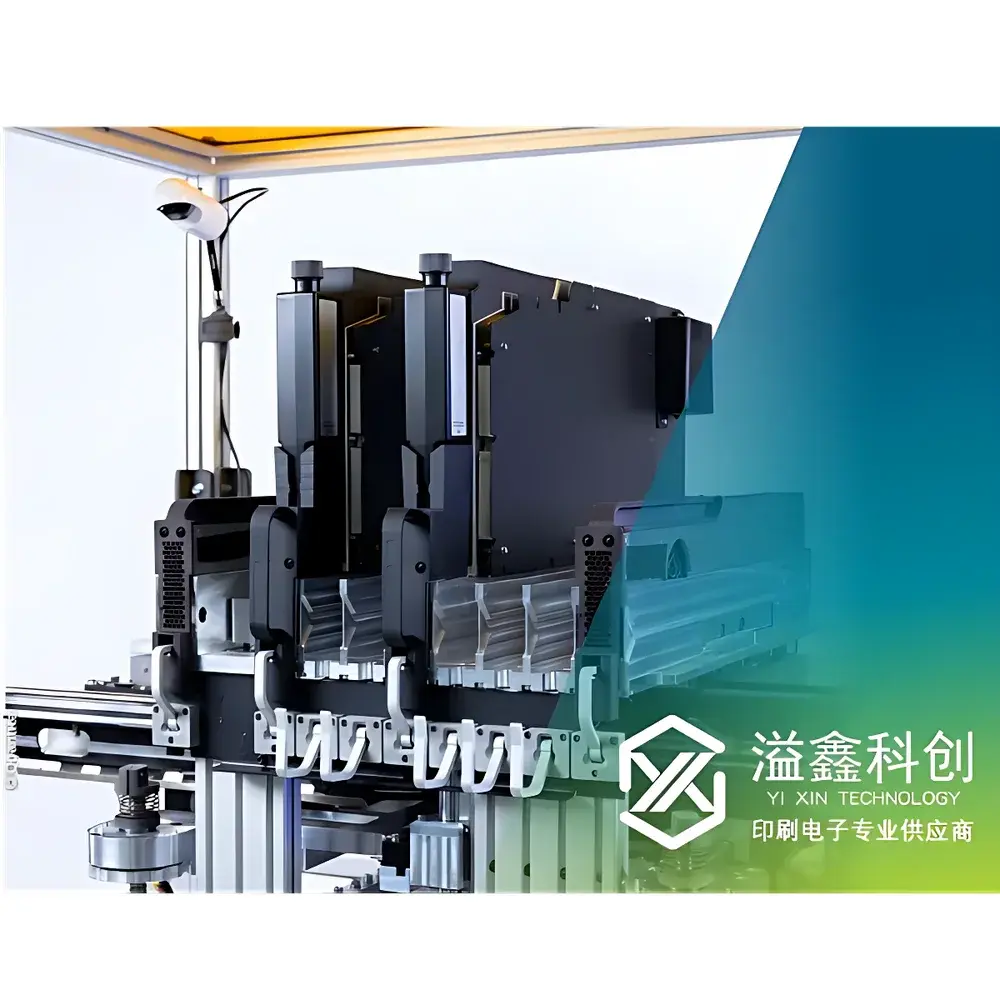
Quantica Open Printer / JetPack Digital High-Viscosity Inkjet Printing System
| Brand | Quantica |
|---|---|
| Origin | Germany |
| Model | Open Printer / JetPack |
| Type | Import |
| Distribution Status | Authorized Distributor |
Overview
The Quantica Open Printer / JetPack is a precision-engineered digital inkjet deposition platform designed specifically for the controlled, non-contact dispensing of high-viscosity functional materials—ranging from 100 mPa·s to over 50,000 mPa·s—well beyond the operational limits of conventional piezoelectric or thermal inkjet systems. Unlike standard inkjet technologies constrained by low-viscosity fluid requirements (<20 mPa·s), this system employs a proprietary electromechanical actuation architecture combined with optimized nozzle geometry and real-time pressure modulation to achieve stable jetting of shear-thinning, particle-laden, and thixotropic formulations. Its core measurement and control principle relies on synchronized droplet formation dynamics, volumetric calibration via gravimetric feedback, and closed-loop positional registration—enabling repeatable, layer-by-layer material placement with sub-50 µm lateral resolution and ±0.3 µm Z-axis repeatability. The system is engineered for integration into industrial R&D labs and pilot-scale manufacturing lines serving advanced electrification, energy conversion, and microelectronics sectors.
Key Features
- Dual-platform configuration: Open Printer (modular R&D platform) and JetPack (compact, production-integrated module) share identical fluidic architecture and software stack
- Viscosity range: Stable jetting from 100 mPa·s up to 50,000 mPa·s without preheating or solvent dilution
- Nozzle compatibility: Interchangeable stainless-steel and ceramic printheads (50–200 µm orifice), supporting both single-nozzle prototyping and multi-nozzle parallel deposition
- Real-time monitoring: Integrated high-speed imaging (100 kfps) and piezoresistive pressure sensing for in-situ droplet velocity, volume, and trajectory validation
- Substrate handling: Vacuum chuck with programmable Z-height compensation; accommodates rigid and flexible substrates up to 300 × 300 mm and thicknesses from 0.1 mm to 25 mm
- Environmental control: Optional inert-gas enclosure (N₂ or Ar) and temperature-regulated stage (20–80 °C) for moisture- or oxygen-sensitive formulations
Sample Compatibility & Compliance
The system supports a broad spectrum of functional materials validated across industrial applications—including epoxy-based structural adhesives, silicone thermal interface materials (TIMs), Pt-catalyst inks for MEA fabrication, conductive silver pastes, UV-curable encapsulants, and fluorinated ionomer dispersions. All material handling pathways comply with ISO 8573-1 Class 4 compressed air purity standards and feature chemically resistant wetted components (Hastelloy C-276, sapphire, PEEK). For regulated environments, the system’s firmware architecture supports audit trails, user-level access control, and electronic signature capability—aligning with FDA 21 CFR Part 11 and EU Annex 11 requirements when deployed under GLP or GMP frameworks. Material safety data sheets (MSDS) and process qualification reports are provided per batch for traceability in automotive (IATF 16949) and energy (IEC 62933-5-1) applications.
Software & Data Management
Control is executed via Quantica’s Q-Print Suite v4.x—a deterministic, deterministic real-time operating system (RTOS)-based application built on Qt framework. It features a parametric pattern editor supporting DXF/SVG import, layer stacking with Z-offset mapping, and dynamic viscosity compensation algorithms that adjust pulse width and drive voltage based on real-time rheological feedback. All print jobs are logged with timestamped metadata including ambient RH/temperature, nozzle temperature, backpressure, and gravimetric yield verification. Raw data exports support HDF5 and CSV formats; API integration (REST/JSON) enables bidirectional communication with MES (e.g., Siemens Opcenter) and PLM systems. Version-controlled job templates can be archived and recalled per ISO/IEC 17025 calibration records.
Applications
- E-motor stator/rotor lamination bonding: Digital deposition of high-Tg epoxy adhesives onto electrical steel laminations—achieving uniform 15–25 µm bond lines, eliminating voids, and reducing eddy current losses by >18% vs. needle dispensing
- Fuel cell MEA fabrication: Precise patterning of catalyst inks (e.g., Pt/C Nafion dispersions) onto gas diffusion layers and proton exchange membranes with <±2% CV in catalyst loading across 10 cm² active areas
- Bipolar plate edge sealing: Conformal deposition of fluorosilicone sealants onto machined graphite composite plates—compensating for ±50 µm surface topography variations without contact or masking
- Thermal interface material (TIM) patterning: Controlled application of phase-change TIMs onto power electronics modules, enabling localized thickness control (20–100 µm) and elimination of pump-out during thermal cycling
- Microbattery electrode structuring: Direct-write of slurry-based cathode/anode inks (NMC, LFP, Si-C composites) with defined porosity gradients and binder distribution profiles
FAQ
What viscosity range is supported without dilution or heating?
The system reliably jets materials from 100 mPa·s to 50,000 mPa·s at ambient temperatures (23 ± 2 °C) using standard nozzles.
Can it handle abrasive or filled formulations?
Yes—ceramic nozzles and Hastelloy fluid paths enable long-term operation with particle-loaded inks containing fillers up to 30 vol% and D90 < 5 µm.
Is offline calibration traceable to national standards?
Gravimetric calibration is performed using METTLER TOLEDO XP200001 balances (±0.1 mg), certified annually per ISO/IEC 17025 by DAkkS-accredited labs.
How is positional accuracy maintained across large-area substrates?
Integrated laser interferometry (Renishaw RLE) provides real-time linear scale feedback to the motion controller, ensuring <±0.5 µm positioning uncertainty over 300 mm travel.
Does the system support automated process validation protocols?
Yes—Q-Print Suite includes configurable IQ/OQ templates aligned with ASTM F3302-21 for additive manufacturing process qualification.







