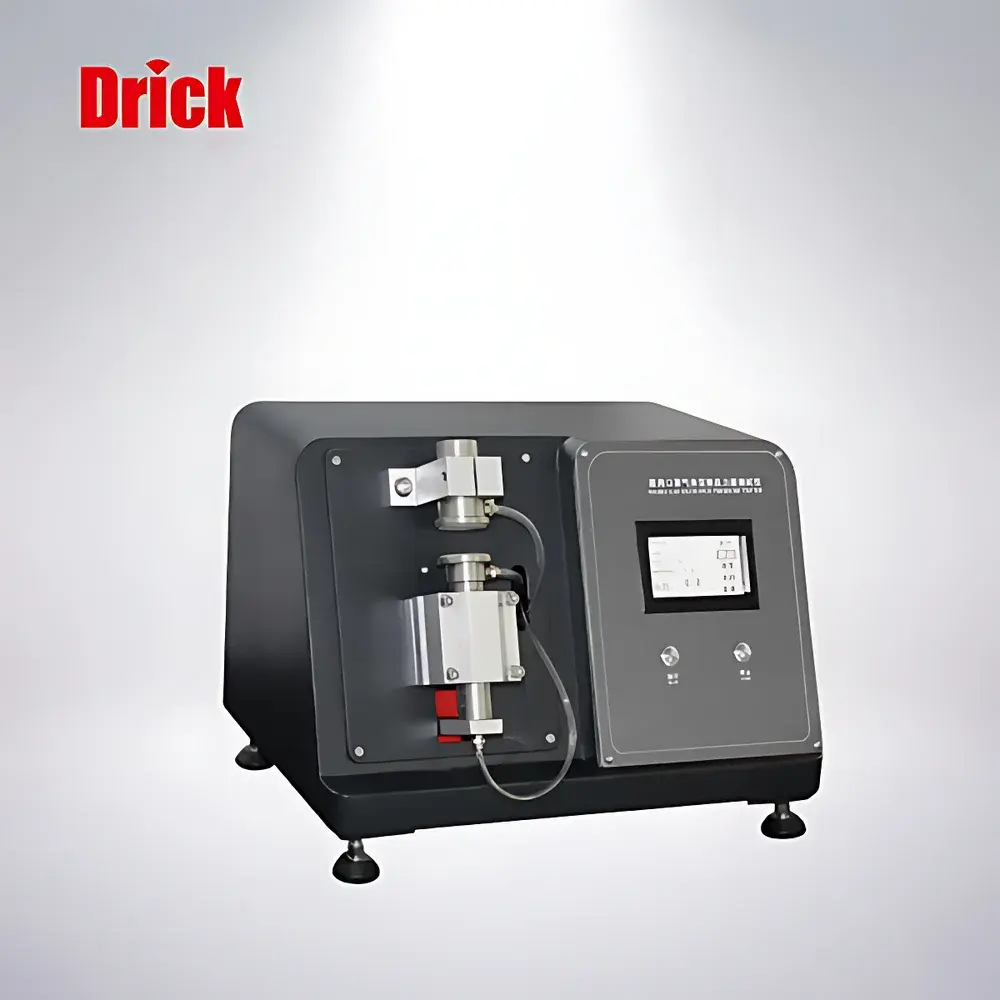
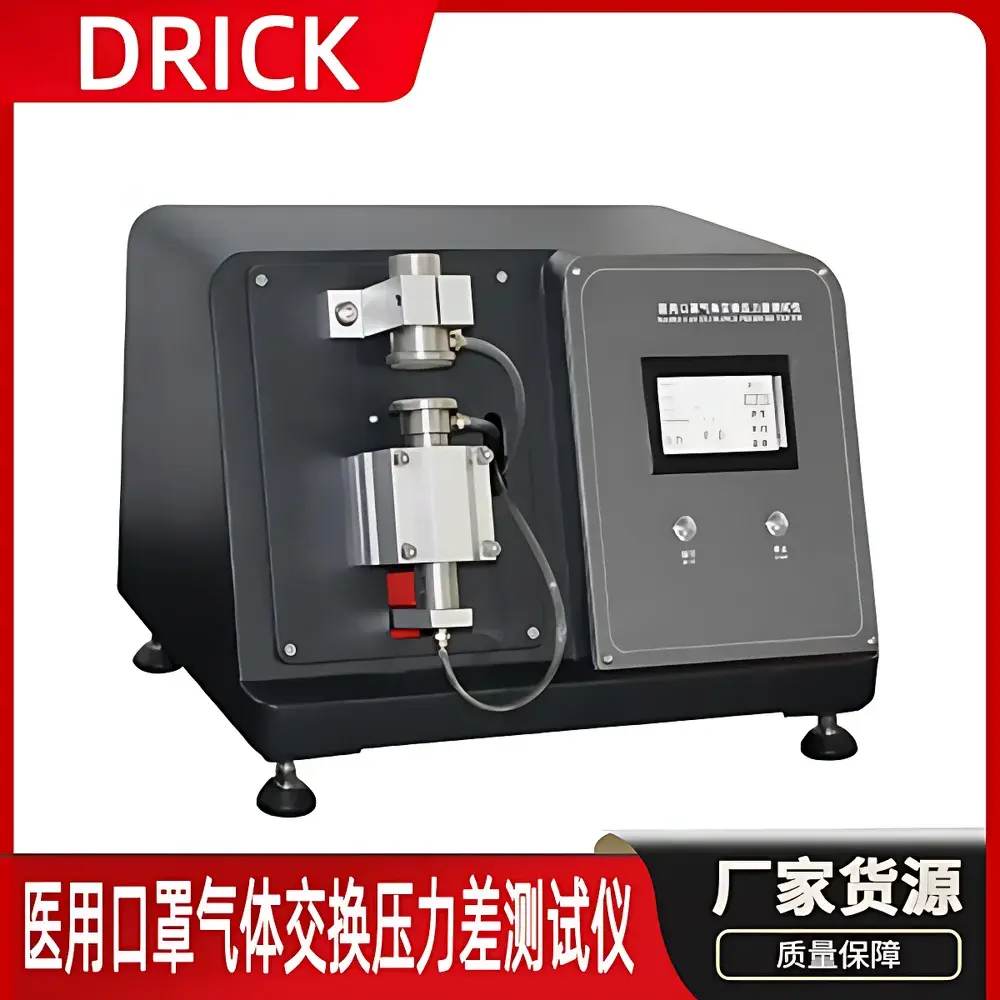
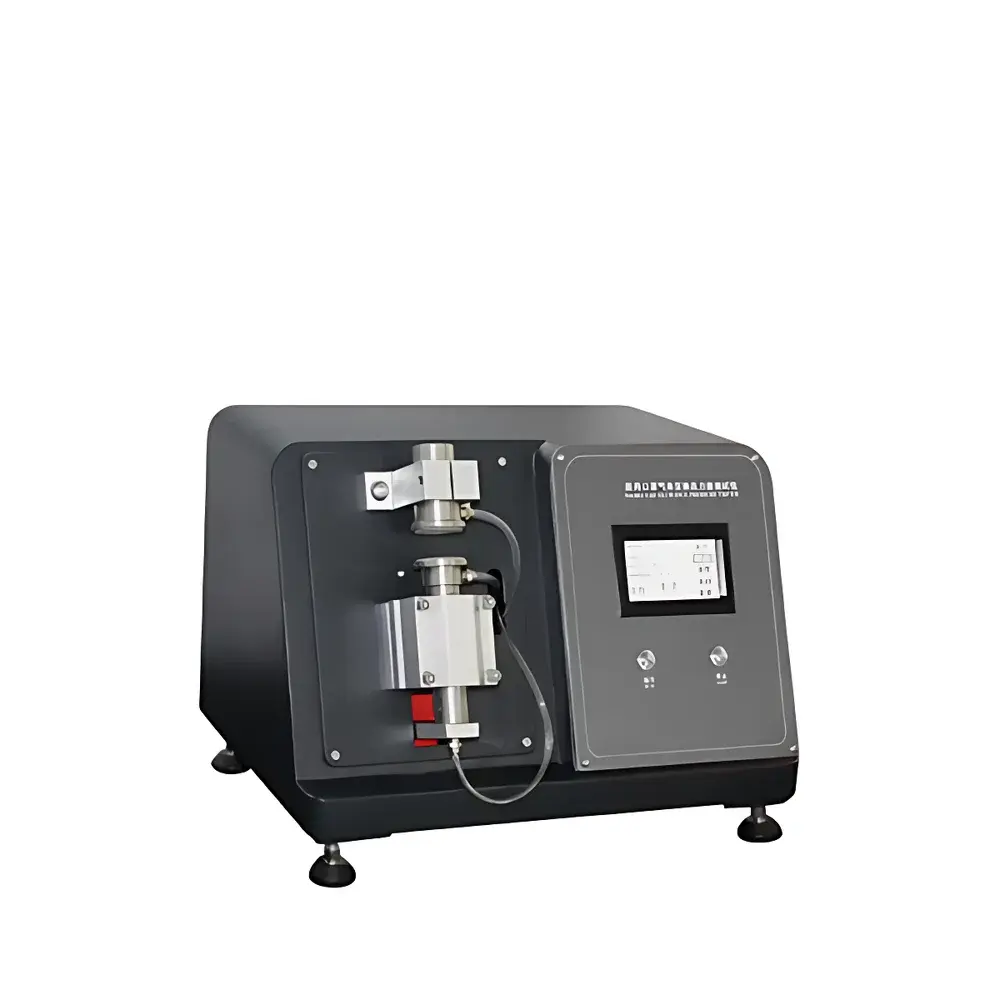
Drick DRK371 Medical Face Mask Air Permeability & Differential Pressure Tester
| Brand | Drick |
|---|---|
| Origin | Shandong, China |
| Manufacturer Type | Direct Manufacturer |
| Model | DRK371 |
| Pressure Difference Range | 0–100 Pa/cm² |
| Accuracy | ±2% |
| Airflow Rate | (8 ± 0.2) L/min |
| Test Area | 4.9 cm² (Φ25 mm aperture) |
| Differential Pressure Sensor Range | 0–500 Pa |
| Resolution | 1 Pa |
| Pneumatic Supply | 0.35–0.8 MPa @ 30 L/min |
| Sealing Method | O-ring seal |
| Display | Color touchscreen with bilingual (CN/EN) menu interface |
| Data Output | Automatic storage and optional thermal printing |
| Dimensions (L×W×H) | 560 × 420 × 380 mm |
| Power | AC 220 V, 50 Hz, 200 W |
| Weight | ~30 kg |
Overview
The Drick DRK371 Medical Face Mask Air Permeability & Differential Pressure Tester is a precision-engineered instrument designed to quantify the pressure differential across medical face mask materials under controlled airflow conditions. It operates on the principle of constant-flow air permeability testing: a regulated volumetric airflow of (8 ± 0.2) L/min is passed perpendicularly through a standardized test area of 4.9 cm² (Φ25 mm circular aperture), and the resulting pressure drop—expressed in pascals per square centimeter (Pa/cm²)—is measured using a high-stability imported differential pressure transducer. This measurement directly correlates with breathability performance, a critical functional parameter for surgical and disposable medical masks. The system complies with the core mechanical testing requirements defined in YY 0469–2011 (Section 5.7, “Pressure Difference”) and YY/T 0969–2013 (Section 5.6, “Air Permeability Resistance”), ensuring alignment with China’s regulatory framework for medical protective equipment. Its robust architecture supports routine QC/QA workflows in manufacturing facilities, third-party testing laboratories, and hospital procurement departments evaluating compliance prior to clinical deployment.
Key Features
- High-accuracy differential pressure sensing with 0–500 Pa range and 1 Pa resolution, calibrated against traceable standards
- Stable, programmable airflow control at (8 ± 0.2) L/min—maintained via integrated mass flow regulation and pressure-regulated pneumatic supply (0.35–0.8 MPa)
- Bilingual (English/Chinese) color touchscreen interface with intuitive menu navigation and real-time graphical display of pressure curves
- Dual-mode operation: touch-screen input supplemented by parallel tactile metal membrane keys for glove-compatible use in cleanroom or lab environments
- O-ring-based sample clamping mechanism ensuring repeatable, leak-free sealing across diverse mask material thicknesses and textures
- Onboard data logging with timestamped records; export-capable via USB or direct thermal printout for audit-ready documentation
- Compact benchtop footprint (560 × 420 × 380 mm) and low power consumption (200 W, AC 220 V / 50 Hz) suitable for ISO Class 5–8 laboratory settings
Sample Compatibility & Compliance
The DRK371 accommodates flat, non-woven, multi-layer composite specimens up to 3 mm in thickness, including melt-blown polypropylene, spunbond layers, and laminated barrier films used in surgical masks, procedure masks, and ASTM F2100 Level 1–3 equivalents. Sample mounting employs a fixed-diameter (Φ25 mm) test head with uniform compression force, minimizing edge effects and ensuring reproducible test area definition (4.9 cm²). All operational parameters—including airflow rate tolerance, pressure sensor calibration interval, and seal integrity verification—are aligned with the metrological rigor required for GLP-compliant testing. While primarily validated against YY-series standards, its measurement methodology is technically consistent with ISO 9237 (Textiles – Determination of air permeability) and ASTM F2299 (Standard Test Method for Determining the Initial Efficiency of Materials Used in Medical Face Masks to Penetration by Particulates), enabling cross-referenced reporting where needed.
Software & Data Management
The embedded firmware supports full-cycle test automation: auto-zeroing before each run, real-time pressure stabilization monitoring, and automatic pass/fail flagging based on user-defined thresholds (e.g., ≤5.0 Pa/cm² per YY 0469–2011). Measurement data—including raw pressure values, airflow stability metrics, test duration, operator ID, and environmental timestamp—is stored internally with SHA-256 hashed integrity verification. Export formats include CSV (for LIMS integration) and PDF reports with embedded device serial number, calibration certificate ID, and digital signature fields. Audit trail functionality logs all configuration changes, user logins, and calibration events—supporting basic 21 CFR Part 11 readiness when deployed within documented quality systems.
Applications
- Routine quality control of surgical mask production batches against YY 0469–2011 and YY/T 0969–2013 specifications
- Comparative evaluation of filtration media breathability during R&D of new electrostatically charged nonwovens
- Supplier qualification testing for raw material vendors supplying melt-blown or SMS laminates
- Regulatory submission support for NMPA registration dossiers requiring breathability characterization data
- Internal validation of mask reprocessing protocols where airflow resistance may degrade after decontamination cycles
FAQ
What standards does the DRK371 explicitly support?
It is configured and validated for YY 0469–2011 (Section 5.7) and YY/T 0969–2013 (Section 5.6); its measurement methodology is also compatible with ISO 9237 and ASTM F2299.
Is calibration certification included with delivery?
Yes—a factory-issued calibration certificate traceable to CNAS-accredited reference standards is supplied, covering pressure sensor and airflow meter verification.
Can the instrument be integrated into a laboratory information management system (LIMS)?
Yes, via USB-host mode exporting timestamped CSV files containing all measured and metadata fields required for automated ingestion.
What maintenance is required to ensure long-term accuracy?
Quarterly verification of O-ring elasticity and seal integrity, annual recalibration of the differential pressure sensor, and biannual inspection of airflow path cleanliness are recommended per the maintenance schedule in the operator manual.
Does the DRK371 meet electromagnetic compatibility (EMC) requirements for medical device labs?
It complies with GB/T 18268.1–2010 (IEC 61326-1) for EMC in laboratory environments, including radiated/conducted emissions and electrostatic discharge immunity testing.