
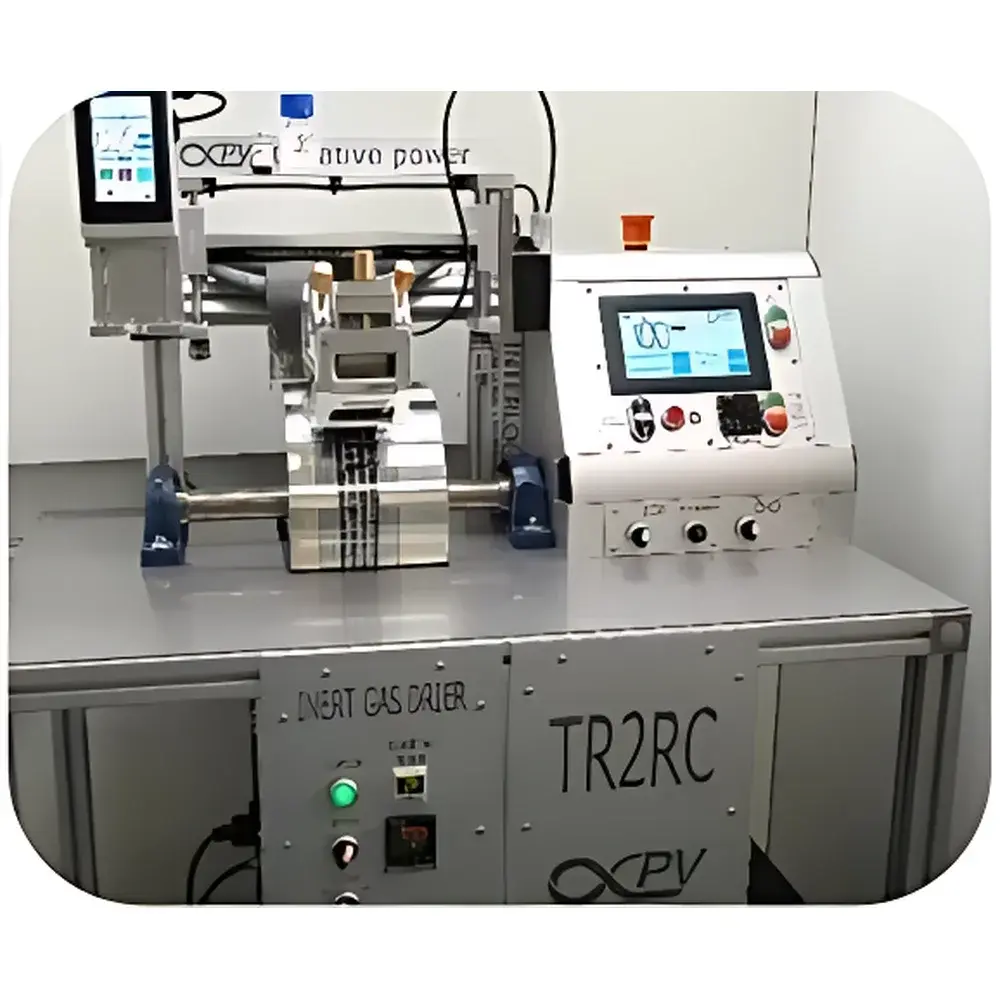
InfinityPV TR2RC Roll-to-Roll Slot-Die Coater
| Brand | InfinityPV |
|---|---|
| Origin | Denmark |
| Model | TR2RC |
| Type | Research-Grade R2R Slot-Die Coating System |
| Application Domain | Printed Electronics, Thin-Film Functional Devices |
| Compliance Framework | Designed for GLP-aligned lab environments |
Overview
The InfinityPV TR2RC Roll-to-Roll (R2R) Slot-Die Coater is a precision-engineered benchtop system designed for controlled, scalable deposition of functional thin films via slot-die coating—a shear-driven, meniscus-regulated fluid delivery technique. Unlike contact-based methods such as blade or gravure coating, slot-die coating enables non-contact, low-shear, and highly reproducible film formation with sub-micron thickness control—critical for multilayer architectures in printed electronics and energy devices. The TR2RC integrates synchronized web handling (unwind/take-up), precision temperature-controlled coating head (±0.5 °C stability), and real-time gap adjustment (±1 µm resolution), enabling deterministic coating across substrates ranging from flexible PET and PI to ultrathin metal foils and glass. Its architecture supports both static (single-pass) and dynamic (continuous R2R) modes, bridging the gap between material formulation validation and pilot-scale process transfer.
Key Features
- Modular slot-die coating head with interchangeable dies (standard 50–200 mm width; custom widths available), supporting single-layer and multi-inlet co-extrusion configurations for graded or bilayer films.
- Motorized web transport system with closed-loop tension control (0.1–5 N range) and speed regulation from 0.01 to 1.5 m/min, ensuring stable meniscus formation under variable line speeds.
- Integrated substrate heating stage (ambient to 120 °C) and optional IR drying module for in-line solvent evaporation and morphology control.
- High-resolution linear encoder feedback on all motion axes, enabling repeatable positioning accuracy within ±2 µm over full travel.
- Stainless-steel and anodized aluminum construction with ESD-safe surface treatment—optimized for cleanroom-compatible operation (ISO Class 5–7).
- CE-marked electrical architecture with emergency stop circuitry and interlocked access panels compliant with EN 60204-1 safety standards.
Sample Compatibility & Compliance
The TR2RC accommodates substrates up to 300 mm wide and 150 µm thick—including polymer films (PET, PEN, PI), conductive textiles, ultrathin stainless steel foils, and rigid carriers (glass, silicon wafers). It accepts viscosities from 10 to 10,000 mPa·s (at 1 s⁻¹ shear rate) and supports solvent systems ranging from low-boiling-point alcohols (e.g., isopropanol) to high-boiling-point glycols (e.g., ethylene glycol). All wetted components are chemically resistant (316L SS, PTFE, FKM seals), facilitating compatibility with aggressive formulations used in perovskite precursor inks, PEDOT:PSS dispersions, and Li-ion cathode slurries. The system is engineered for alignment with laboratory quality management frameworks: audit-ready operation logs, user-access-level permissions, and timestamped parameter records support adherence to GLP principles and internal SOP enforcement. While not FDA-certified as a medical device, its data integrity features—including immutable parameter snapshots and exportable CSV/JSON metadata—facilitate traceability required for preclinical materials development under ISO 13485-informed protocols.
Software & Data Management
Operation is managed via InfinityPV’s proprietary CoatingStudio v3.2 software, running on an embedded industrial PC (Windows 10 IoT Enterprise). The interface provides real-time visualization of web speed, coating gap, heater setpoints, and motor currents, with configurable alarm thresholds and automatic shutdown triggers. All operational parameters—including die-to-substrate gap, pump flow rate, web tension, and temperature profiles—are logged at 10 Hz and stored with SHA-256 checksums. Export formats include time-stamped CSV for post-processing in MATLAB or Python, and structured JSON for integration into LIMS or ELN platforms (e.g., LabArchives, Benchling). Role-based user accounts (Operator, Engineer, Admin) enforce parameter lockout and change history tracking—fully supporting 21 CFR Part 11 readiness when deployed with validated digital signature modules and external time servers.
Applications
The TR2RC serves as a primary platform for translational research in next-generation optoelectronic and electrochemical devices. It is routinely deployed in academic and national labs for fabricating: organic photovoltaic (OPV) active layers with controlled vertical phase separation; perovskite absorber films requiring solvent-annealing synchronization; patterned electrolyte membranes for micro-fuel cells; stretchable electrode arrays for epidermal biosensors; and ion-conductive interlayers in solid-state battery prototypes. Its ability to maintain uniform wet film thickness (CV < 2.5% over 200 mm width) while preserving nanoscale morphology makes it indispensable for structure–property correlation studies where coating-induced aggregation or dewetting must be decoupled from intrinsic material behavior.
FAQ
What substrate widths and thicknesses can the TR2RC accommodate?
Standard configuration supports substrates 50–300 mm wide and 25–150 µm thick; custom guides and tension sensors are available for thinner (400 mm) configurations.
Is the system compatible with reactive or air-sensitive inks?
Yes—optional N₂-purged glovebox integration (with feedthroughs for power, data, and pneumatic lines) enables inert-atmosphere coating of moisture-sensitive perovskites or lithium-based slurries.
Can coating parameters be exported for regulatory submission?
All raw operational logs—including timestamps, setpoints, and sensor readings—are exportable in machine-readable formats (CSV, JSON) with cryptographic hashing for integrity verification, satisfying documentation requirements for peer-reviewed publications and pre-IND materials dossiers.
Does InfinityPV provide application support for ink formulation optimization?
Yes—InfinityPV’s Applications Lab offers remote and on-site collaborative testing, including rheological profiling of candidate inks, meniscus stability analysis, and defect root-cause mapping using high-speed imaging and in-line optical monitoring add-ons.




