
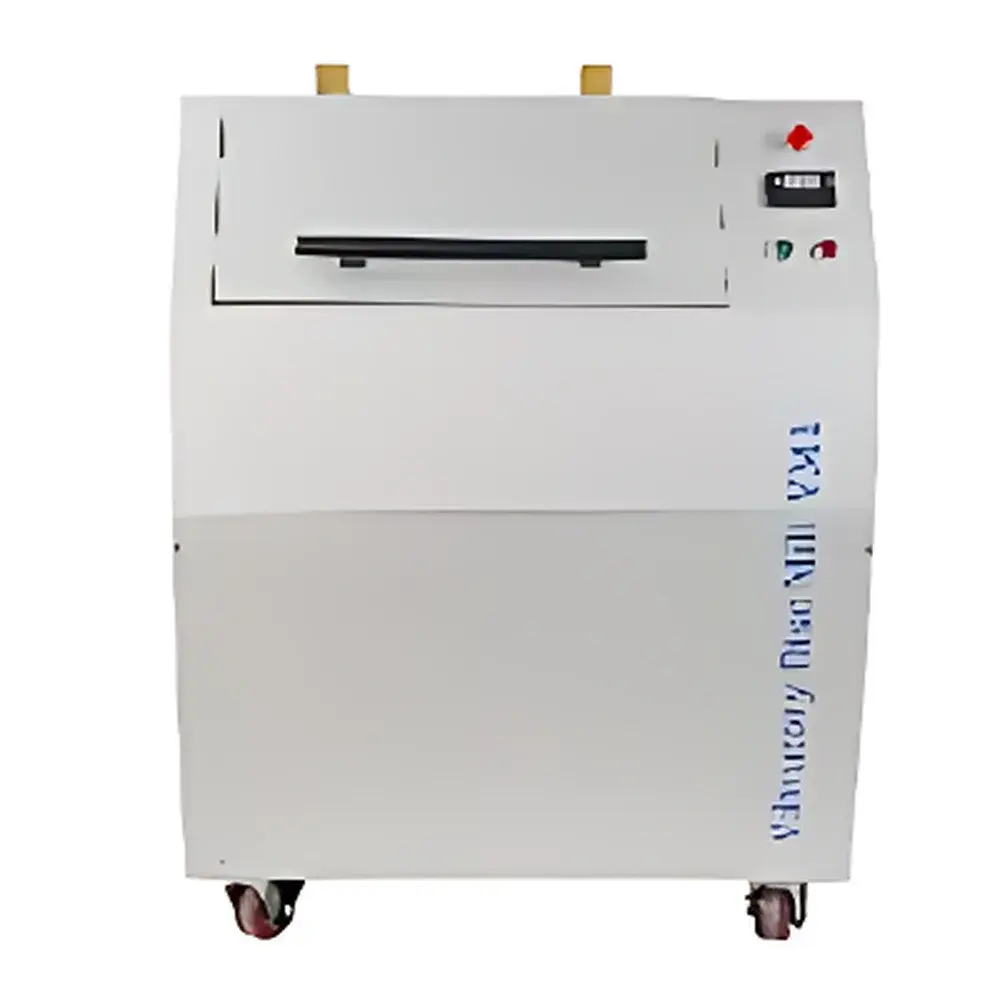
Grindemann VM1 Vibration Cup Grinder
| Brand | Grindemann |
|---|---|
| Model | VM1 |
| Type | Vibration Cup Grinder |
| Origin | Beijing, China |
| Manufacturer | Grindemann Instruments Co., Ltd. |
| Sample Hardness | Medium-hard to hard, brittle, fibrous |
| Max Feed Size | < 20 mm |
| Final Particle Size (d95) | < 20 µm |
| Batch Volume Range | 35–2000 mL |
| Operating Speed | 910 rpm (adjustable) |
| Grinding Time Range | 00:01–99:59 (mm:ss) |
| Available Jar Capacities | 50, 100, 300, 400, 800, 1000, 2000 mL |
| Jar Materials | Hardened Steel, Tungsten Carbide |
Overview
The Grindemann VM1 Vibration Cup Grinder is an engineered laboratory grinding system designed for high-efficiency, low-contamination size reduction of medium-hard to hard, brittle, and fibrous materials. It operates on the principle of three-dimensional vibrational energy transmission—generating controlled impact, shear, and compressive forces between the sample and grinding media inside a sealed cup. Unlike planetary or rotor-stator mills, the VM1 employs a fixed-cup configuration mounted on a dynamically balanced vibration baseplate, eliminating rotational torque and enabling reproducible, non-thermal comminution. This makes it especially suitable for spectroscopic sample preparation (e.g., XRF, XRD, FTIR), where particle homogeneity, minimal amorphization, and elemental integrity are critical. The instrument’s mechanical architecture ensures minimal cross-contamination and negligible metal leaching—particularly when tungsten carbide jars are used—supporting trace-level analytical workflows in regulated environments.
Key Features
- Three-axis high-frequency vibration drive (910 rpm nominal, continuously adjustable) delivering uniform energy distribution across the entire sample bed
- Quick-clamp retention system with integrated mechanical assist lever—enabling single-handed jar loading/unloading while maintaining ISO 17025-compliant positional repeatability
- Modular jar platform accommodating seven standard capacities (50–2000 mL), each validated for mass balance accuracy and vibration coupling efficiency
- Sealed, dust-tight cup assembly with pressure-locked lid gasketing—meeting IP54 environmental protection rating for routine lab use
- Front-panel digital interface with real-time timer display (00:01–99:59), speed confirmation, and cycle completion signaling
- Structural frame constructed from reinforced cast aluminum alloy with anti-vibration damping mounts—reducing transmitted floor resonance by >75% compared to rigid steel bases
Sample Compatibility & Compliance
The VM1 accepts feed particles up to 20 mm in maximum dimension and consistently achieves d95 ≤ 20 µm final particle size under optimized parameters—validated per ISO 13320:2020 (laser diffraction) and ASTM D4294-21 (XRF sample prep). Compatible sample categories include oxides (Al2O3, ZrO2), silicates (cement clinker, fly ash), geological matrices (soil, slag, coal), and organic-rich composites (wood flour, dried biomass). Jar material selection (hardened steel or tungsten carbide) allows compliance with USP for pharmaceutical excipient milling and ASTM C114-22 for cement fineness testing. All electrical components conform to IEC 61010-1:2010 safety standards; CE marking is applicable for EU-based deployment.
Software & Data Management
While the VM1 operates as a stand-alone benchtop unit without embedded PC connectivity, its control logic supports full audit trail capability via optional external logging: analog voltage output (0–10 V) mirrors real-time motor load and timer status, enabling integration with LIMS or SCADA systems. For GLP/GMP laboratories, time-stamped operational records—including start/stop timestamps, speed setting, and jar ID—can be manually entered into electronic lab notebooks compliant with FDA 21 CFR Part 11 requirements. Firmware versioning and calibration history are maintained via engraved serial plate and paper-based service log—consistent with ISO/IEC 17025 clause 7.7 documentation protocols.
Applications
- X-ray fluorescence (XRF) and X-ray diffraction (XRD) sample homogenization for geochemical and metallurgical assay
- Preparation of certified reference materials (CRMs) requiring sub-20 µm particle size distribution and minimal phase transformation
- Cement and concrete quality control per ASTM C186 and EN 196-6
- Environmental soil and sediment analysis per EPA Method 6010D and ISO 11466
- Routine QC grinding of catalyst supports, battery electrode precursors, and ceramic green bodies
FAQ
What types of samples are incompatible with the VM1?
Samples with high moisture content (>15% w/w), thermolabile polymers, or explosive compounds (e.g., perchlorates) are not recommended due to potential jar pressurization or thermal degradation during extended grinding cycles.
Can the VM1 be used for cryogenic grinding?
No—the instrument is not rated for liquid nitrogen immersion or sub-ambient operation; jar thermal contraction may compromise sealing integrity and vibration coupling efficiency.
Is validation support available for regulated industries?
Yes—Grindemann provides IQ/OQ documentation templates aligned with ASTM E2500-21 and GAMP5 guidelines, including performance qualification protocols for d95 consistency, inter-jar reproducibility, and speed linearity verification.
How often does the vibration baseplate require recalibration?
Under normal usage (≤8 hrs/day), the baseplate’s dynamic balance remains stable for ≥24 months; annual verification using ISO 20816-1 vibration amplitude measurement is recommended.
Are replacement jars traceable to material certifications?
Yes—each tungsten carbide and hardened steel jar ships with a CoA listing hardness (HRC or HV), density, and batch-specific SEM microstructure report upon request.



