
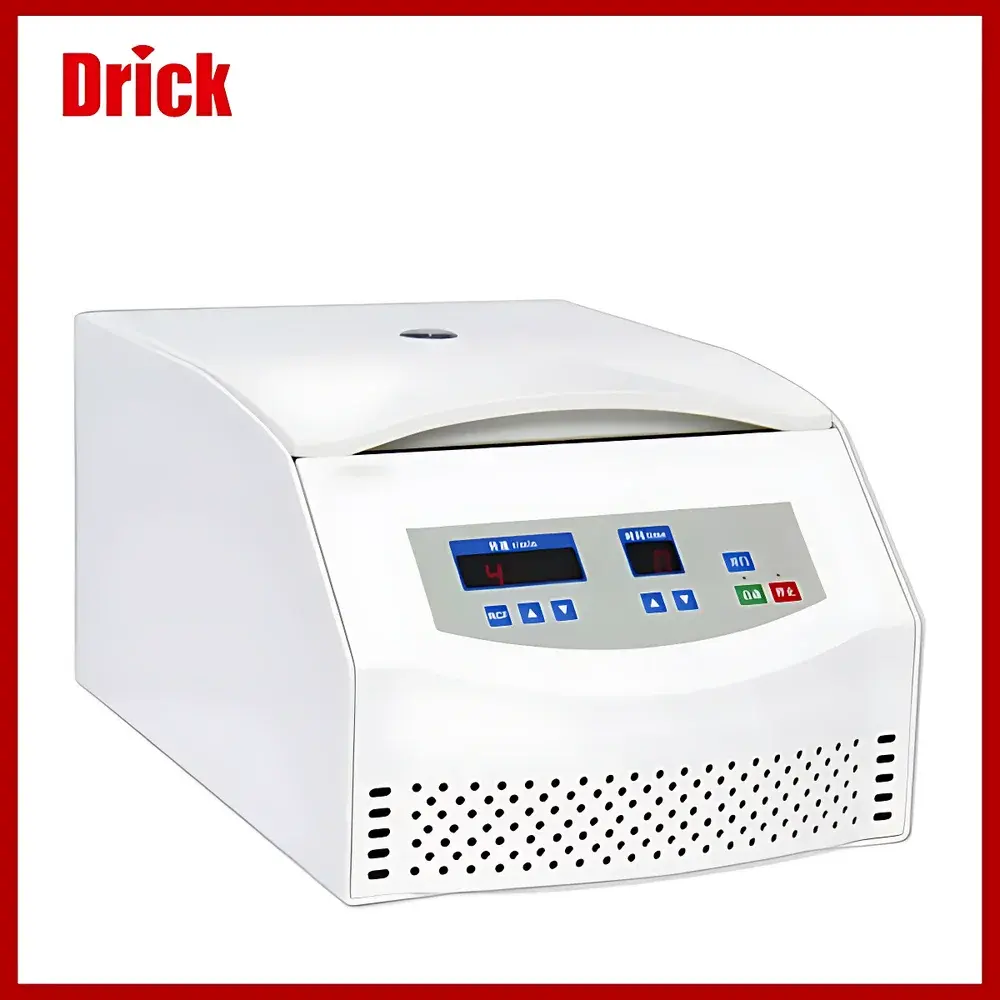
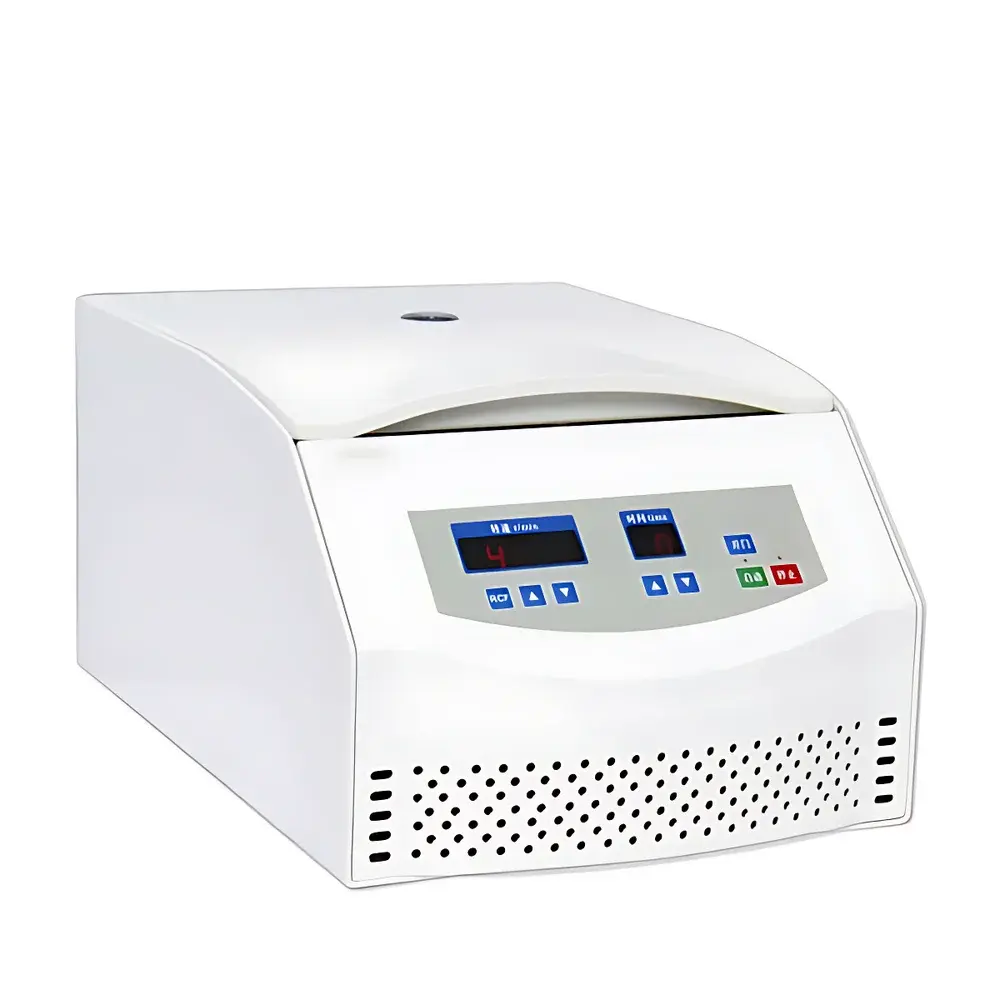
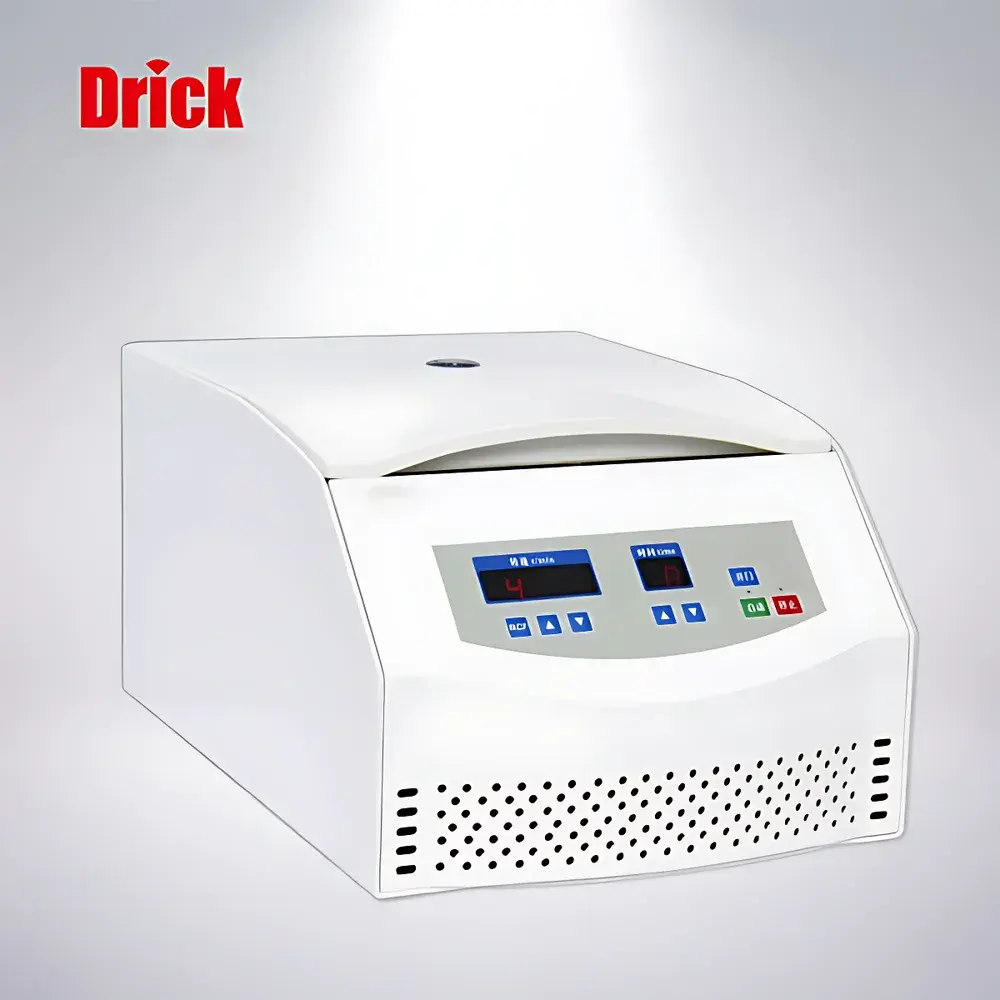
Drick DRK-TD4A Benchtop Low-Speed Centrifuge
| Brand | Drick |
|---|---|
| Origin | Shandong, China |
| Manufacturer Type | Original Equipment Manufacturer (OEM) |
| Product Category | Domestic |
| Model | DRK-TD4A |
| Instrument Type | Benchtop Centrifuge |
| Maximum Speed | 10,000 rpm |
| Maximum Relative Centrifugal Force (RCF) | 2390 × g |
| Rotor Configuration | Fixed-Angle Rotor |
| Dimensions (W×D×H) | 485 × 320 × 255 mm |
| Compliance | Designed to meet ISO 21501-4 and IEC 61010-1 safety standards for laboratory centrifuges |
Overview
The Drick DRK-TD4A Benchtop Low-Speed Centrifuge is an engineered solution for routine separation tasks in chemistry, physics, and general-purpose laboratories. Operating on the principle of sedimentation under controlled centrifugal force, this instrument separates heterogeneous mixtures—such as suspensions, emulsions, and cell lysates—based on particle density, size, and shape. With a maximum rotational speed of 10,000 rpm and a peak RCF of 2390 × g, the DRK-TD4A delivers reproducible performance across a wide operational range suitable for preparative applications including blood component separation, precipitate recovery, polymer clarification, and particulate settling studies. Its compact benchtop footprint (485 × 320 × 255 mm) ensures compatibility with standard laboratory workspaces while maintaining structural rigidity and vibration-dampened operation.
Key Features
- Robust brushless DC motor with closed-loop speed control, ensuring stable rotational accuracy within ±20 rpm across the full speed range (300–10,000 rpm)
- Fixed-angle rotor configuration optimized for high-throughput sample processing; compatible with common tube formats including 15 mL and 50 mL conical centrifuge tubes
- Microprocessor-based control system with real-time display of speed, time, and RCF; programmable run profiles with up to 9 user-defined protocols
- Automatic rotor recognition and imbalance detection system compliant with IEC 61010-1 mechanical safety requirements
- Double-layer reinforced polycarbonate lid with integrated safety interlock; certified for continuous operation under ambient laboratory conditions (15–35 °C, <80% RH)
- Thermally insulated housing minimizing heat generation during extended runs, supporting temperature-sensitive biological and chemical samples
Sample Compatibility & Compliance
The DRK-TD4A accommodates standard polypropylene and polycarbonate centrifuge tubes (up to 50 mL capacity), as well as microcentrifuge tubes (0.2–2.0 mL) when used with optional adapters. It supports both aqueous and organic solvent-based matrices, including buffered saline solutions, ethanol/water mixtures, and dilute acid/base suspensions. The unit conforms to ISO 21501-4 for particle size distribution instrumentation referencing, and its electrical design complies with IEC 61010-1:2012 for laboratory equipment safety. While not classified as a GLP/GMP-certified device per se, its programmable memory, audit-ready run logs, and consistent mechanical output support traceability in regulated environments such as QC labs operating under ISO/IEC 17025 or internal SOP frameworks.
Software & Data Management
The DRK-TD4A operates via embedded firmware without external PC dependency. All run parameters—including speed, time, acceleration/deceleration ramps, and RCF—are stored locally in non-volatile memory. Each completed run generates a timestamped record containing start/stop time, actual speed deviation, and total runtime. These logs are exportable via USB interface (standard Type-A port) in CSV format for integration into LIMS or laboratory documentation systems. Though no proprietary software suite is required, the device supports basic CSV parsing tools commonly used in academic and industrial QA/QC workflows. For facilities requiring FDA 21 CFR Part 11 compliance, third-party electronic lab notebook (ELN) platforms may be configured to ingest exported log files with appropriate metadata tagging and user authentication.
Applications
- Preparative isolation of erythrocytes, leukocytes, and platelets from whole blood in clinical research settings
- Sedimentation analysis of colloidal dispersions and nanoparticle suspensions in materials science labs
- Removal of insoluble catalyst residues following organic synthesis reactions
- Clarification of enzyme-containing supernatants prior to chromatographic analysis
- Standardized particulate recovery in environmental water testing protocols (e.g., ASTM D3556 for suspended solids)
- Routine quality control of polymer emulsions and latex formulations in R&D and production labs
FAQ
What is the maximum tube capacity supported by the standard rotor?
The fixed-angle rotor accepts up to six 50 mL conical tubes or twelve 15 mL tubes per run.
Does the DRK-TD4A support refrigerated operation?
No—this is a non-refrigerated benchtop model intended for ambient-temperature applications only.
Is rotor balancing required before each run?
Yes—manual balancing using matched tube mass is mandatory; the unit includes imbalance detection but does not auto-compensate.
Can custom rotors be installed?
Only Drick-certified fixed-angle rotors designed specifically for the DRK-TD4A platform are approved for use.
What maintenance intervals are recommended?
Annual inspection of drive coupling, rotor threads, and lid latch mechanism is advised; rotor lifetime is rated at 10,000 cycles or 5 years, whichever occurs first.



