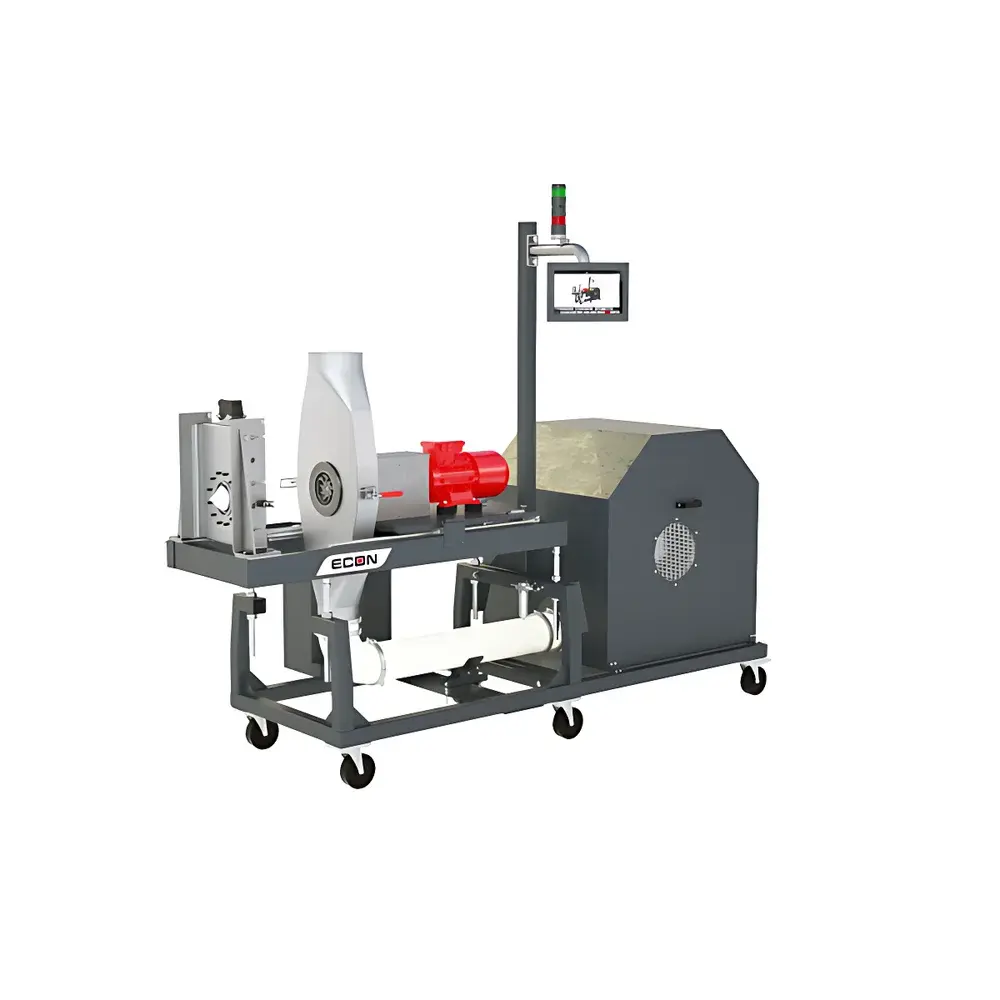
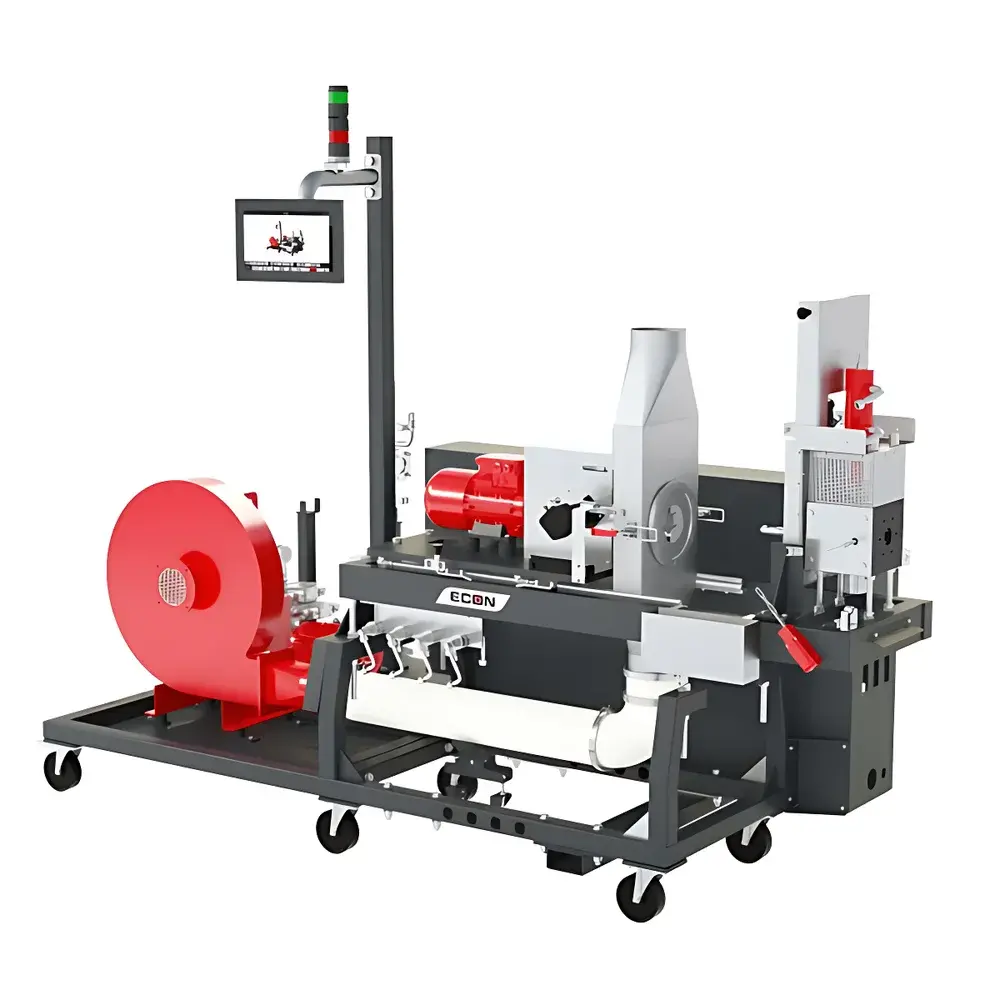
ECON ELG Air Pelletizing System and EWA Water & Air Pelletizing System
| Brand | ECON |
|---|---|
| Origin | Austria |
| Model | ELG, EWA |
| Type | Air Pelletizing System / Combined Underwater & Air Pelletizing System |
| Application Focus | Wood-Plastic Composites (WPC), Natural Fiber-Reinforced Polymers, PVC, Thermoplastics |
| Cooling Medium | Compressed air (ELG) |
| System Architecture | Modular, Lab-Scale to Pilot-Scale Configurable |
| Compliance Context | Designed for GLP-aligned lab environments |
| Software Interface | Manual operation with pneumatic/hydraulic actuation controls |
Overview
The ECON ELG Air Pelletizing System and its dual-mode counterpart, the EWA Water & Air Pelletizing System, are engineered specifically for thermoplastic compounds with high moisture sensitivity, low thermal mass, or structural fragility—particularly wood-plastic composites (WPC), natural fiber-reinforced polymers, and rigid PVC formulations. Unlike conventional underwater pelletizing (UWP) systems that rely on water immersion for cooling and conveying, the ELG employs a controlled stream of conditioned compressed air to simultaneously cool extrudate strands and transport cut pellets away from the die face. This eliminates post-cutting drying steps, which—especially in WPC processing—often fail to reduce residual moisture below 0.3 wt%, leading to agglomeration, mold growth during storage, or compromised downstream compounding performance. The ELG’s die-face cutting zone incorporates an integrated thermal insulation layer that maintains a stable, sub-ambient surface temperature without condensation risk, ensuring clean, discrete pellet formation free from stringing or cold-flow adhesion. The EWA variant extends this architecture by integrating a rapid-switch manifold system, enabling full operational conversion between air and underwater modes within under five minutes—without tooling changes or recalibration.
Key Features
- Die-face air-cooling architecture with thermally insulated cutting chamber for consistent pellet morphology and minimal thermal shock
- Modular pneumatic conveying path optimized for low-density, hygroscopic, or fibrous pellets—reducing attrition and static charge buildup
- EWA dual-mode design supports both air and underwater pelletizing via interchangeable flow manifolds and sealed die plate interfaces
- Tool-less mode transition: mechanical reconfiguration completed manually in ≤4 minutes; no firmware reset or sensor recalibration required
- Compact footprint (standard lab configuration: 1.2 m × 0.8 m × 1.6 m H) suitable for extrusion pilot lines and R&D facilities with space constraints
- Stainless-steel wetted components (EWA) compliant with FDA 21 CFR 177.2400 for food-contact polymer applications
Sample Compatibility & Compliance
The ELG and EWA systems accommodate strand diameters from 1.5 mm to 4.0 mm and support nominal throughput ranges of 5–60 kg/h—optimized for laboratory-scale formulation development and pre-commercial validation. They are validated for use with cellulose-based fillers (e.g., wood flour, bamboo fibers), mineral-filled PVC, PLA, PP, and PE matrices exhibiting melt viscosities between 200–5,000 Pa·s at 190 °C. Both systems conform to mechanical safety requirements per EN ISO 13857 and electrical safety per EN 60204-1. For regulated environments, the EWA’s water circuit can be configured with conductivity monitoring and temperature logging (±0.5 °C accuracy) to support GLP audit trails. While not intrinsically rated for ATEX Zone 21, optional inert gas purging kits are available for processing combustible wood flour blends.
Software & Data Management
The base ELG/EWA configuration operates via manual valve banks and analog pressure gauges. Optional digital instrumentation includes a PLC-controlled air pressure regulator (0.2–0.8 MPa range), real-time strand temperature monitoring via embedded K-type thermocouples (±1.5 °C), and Ethernet-enabled data logging (Modbus TCP) for time-stamped records of air flow rate, cutting frequency, and motor current draw. All logged parameters comply with ALCOA+ principles when exported to CSV or integrated with LIMS platforms. No proprietary software license is required; configuration files are human-readable XML and editable offline.
Applications
- R&D of moisture-sensitive biocomposites where residual water content must remain <0.25 wt% to prevent hydrolytic degradation during storage
- Process window mapping for natural fiber loading levels >40 wt%—where underwater quenching induces interfacial debonding
- PVC compound optimization requiring minimal thermal gradient across pellet cross-section to avoid internal stress cracking
- Multi-formulation screening in shared lab infrastructure: one EWA unit replaces two dedicated UWP and air-pelletizing stations
- Validation of pellet integrity per ISO 17892-10 for geosynthetic reinforcement granules used in civil engineering applications
FAQ
Can the EWA system operate continuously in both air and water modes?
Yes—provided the die plate, cutter assembly, and conveying duct are cleaned and inspected between mode transitions. Continuous mixed-mode operation is not supported.
What is the minimum strand diameter supported by the ELG system?
1.5 mm, using standard 12-hole die plates; custom multi-hole configurations down to 0.8 mm are available upon request.
Is the air supply required to be dried and filtered?
Yes—ISO 8573-1 Class 3:4:3 compressed air (dew point ≤ −20 °C, particle ≤ 5 µm, oil ≤ 0.1 mg/m³) is mandatory to prevent nozzle clogging and ensure stable pellet trajectory.
Does the system include pellet size classification capability?
No—size classification is performed offline using vibratory sieves or air-classification units; the ELG/EWA outputs as-cut pellets only.
Are spare parts and technical documentation available in English?
Yes—full OEM technical manuals, exploded diagrams, and certified spare parts lists are supplied in English with every system shipment.