ECON ESD Discontinuous Screen Changer
| Brand | ECON |
|---|---|
| Origin | Austria |
| Model | ESD |
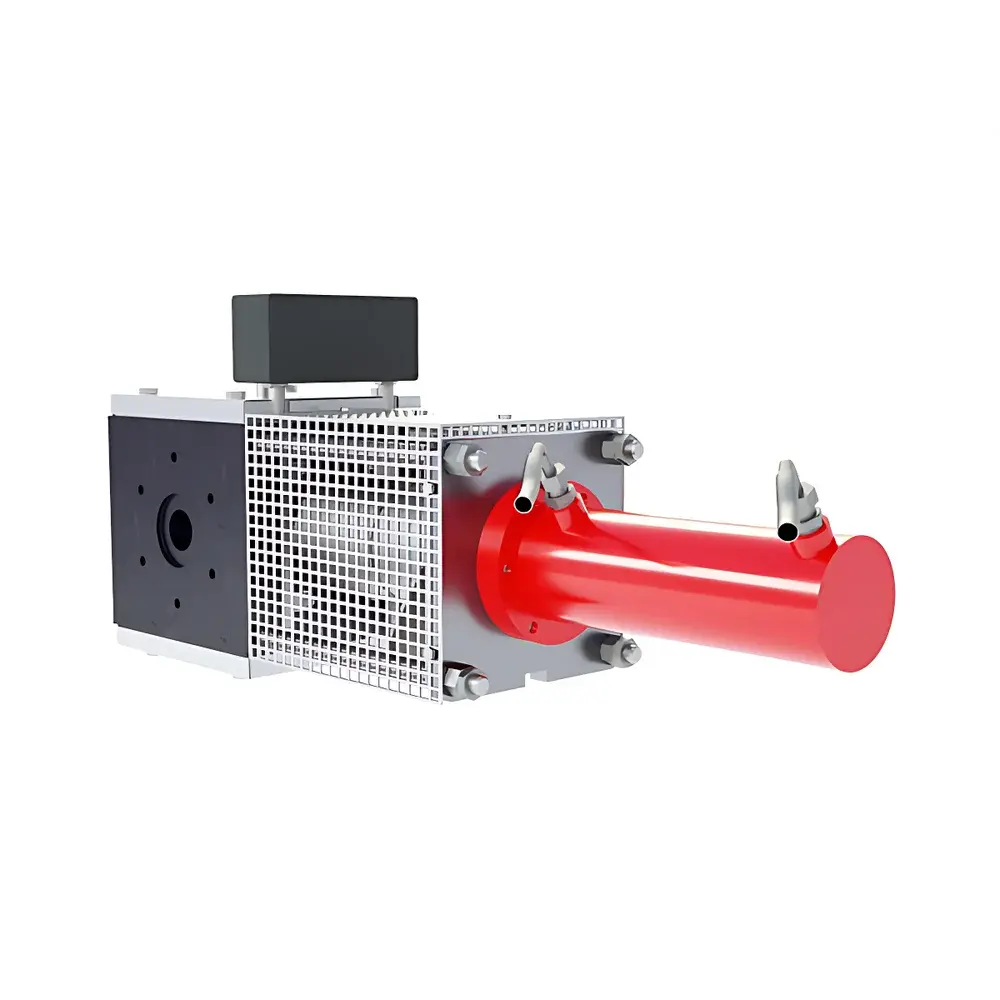
| Type | Hydraulic Discontinuous Screen Changer for Polymer Extrusion |
| Screening Area Efficiency | ~65% |
| Throughput Range | 1 kg/h to 2500 kg/h |
| Cooling Configuration | Air-cooled piston tip (ETS variant for low-viscosity melts) |
| Compliance | Designed for ISO 9001-compliant extrusion lines |
Overview
The ECON ESD is a hydraulically actuated discontinuous screen changer engineered specifically for precision polymer extrusion processes where melt integrity, operational safety, and material compatibility are critical. Unlike continuous or rotating screen changers, the ESD operates exclusively during planned machine stops—ensuring zero risk of melt leakage, pressure surges, or cross-contamination between screen changes. Its core mechanism relies on a robust, axially translating piston that carries a pre-assembled screen pack out of the melt stream for manual replacement. This design eliminates dynamic sealing challenges inherent in high-shear, high-temperature environments and is particularly suited for thermally sensitive or low-viscosity polymers such as polyethylene terephthalate (PET), polyamide (PA), and certain engineering resins. The ESD’s flow-path geometry is optimized using computational fluid dynamics (CFD) to minimize pressure drop across the screening zone—typically less than 1.2 bar at rated throughput—thereby reducing thermal degradation, preserving molecular weight distribution, and extending screen life.
Key Features
- Hydraulic piston drive system with position feedback and pressure monitoring for repeatable, force-controlled screen ejection
- Optimized melt channel geometry delivering ≤65% effective screening area while maintaining low ΔP (<1.2 bar at 2500 kg/h)
- Modular screen housing compatible with standard 30–150 µm mesh configurations and multi-layer filter packs (e.g., coarse/fine/coarse)
- ETS variant available with integrated air-cooling at the piston tip—preventing melt seepage during dwell time for PET, PA, and other low-melt-strength materials
- Stainless steel construction (AISI 316L contact surfaces) with hardened guide sleeves for long-term dimensional stability under cyclic thermal loading
- Designed for integration with PLC-based extruder control systems via standard 4–20 mA and digital I/O interfaces
Sample Compatibility & Compliance
The ECON ESD supports thermoplastic melts with viscosity ranges from 10² to 10⁴ Pa·s at processing temperatures up to 320 °C. It is routinely deployed in compounding lines handling PET bottle flake regrind, glass-filled PA6/66, TPU elastomers, and flame-retardant ABS formulations. All wetted components comply with EU Regulation (EC) No. 1935/2004 for food-contact plastics when used with certified screen media. The unit meets mechanical safety requirements per EN ISO 13857 and is supplied with CE documentation verifying conformity with the Machinery Directive 2006/42/EC. Optional ATEX-certified hydraulic power units are available for use in Zone 2 explosive atmospheres.
Software & Data Management
While the ESD itself is a hardware-integrated mechanical device without embedded firmware, its operation is fully traceable within modern extrusion control architectures. When interfaced with Siemens SIMATIC S7 or Rockwell ControlLogix PLCs, screen change events—including piston position, hydraulic pressure, cycle duration, and timestamp—are logged into the plant MES via OPC UA. Audit trails support GLP/GMP compliance in regulated sectors (e.g., medical-grade compound production). Screen usage history can be correlated with melt pressure trends and torque data to optimize preventive maintenance intervals and validate batch consistency per ASTM D3835 and ISO 11443.
Applications
- Recycled PET flake purification lines requiring frequent screen changes due to high contaminant load
- Engineering plastic compounding where carbon black dispersion or mineral filler homogeneity must be preserved across batches
- Medical tubing extrusion using USP Class VI-compliant resins—where screen integrity directly impacts particulate limits per USP
- Low-volume specialty polymer development (1–50 kg/h), where cost-effective screening flexibility outweighs the need for continuous operation
- Lab-scale twin-screw extruders (e.g., Thermo Scientific HAAKE MiniLab) equipped with modular die adapters
FAQ
Does the ESD require full extruder shutdown for every screen change?
Yes—screen replacement occurs only during intentional process stoppages. This ensures zero melt bypass and eliminates the risk of unmelted contaminants entering downstream tooling.
Can the ESD handle abrasive fillers such as calcium carbonate or talc?
Yes, provided screen packs include wear-resistant stainless steel backing meshes and the piston seal system is serviced per ECON’s 500-hour maintenance schedule.
Is remote diagnostics supported?
Not natively—but hydraulic pressure transducers and limit switches are wired to standard I/O terminals, enabling third-party SCADA integration for real-time status monitoring.
What is the typical lead time for spare screen housings and piston seals?
Standard spare parts are stocked in ECON’s Vienna warehouse and shipped globally within 5 business days under standard terms.
How does the ETS variant differ thermally from the base ESD model?
The ETS incorporates a dedicated compressed-air manifold routed to the piston’s distal face, maintaining surface temperature below 120 °C—even during extended dwell periods at 280 °C melt temperature—thus preventing viscous creep and seal failure.