
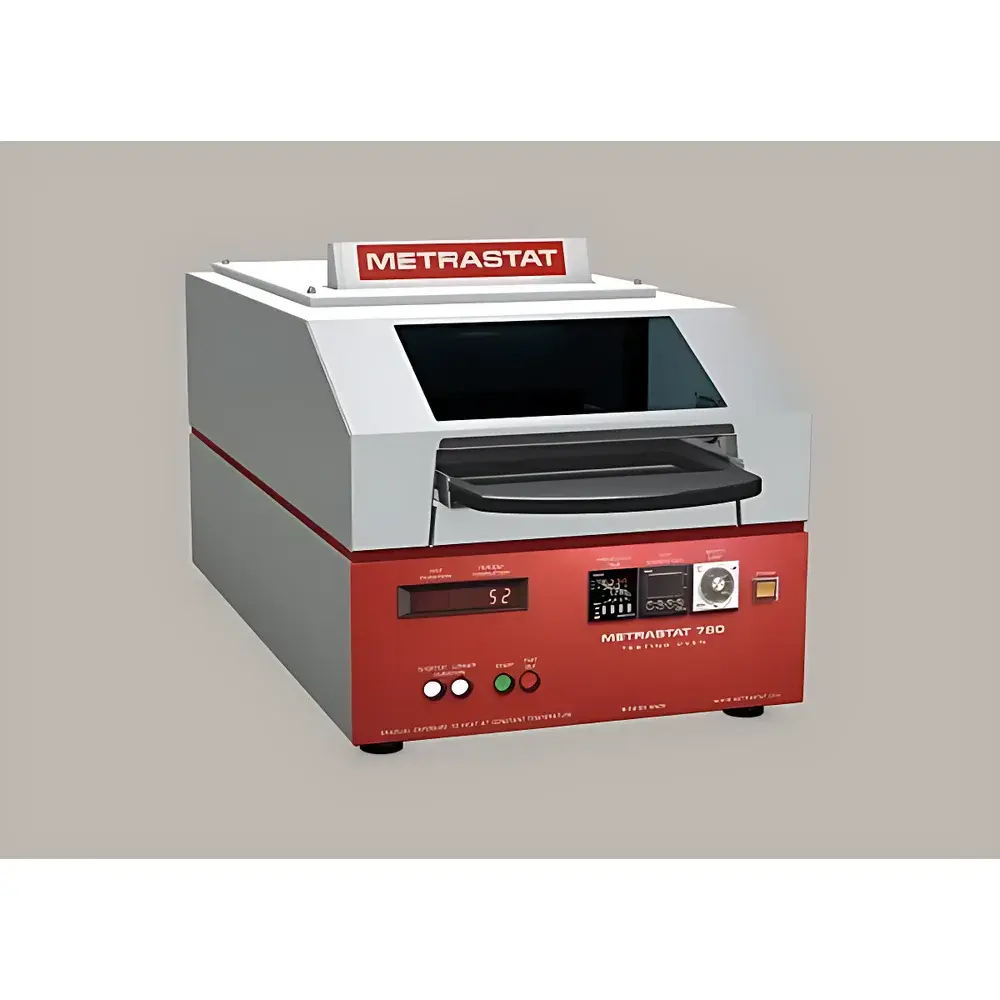
METRASTAT 780 Automated Polymer Thermal Exposure Test Chamber (DIN 5381F / AFNOR T51-224 Compliant)
| Origin | Germany |
|---|---|
| Manufacturer Type | Authorized Distributor |
| Origin Category | Imported |
| Model | METRASTAT 780 |
| Price | Upon Request |
| Max Temperature | 200–300 °C |
| Temperature Range | 50–300 °C ±1% |
| Heating Power | 2400 W (12 × 200 W elements) |
| Heating Rate | RT → 300 °C in ~10 min |
| Sample Capacity | 10 positions (260 × 12 × 6 mm trays) |
| Preheat Duration | Adjustable from 1 min to unlimited |
| Test Duration | Programmable from 1 min to 32 days |
| Dimensions (W×H×L) | 450 × 400 × 790 mm |
| Weight | 61 kg |
| Construction Material | 316L stainless steel |
| Control Sensor | Pt1000 RTD |
| Power Supply | 185–245 VAC, 48–62 Hz |
Overview
The METRASTAT 780 is a precision-engineered, fully automated thermal exposure test chamber designed specifically for standardized stepwise thermal aging of polymeric materials under controlled, reproducible conditions. It implements the sequential heating protocols defined in DIN 5381F (“Testing of plastics — Determination of thermal stability by stepwise heating”) and AFNOR T51-224 (“Plastics — Thermal degradation testing — Stepwise temperature increase method”). Unlike general-purpose ovens or environmental chambers, the METRASTAT 780 integrates closed-loop thermal control, programmable exposure sequencing, and real-time sample progression monitoring—enabling laboratories to quantify polymer degradation kinetics, onset temperatures of volatilization, and time-temperature superposition behavior with metrological traceability. Its operational principle relies on precise ramp-and-hold thermal profiling, where specimens undergo successive isothermal exposures at incrementally elevated temperatures—each stage timed and logged autonomously. This methodology supports predictive lifetime modeling (e.g., Arrhenius extrapolation) and comparative evaluation of stabilizer efficacy across formulations.
Key Features
- 316L stainless steel construction ensures long-term resistance to halogenated acid vapors (e.g., HCl, HBr) and high-humidity tropical environments—critical for testing flame-retarded polymers and cable insulation materials.
- 10-position non-stick, corrosion-resistant sample carrier system with standardized 260 × 12 × 6 mm trays—designed to prevent cross-contamination and ensure uniform convective heat transfer across all specimens.
- Microprocessor-based temperature controller with Pt1000 platinum resistance thermometer feedback, delivering ±1% accuracy across the full 50–300 °C operating range.
- Dynamic thermal protocol engine: automatically transitions from static preheating (user-defined duration) to dynamic multi-step heating sequences—including dwell times, ramp rates, and termination criteria—all programmable via front-panel interface.
- Persistent on-screen display showing real-time chamber temperature, elapsed time per step, cumulative exposure duration, and active test phase—supporting unattended operation over extended periods (up to 32 days).
- Modular heating architecture comprising twelve 200 W resistive elements arranged in series—ensuring rapid, uniform thermal response (RT → 300 °C in approximately 10 minutes) and stable thermal homogeneity (< ±2 °C across load zone).
Sample Compatibility & Compliance
The METRASTAT 780 accommodates standard flat-strip polymer specimens conforming to DIN 5381F geometry requirements. Its chamber volume and airflow design comply with ISO 2578 (plastics — determination of time-temperature relationships) and support validation against ASTM D3045 (standard practice for heat aging of plastics). The 316L enclosure meets EN 61000-6-3 (EMC immunity) and is compatible with GLP-compliant laboratory infrastructure. While not certified as explosion-proof, its sealed construction and halogen-resistant materials make it suitable for use with thermally unstable halogenated polymers when operated within specified safety margins. No internal fans or moving parts contact samples—eliminating mechanical stress artifacts during aging.
Software & Data Management
The integrated controller logs timestamped temperature data at user-selectable intervals (1–60 seconds) to non-volatile memory. Export is supported via USB port in CSV format for post-test analysis in MATLAB, Excel, or statistical process control (SPC) platforms. Audit trails record operator ID (if networked), parameter changes, and alarm events—facilitating compliance with FDA 21 CFR Part 11 requirements when paired with validated LIMS integration. Firmware supports firmware version tracking and calibration certificate linkage. No proprietary software installation is required; raw data files are human-readable and compatible with ISO/IEC 17025 accredited reporting workflows.
Applications
- Thermal stability ranking of engineering thermoplastics (e.g., PBT, PPS, PEI) and elastomers under accelerated aging conditions.
- Evaluation of antioxidant and heat stabilizer performance in PVC, polyolefins, and fluoropolymers.
- Pre-normative development work aligned with IEC 60216 (electrical insulating materials) and UL 746B (polymeric materials for electrical equipment).
- Supporting failure analysis of automotive interior components exposed to dashboard-level thermal cycling.
- Generating input data for ISO 11359-2 (dynamic mechanical thermal analysis correlation) and ISO 13477 (thermal degradation modeling).
FAQ
Does the METRASTAT 780 support custom thermal profiles beyond DIN 5381F and AFNOR T51-224?
Yes—the controller allows user-defined multi-segment programs including variable ramp rates, dwell times, and conditional logic (e.g., hold until weight loss threshold detected via optional mass loss module).
Is calibration documentation included with shipment?
Each unit ships with a factory calibration certificate traceable to PTB (Physikalisch-Technische Bundesanstalt), covering sensor linearity, temperature uniformity mapping, and timing accuracy verification.
Can the chamber be integrated into an automated test lab network?
It features RS-485 Modbus RTU and optional Ethernet/IP interfaces for SCADA-level integration, enabling centralized scheduling, remote status monitoring, and event-triggered notifications.
What maintenance is required to sustain measurement integrity?
Annual verification of Pt1000 sensor drift and heater element resistance balance is recommended; no consumables or routine lubrication are required due to solid-state architecture.
Is the METRASTAT 780 compliant with CE and UKCA marking requirements?
Yes—it bears CE marking per Machinery Directive 2006/42/EC and EMC Directive 2014/30/EU, and UKCA marking is available upon request with UK-recognized notified body assessment.



