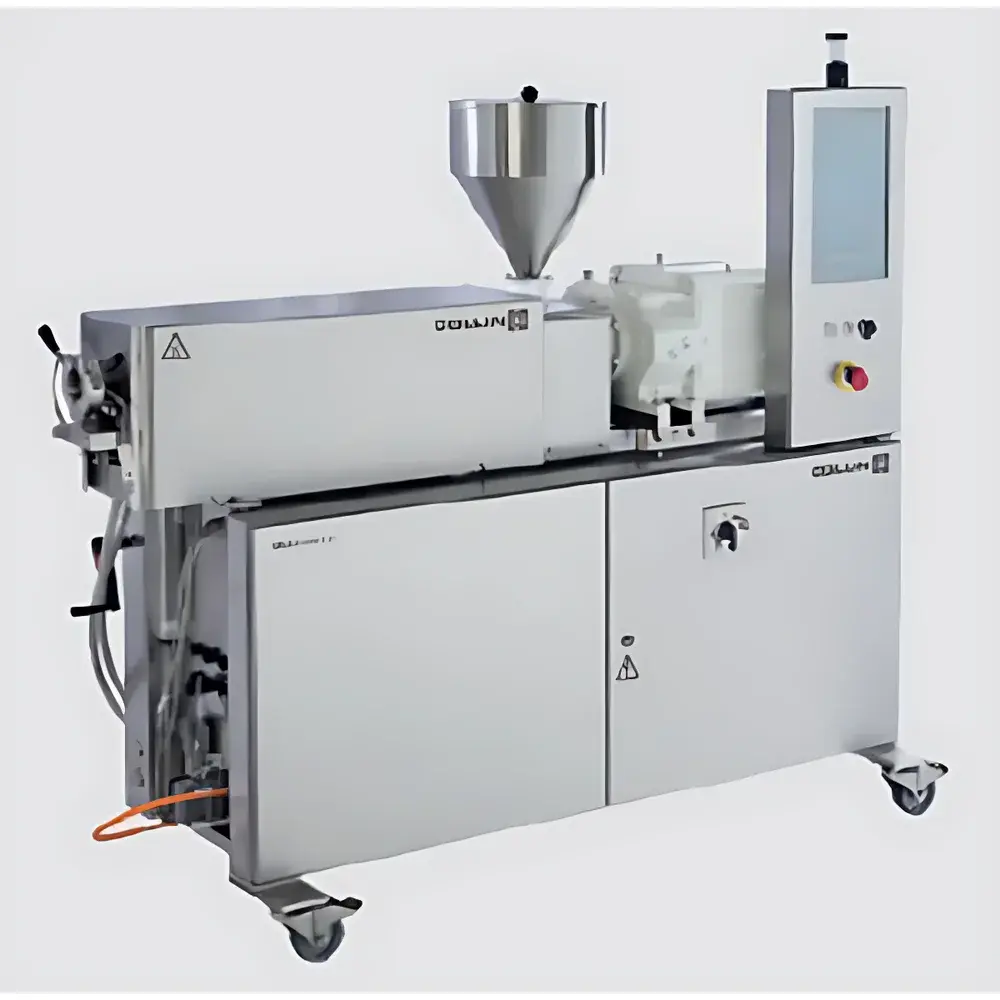
COLLIN E-Series Single-Screw Extruders for Food Applications
| Brand | COLLIN |
|---|---|
| Origin | Germany |
| Model Range | E 12 P, E 16 P, E 20 P, E 25 P, E 30 P, E 45 P, E 60 P |
| Screw Diameter | 12 mm to 60 mm |
| Dimensions (L×W×H) | 1330×680×1650 mm to 3100×1200×2000 mm |
| Drive | Compact gearmotor or high-torque motor |
| Feed Zone | Grooved, water-cooled via jacketed cooling sleeve |
| Barrel | Hydraulically height-adjustable processing unit |
| Temperature Control | Thermal oil heating (up to 250 °C), forced-air cooling, optional liquid cooling per ISO cleanroom requirements |
| Screw | Customer-specific design per material rheology and formulation |
| Hopper | Food-grade stainless steel (AISI 316) |
| Die Clamping Flange | Quick-connect, optionally heated |
| Electrical Cabinet | Mobile, integrated enclosure with PLC, I/O interfaces, main disconnect switch |
| Compliance | Designed to meet EU Machinery Directive 2006/42/EC, EC 1935/2004 for food contact materials, and hygienic design principles aligned with EHEDG Doc. Type A & FDA 21 CFR Part 110 |
Overview
The COLLIN E-Series Single-Screw Extruders are precision-engineered laboratory and pilot-scale extrusion systems specifically developed for R&D, formulation optimization, and small-batch production in the food industry. Operating on the fundamental principle of continuous shear-driven melt conveying and homogenization, these extruders enable controlled thermal-mechanical processing of thermoplastic food matrices—including pasta doughs, pet food formulations, aquafeed pellets, starch-based snacks, and gluten-free cereal blends. Each system integrates a modular barrel assembly, a hydraulically adjustable processing zone, and a fully configurable screw geometry to replicate industrial-scale extrusion behavior at reduced throughput—ensuring scalability from benchtop trials to commercial line validation. The E-Series complies with stringent hygienic design standards for food-contact equipment, including surface finish Ra ≤ 0.8 µm on all wetted parts, crevice-free construction, and full traceability of material certifications (EN 10204 3.1).
Key Features
- Food-grade construction throughout: AISI 316 stainless steel feed hopper, barrel cladding, and die interface; all elastomers compliant with EC 1935/2004 and FDA 21 CFR §177.2600
- Grooved feed throat with integrated water-cooling jacket ensures stable volumetric feeding of low-bulk-density or moisture-sensitive powders (e.g., dried fish meal, hydrolyzed protein blends)
- Modular barrel segments with independent thermal zones: heated via pressurized thermal oil (max. 250 °C) and cooled via forced-air blowers or optional closed-loop glycol circulation (ISO Class 7–8 compatible)
- Hydraulic height adjustment of the barrel assembly enables precise alignment with downstream equipment (e.g., vacuum degassing units, strand dies, or rotary cutters) without mechanical realignment
- Custom screw configurations—including conveying, mixing, melting, and venting elements—designed using torque-limiting profiles and axial clearance optimization to minimize thermal degradation of heat-labile nutrients (e.g., vitamins, probiotics, enzymes)
- Mobile electrical cabinet housing a CE-certified PLC (Siemens S7-1200), analog/digital I/O modules, safety-rated emergency stop circuitry, and EtherNet/IP communication for integration into centralized lab automation platforms
Sample Compatibility & Compliance
The E-Series accommodates a broad spectrum of food-grade feedstocks: wheat semolina, rice flour, pea protein isolates, microalgae biomass, insect meal, hydrocolloid blends (xanthan, guar, carrageenan), and pre-gelatinized starches. All wetted surfaces conform to EHEDG Guideline Doc. Type A (2022) for clean-in-place (CIP) compatibility and pass visual inspection per ISO 14644-1 Class 8 particle count thresholds when equipped with liquid cooling. Systems are supplied with full material declarations (RoHS, REACH SVHC), weld procedure specifications (WPS), and hygienic surface finish verification reports. Optional validation packages include IQ/OQ documentation aligned with GMP Annex 15 and FDA Process Validation Guidance (2011).
Software & Data Management
Extrusion parameters—including screw speed (0.1–300 rpm), barrel zone temperatures (±0.5 °C accuracy), motor torque (0.1 N·m resolution), melt pressure (up to 400 bar), and feed rate—are logged synchronously at 10 Hz via COLLIN’s proprietary ExtrusionLab software. The platform supports ASTM F2963-compliant audit trails, user-level access control (admin/operator/technician), electronic signature capture, and PDF report generation with embedded metadata (time stamps, operator ID, version-controlled SOP references). Data export formats include CSV, HDF5, and OPC UA for seamless ingestion into LIMS or MES environments. All firmware and software comply with FDA 21 CFR Part 11 requirements for electronic records and signatures.
Applications
- Pasta & noodle development: Optimization of gluten network formation, hydration kinetics, and die swell behavior across durum wheat, buckwheat, and legume-based formulations
- Pet food & aquafeed: Twin-screw simulation via segmented screw design; evaluation of starch gelatinization, protein denaturation, and lipid oxidation under controlled residence time distribution (RTD)
- Functional food manufacturing: Encapsulation of probiotics, omega-3 oils, or polyphenols using co-extrusion-capable die adapters and vacuum venting modules
- Gluten-free product scaling: Rheological profiling of high-fiber, low-viscosity batters using torque and pressure feedback to predict die output stability
- Novel ingredient integration: Processing of upcycled food streams (fruit pomace, spent grain, seaweed extracts) with minimal thermal exposure to preserve antioxidant activity
FAQ
What is the maximum allowable operating temperature for the barrel zones?
Thermal oil heating supports continuous operation up to 250 °C; short-term excursions to 280 °C are permissible with prior engineering review and enhanced cooling protocols.
Can the E-Series be validated for GMP-compliant pilot production?
Yes—COLLIN provides IQ/OQ protocols, calibration certificates traceable to PTB (Physikalisch-Technische Bundesanstalt), and FAT/SAT documentation packages upon request.
Is screw interchangeability supported across model sizes (e.g., E 20 P to E 30 P)?
No—each model features proprietary drive coupling geometry and barrel flange dimensions; however, COLLIN offers cross-model screw design libraries to accelerate scale-up studies.
Does the system support automated recipe management and batch reporting?
Yes—ExtrusionLab includes recipe templates with parameter constraints, version history, and automated compliance reporting per ISO 22000 Clause 8.5.2.
Are EHEDG-certified spare parts available for critical wear components?
All screws, bushings, and die inserts are manufactured to EHEDG Doc. Type A dimensional tolerances and supplied with surface roughness certification (Ra ≤ 0.4 µm on critical sealing surfaces).