
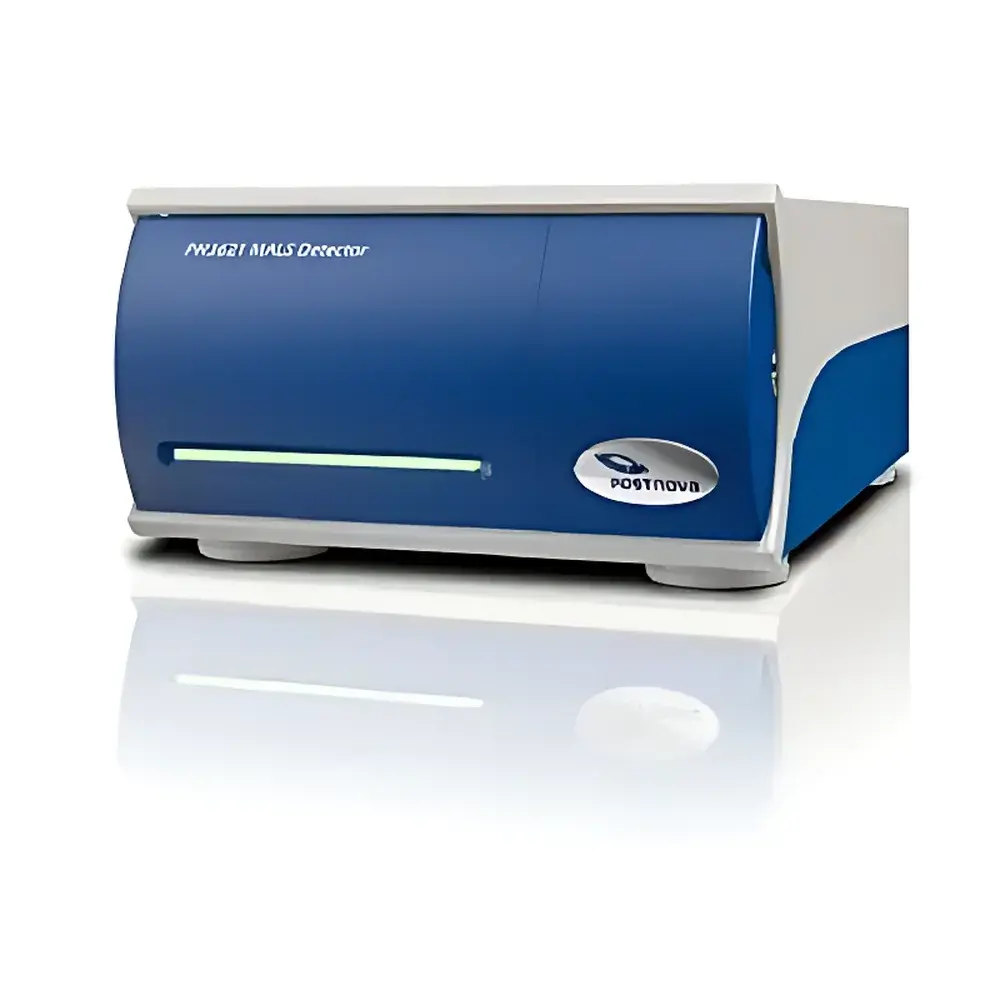
POSTNOVA PN3621 Crown 21 Multi-Angle Static Light Scattering (MALS) Detector
| Brand | POSTNOVA |
|---|---|
| Origin | Germany |
| Model | PN3621 |
| Detection Angles | 21 fixed angles (7° to 165°) |
| Configuration Options | Offline-only and Offline/Online Hybrid Modes |
| Compliance | Designed for integration with SEC/GPC, FFF, and HPLC systems |
Overview
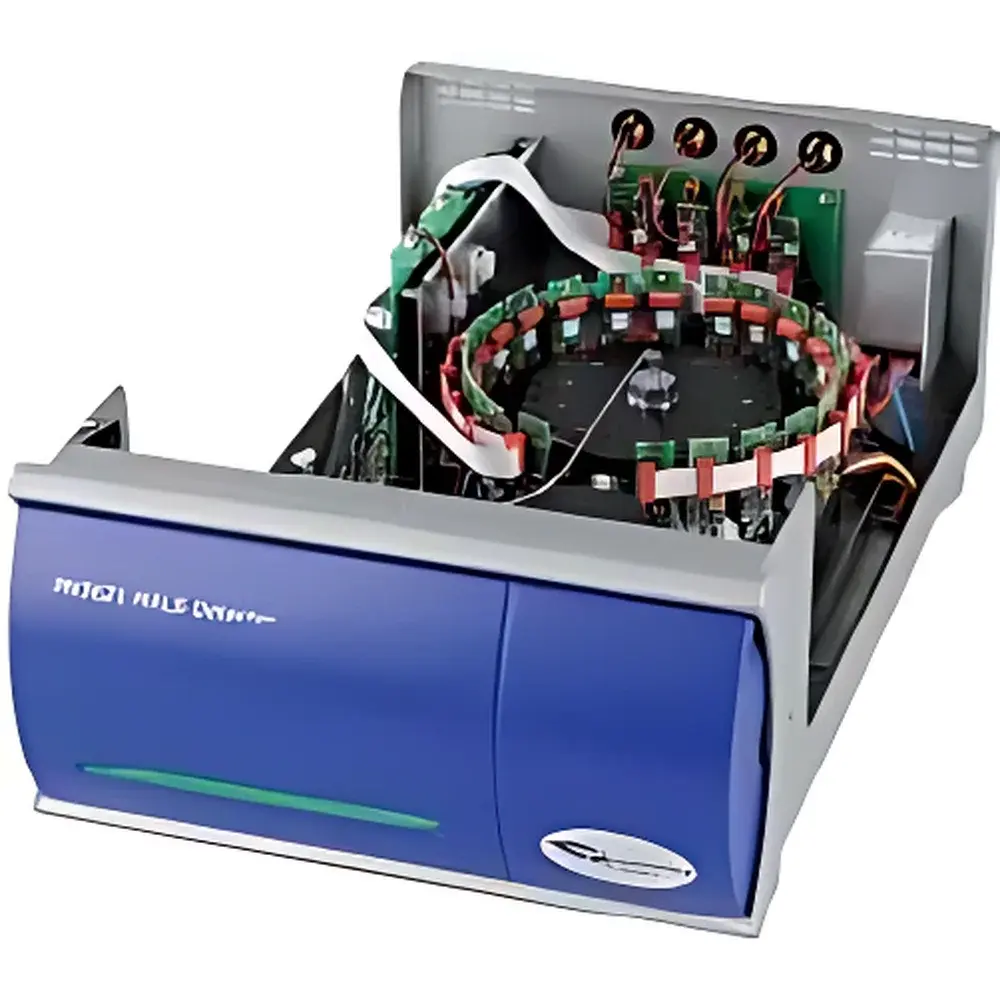
The POSTNOVA PN3621 Crown 21 is a second-generation multi-angle static light scattering (MALS) detector engineered for absolute molar mass, size (Rg), and conformational analysis of macromolecules and nanoparticles in solution. Unlike dynamic light scattering (DLS) or single-angle detectors, the PN3621 implements true static light scattering based on angular intensity distribution measurement across 21 precisely calibrated, fixed scattering angles—from 7° to 165°—enabling robust Debye, Zimm, and Berry plot generation without angular interpolation or mechanical movement. Its optical architecture eliminates moving parts, ensuring long-term angular fidelity and signal reproducibility critical for regulatory-compliant characterization under GLP or GMP environments. The detector operates at a stabilized 660 nm laser wavelength with thermally regulated optics, minimizing thermal drift and enabling sub-picoamp baseline stability over extended acquisition periods (>24 h). It is fully compatible with size-exclusion chromatography (SEC), field-flow fractionation (FFF), and high-performance liquid chromatography (HPLC) platforms as an online orthogonal detector, or functions autonomously in offline cuvette-based mode for batch sample analysis.
Key Features
- 21 fixed, factory-aligned scattering angles (7°, 12°, 17°, …, 165°) — no motorized goniometer, eliminating angular repeatability error and mechanical wear
- Thermally stabilized optical bench with active temperature control (±0.02 °C), ensuring <0.5% baseline drift over 8-hour continuous operation
- Low-noise, high-dynamic-range photodiode array with 12-bit digitization and hardware background subtraction
- Dual operational modes: standalone offline cuvette configuration and integrated online flow-cell configuration (compatible with 0.5–2.0 mm ID capillaries)
- Optimized for low-volume flow cells (2.5 µL path length) and high-sensitivity detection down to ~10 µg/mL for proteins and synthetic polymers
- Modular design supporting seamless integration with POSTNOVA AF4, SEC, or third-party chromatography data systems via analog voltage output and digital Ethernet interface
Sample Compatibility & Compliance
The PN3621 supports aqueous and organic solvent systems—including DMF, THF, chloroform, and DMSO—across refractive index ranges from 1.33 to 1.55. Its flow cell is constructed from fused silica and chemically resistant PEEK, validated for use with aggressive solvents and biological buffers. All firmware and data handling routines comply with FDA 21 CFR Part 11 requirements when deployed with POSTNOVA’s NovaSEC software (audit trail, electronic signatures, role-based access). The instrument meets ISO/IEC 17025 calibration traceability standards through NIST-traceable angular alignment verification and laser power certification. It is routinely employed in QC labs for USP , ASTM D6992, and ISO 13321-compliant particle sizing and polymer characterization workflows.
Software & Data Management
Controlled via NovaSEC v4.x software, the PN3621 provides real-time MALS data acquisition synchronized with UV, RI, or DLS signals. Software modules include automatic Rg/Mw calculation using first-order Zimm extrapolation, batch processing for multi-sample comparison, and export of raw intensity tables (I(θ)) in ASCII or HDF5 format for third-party analysis (e.g., ASTRA, CHROMIX, or custom Python/Matlab scripts). Audit trails record all parameter changes, calibration events, and user actions with timestamps and operator IDs. Data files are SHA-256 hashed and digitally signed to ensure integrity during regulatory submission (e.g., IND, BLA, or marketing authorization dossiers).
Applications
- Absolute molar mass determination of synthetic polymers (e.g., polyacrylamide, PEG, PMMA) without calibration standards
- Conformational analysis of biologics (mAbs, ADCs, fusion proteins) including aggregation state, branching ratio, and compactness (ρ = Rg/Rh)
- Characterization of virus-like particles (VLPs), liposomes, and lipid nanoparticles (LNPs) in formulation development
- Stability assessment under thermal, pH, or shear stress via time-resolved MALS coupled with FFF
- Validation of column calibration in SEC-GPC and correction of band broadening effects
- Reference-method support for ISO/IEC 17025-accredited testing laboratories
FAQ
What distinguishes the PN3621 from first-generation MALS detectors like the PN3607?
The PN3621 doubles the angular resolution (21 vs. 7 angles), replaces the stepper-motor goniometer with a fixed-optic array, improves thermal stability by >4×, and introduces dual-mode (offline/online) flexibility—significantly enhancing precision for Rg and low-Mw species.
Can the PN3621 be used without chromatography?
Yes—the offline cuvette mode supports direct batch analysis of purified samples, enabling rapid screening of molar mass distributions and conformational changes in stability studies.
Is the detector compatible with non-POSTNOVA separation systems?
Yes—standard analog outputs (0–1 V) and Ethernet-based TCP/IP communication enable integration with Agilent, Waters, Shimadzu, and Wyatt systems via configurable trigger and synchronization protocols.
Does the system support 21 CFR Part 11 compliance out-of-the-box?
When operated with NovaSEC v4.x and configured with user authentication, audit logging, and electronic signature modules, full Part 11 compliance is achieved—including secure data storage, change control, and retention policies.
What maintenance is required for long-term angular accuracy?
No routine recalibration is needed; angular alignment is factory-verified and mechanically locked. Annual performance verification using certified polystyrene latex standards (NIST SRM 1960) is recommended for GLP audits.



