
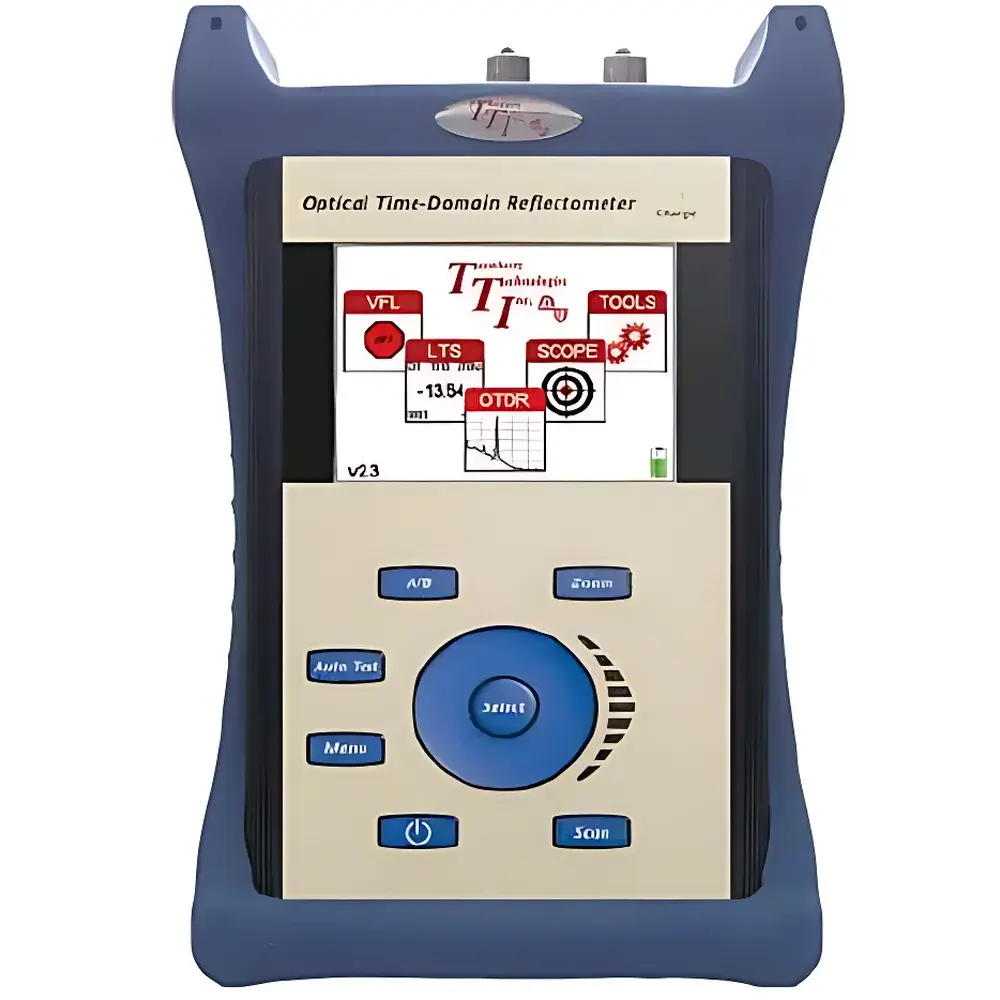
TTI FTE-7000 / FTE-7500 Optical Time-Domain Reflectometer
| Brand | TTI |
|---|---|
| Origin | USA |
| Model | FTE-7000 / FTE-7500 |
| Wavelengths | 850/1300 nm (MM), 1310/1550/1625 nm (SM), ±20 nm |
| Dynamic Range | 36 dB (SM, FTE-7000), 32 dB (SM, FTE-7500) |
| Event Dead Zone | 1 m (FTE-7000), 2 m (FTE-7500) |
| Attenuation Dead Zone | 4 m (FTE-7000), 5 m (FTE-7500) |
| Distance Uncertainty | ±(0.75 m + 0.005% × distance + sampling resolution) |
| Sampling Resolution | 0.125–32 m (FTE-7000), 0.25–64 m (FTE-7500) |
| Measurement Range | Up to 240 km (SM) |
| Storage Capacity | 1000 traces |
| Display | 4-inch color touchscreen |
| Battery Life | 10 hr (FTE-7000), 8 hr (FTE-7500) |
| Operating Temperature | –10 °C to +50 °C |
| Compliance | IEC 61300-3-35 (connector inspection), Telcordia GR-196-CORE, SR-4731 |
Overview
The TTI FTE-7000 and FTE-7500 Optical Time-Domain Reflectometers (OTDRs) are field-deployable, precision instruments engineered for characterization, troubleshooting, and certification of optical fiber links in telecommunications, enterprise networks, and FTTx infrastructure. Based on the principle of backscattered light analysis—specifically Rayleigh scattering and Fresnel reflections—these OTDRs inject calibrated laser pulses into the fiber under test and analyze the time-resolved return signal to quantify attenuation, locate splices, connectors, bends, and breaks, and determine overall link integrity. Both models support multimode (850/1300 nm) and single-mode (1310/1550/1625 nm) operation with wavelength-accurate ±20 nm tolerance, enabling compliance with industry-standard test methodologies defined in ITU-T G.652, G.655, and IEC 61280-4-1. The FTE-7000 delivers up to 36 dB dynamic range for high-loss or extended-reach SM deployments, while the FTE-7500 offers optimized responsiveness (sub-second trace refresh) and robustness for rapid fault isolation in live network maintenance.
Key Features
- 4-inch high-resolution color touchscreen interface with intuitive icon-driven navigation and context-sensitive on-screen help
- Integrated video inspection system compliant with IEC 61300-3-35 pass/fail connector grading; captured images embed directly into trace reports
- AutoTest mode: automatically selects optimal pulse width, range, and averaging parameters based on fiber type and length, reducing operator dependency
- Real-time trace update rate of 4 Hz—enabling live observation of splice optimization or bend-induced loss during installation
- Short event dead zone (1 m for FTE-7000; 2 m for FTE-7500) and low attenuation dead zone (4–5 m), critical for dense patch panel or splitter testing
- Dual-port connectivity: USB Type-A host port for flash drive export and mini-USB device port for PC synchronization and firmware updates
- Embedded VFL (Visual Fault Locator) at 650 nm for quick macro-bend or break identification without external tools
- Ruggedized magnesium alloy chassis with IP52-rated rubber overmold, tested to MIL-STD-810G for shock, vibration, and thermal cycling
Sample Compatibility & Compliance
The FTE-7000 and FTE-7500 support universal connector adaptability via field-replaceable FC, ST, and SC interfaces, accommodating both SM and MM fiber geometries (including OM1–OM5 and OS1–OS2). Integrated power meter functionality (InGaAs detector, –77 dBm to +5 dBm, ±0.18 dB uncertainty at reference conditions) enables simultaneous end-to-end loss verification per IEC 61280-2-9. All trace analysis—including event detection, loss calculation, and reflectance quantification—adheres to Telcordia GR-196-CORE and SR-4731 reporting conventions. Video inspection outputs conform to IEC 61300-3-35 grading zones (Core, Cladding, Ferrule), with image metadata (timestamp, fiber ID, operator tag) preserved in CertSoft-generated PDF reports. Device firmware and data handling comply with GLP-aligned audit trail requirements, supporting user-defined password protection and timestamped file versioning.
Software & Data Management
CertSoft—a Windows-based analysis and reporting suite—is included with each unit and fully compatible with Telcordia SR-4731 templates. It supports multi-trace overlay comparison, automated pass/fail evaluation against user-defined thresholds (e.g., splice loss < 0.05 dB, reflectance < –40 dB), and synchronized annotation of connector images with corresponding OTDR events. Projects are managed hierarchically: parameter sets (refractive index, pulse width, threshold limits) are saved per job folder, ensuring repeatability across technicians and sites. Trace files (.trc) retain full raw sampling data (up to 256k points), enabling post-acquisition re-analysis without retesting. USB mass storage mode allows direct drag-and-drop export of reports (PDF, CSV, XML) and trace archives; no proprietary drivers required. CertSoft also exports to industry-standard formats including SOR (Standard OTDR Result) and .sor-compatible databases used in OSS/BSS platforms.
Applications
- Pre-commissioning certification of OSP and indoor fiber runs per ANSI/TIA-568.3-D and ISO/IEC 14763-3
- Live-network troubleshooting: rapid isolation of macrobends, crushed cables, or degraded splices using real-time trace overlay
- Fiber characterization in data centers—especially for high-density MPO/MTP trunks where short dead zones are essential
- FTTH drop cable validation, including splice loss verification at distribution points and terminal boxes
- Contractor acceptance testing with auditable, timestamped reports containing embedded video evidence and CertSoft-certified metrics
- Training and education: built-in screen tutorials and guided workflows reduce learning curve for new technicians
FAQ
What wavelengths are supported, and how is wavelength selection handled?
The FTE-7000 supports 850/1300 nm (MM), 1310/1550/1625 nm (SM), and quad-wavelength configurations. The FTE-7500 supports identical bands. Wavelength selection is manual or auto-detected when paired with compatible TTI 1500-series light sources.
Does the device meet Telcordia GR-196 requirements for field OTDRs?
Yes—both models implement event detection algorithms, loss measurement linearity (±0.05 dB/dB), and reporting structures aligned with GR-196-CORE Annex A and SR-4731 Appendix B.
Can trace files be exported without CertSoft?
Yes—via USB mass storage mode, traces (.trc) and images (.jpg) are accessible as standard files; however, advanced analysis and compliance reporting require CertSoft.
Is battery replacement user-serviceable?
No—the Li-ion battery is sealed and field-replaceable only by authorized service centers to maintain IP52 integrity and calibration traceability.
How is measurement uncertainty quantified per standard practice?
Distance uncertainty follows the formula ±(0.75 m + 0.005% × distance + sampling resolution), consistent with IEC 61280-4-1 Clause 7.3 for OTDR calibration verification.





