
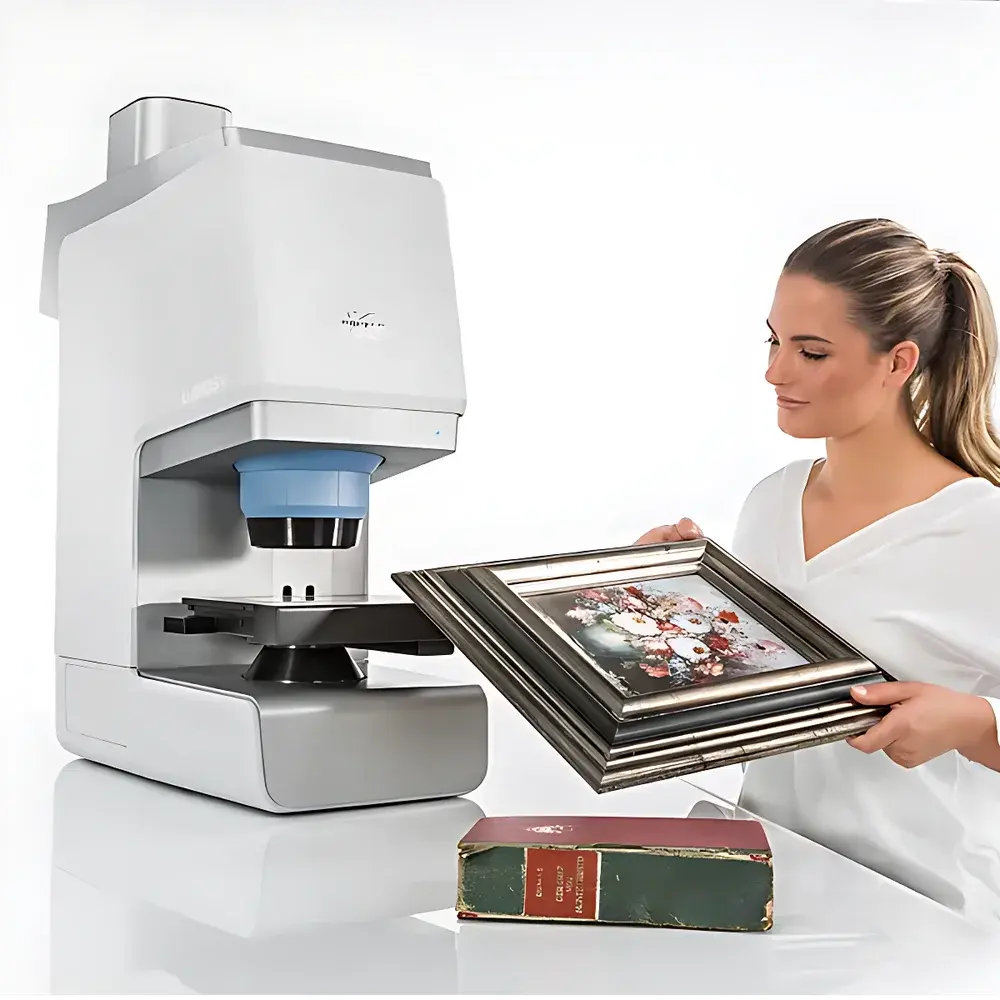
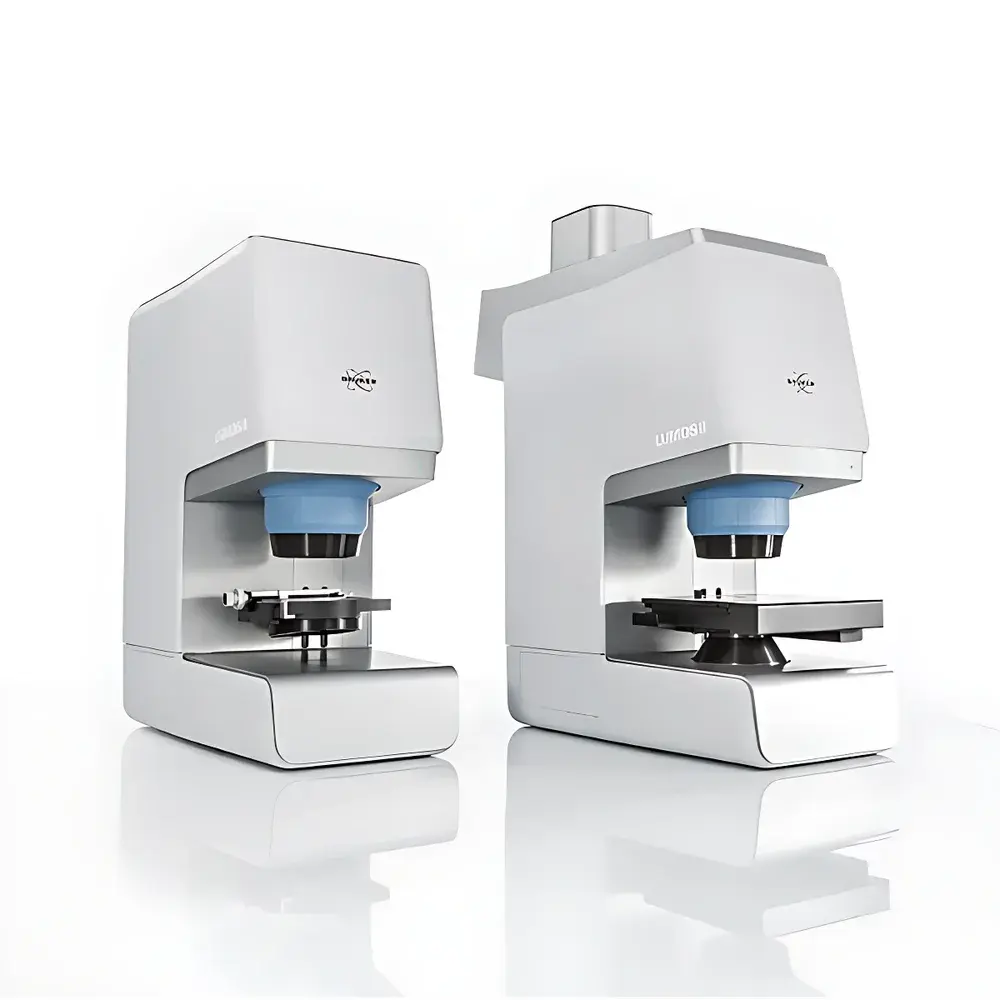
Bruker LUMOS II Standalone FTIR Microscope
| Brand | Bruker |
|---|---|
| Origin | Germany |
| Model | LUMOS II |
| Instrument Type | Laboratory FTIR Microscope |
| Detector Options | Standard TE-MCT (liquid-nitrogen-free), Optional FPA Imaging Detector |
| Calibration Technology | PermaSure+ |
| Automation Level | Fully Motorized & Automated |
| Max Sample Thickness | 40 mm |
| Optical Material | ZnSe (humidity-resistant) |
| Footprint | Compact, Standalone Design |
| Power Consumption | Low |
| Compliance | cGMP, FDA 21 CFR Part 11, ASTM E1252, ISO 17025-ready |
| Software | OPUS with Guided Workflow, Auto OQ/PQ, Pharmacopeial Test Modules |
Overview
The Bruker LUMOS II is a fully integrated, standalone Fourier Transform Infrared (FTIR) microscope engineered for high-spatial-resolution chemical imaging and microspectroscopy in regulated and research-intensive laboratory environments. Unlike conventional benchtop FTIR systems requiring external interferometers or cryogenic cooling, the LUMOS II embeds a thermoelectrically cooled mercury cadmium telluride (TE-MCT) detector as standard—eliminating liquid nitrogen dependency while maintaining high signal-to-noise ratio across the mid-IR range (7500–375 cm⁻¹). Its optical architecture leverages a permanently aligned, vibration-insensitive interferometer and ZnSe-based transmission optics, providing robust performance under ambient humidity conditions without purge gas requirements. Designed for direct integration into quality control labs, R&D facilities, and forensic units, the system delivers diffraction-limited spatial resolution down to <1 µm in visual mode and spectral fidelity compliant with ASTM E1252 and ISO 17025 documentation standards.
Key Features
- Fully motorized and automated optical path: Enables reproducible positioning of objectives, apertures, and beam splitters without manual intervention.
- PermaSure+ calibration technology: Provides long-term spectral stability through real-time internal reference tracking—reducing recalibration frequency and supporting audit-ready traceability.
- Modular detector compatibility: Standard TE-MCT detector (no liquid nitrogen); optional 64×64 or 128×128 pixel FPA detector for rapid hyperspectral imaging at frame rates up to 10 Hz.
- Multi-mode sample interface: Supports ATR, transmission, and reflection measurements with interchangeable objectives (4× to 32× magnification) and adjustable aperture control.
- Extended sample handling capacity: Accommodates specimens up to 40 mm in thickness, including cross-sectioned polymer laminates, coated wafers, and encapsulated biological tissues.
- Compact standalone footprint: Integrates interferometer, microscope, detector, and electronics within a single chassis—minimizing lab space requirements and eliminating external alignment dependencies.
Sample Compatibility & Compliance
The LUMOS II accommodates diverse sample geometries and material classes without modification: solid particulates (e.g., microplastics, pharmaceutical excipients), thin films, bulk polymers, semiconductor layers, forensic trace evidence (paint chips, fibers), and hydrated biological sections. Its ZnSe optical train ensures operational stability in non-purged, high-humidity environments—critical for routine QC in manufacturing cleanrooms or field-deployable forensic labs. The system meets regulatory expectations for data integrity under FDA 21 CFR Part 11, including electronic signature support, audit trail logging, and role-based user access control. All software-driven qualification protocols—including Operational Qualification (OQ) and Performance Qualification (PQ)—are preconfigured in OPUS and align with USP , EP 2.2.24, and ICH Q5E guidelines for spectroscopic method validation.
Software & Data Management
Controlled exclusively via Bruker’s OPUS 8.x platform, the LUMOS II features context-aware, step-by-step measurement wizards that guide users from sample placement to spectral acquisition and chemometric analysis. Integrated spectral libraries (Polymer, Pharmaceutical, Forensic, and Environmental) support automated peak identification and classification. Hyperspectral FPA datasets are processed using multivariate algorithms (PCA, cluster analysis, spectral unmixing) with batch processing capability. Raw interferograms and spectra are stored in Bruker’s proprietary .0 format, which preserves full metadata (instrument configuration, environmental logs, operator ID, timestamp) required for GLP/GMP audits. Data export options include ASCII, CSV, and JCAMP-DX formats compatible with third-party LIMS and statistical analysis tools.
Applications
- Failure analysis: Identification of contaminant residues, oxidation products, or delamination interfaces in electronic assemblies and automotive composites.
- Pharmaceutical QA/QC: Verification of API distribution homogeneity in tablets, coating uniformity assessment, and counterfeit drug detection.
- Environmental microplastic characterization: Morphological mapping combined with functional group identification in water filtration samples.
- Forensic trace evidence: Discrimination of dyed fibers, adhesive tapes, and gunshot residue components based on spectral fingerprinting.
- Life science tissue imaging: Label-free mapping of lipid/protein distribution in formalin-fixed paraffin-embedded (FFPE) histological sections.
- Polymer and coating development: Cross-sectional analysis of multilayer packaging films and degradation profiling under accelerated aging conditions.
FAQ
Does the LUMOS II require liquid nitrogen or continuous purge gas?
No. The standard TE-MCT detector operates at thermoelectric cooling temperatures (−10 °C), and the ZnSe optics eliminate the need for dry air or nitrogen purging—even in environments with >60% relative humidity.
Can the system perform quantitative analysis in compliance with pharmacopeial methods?
Yes. Preloaded USP, EP, and JP test modules—including dissolution testing, content uniformity, and identification tests—are validated and support 21 CFR Part 11-compliant reporting.
Is FPA imaging limited to transmission mode?
No. The LUMOS II supports FPA-based chemical imaging in ATR, transmission, and reflection geometries via motorized mode switching and objective-specific calibration routines.
What is the maximum allowable sample height for vertical loading?
The stage accommodates samples up to 40 mm in total height, enabling analysis of thick industrial components, multi-layer PCBs, or embedded geological specimens without sectioning.
How is instrument performance verified over time?
PermaSure+ continuously monitors interferometer alignment and detector response drift; automated OQ/PQ routines generate PDF reports with pass/fail criteria aligned to ISO/IEC 17025 accreditation requirements.



