
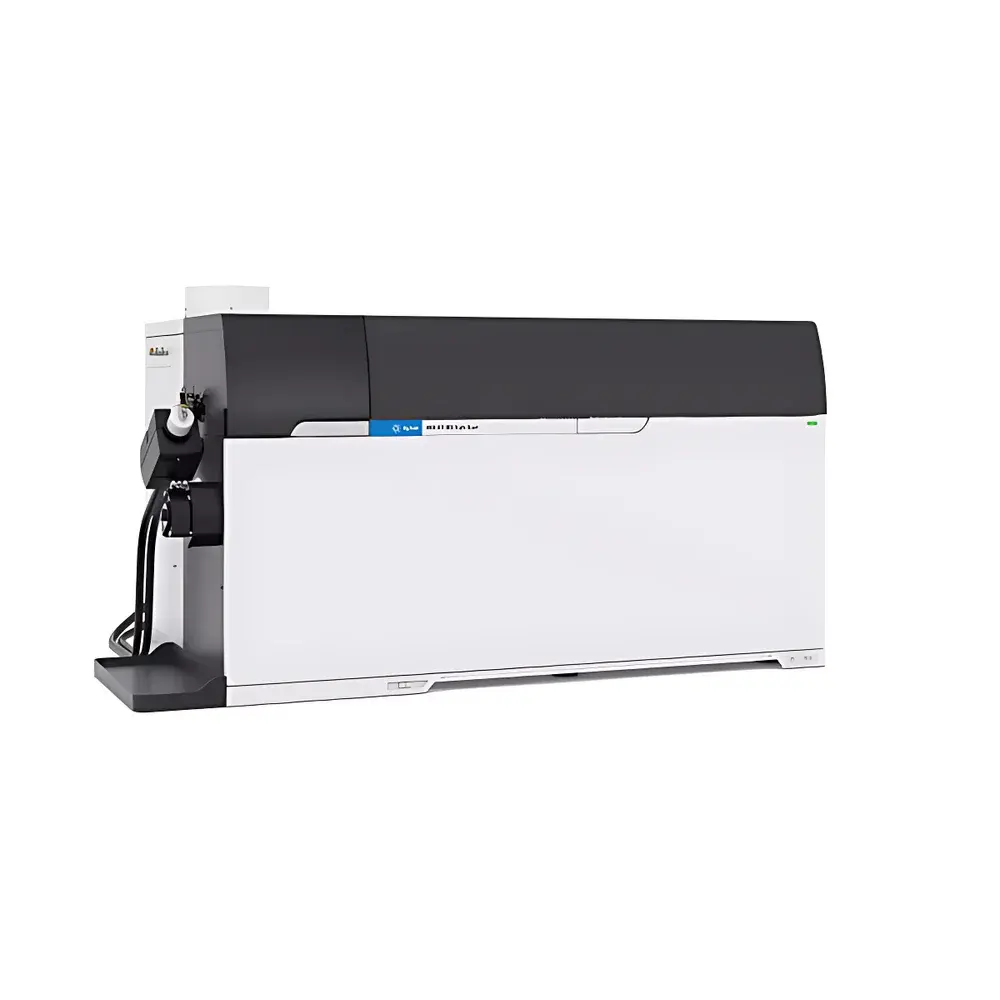
Agilent 8900 Triple Quadrupole ICP-MS
| Brand | Agilent Technologies |
|---|---|
| Origin | USA |
| Instrument Type | Triple Quadrupole Inductively Coupled Plasma Mass Spectrometer |
| Model | 8900 |
| Mass Range (amu) | Not publicly specified — configured for full elemental coverage from 6Li to 238U and beyond |
| Resolution (unit mass resolution) | Achieved at 1 u with high transmission efficiency under high-vacuum dual-quadrupole operation |
| Detection Limits (ng·L⁻¹) | Sub-attogram-level for key isotopes (e.g., <0.01 ng·L⁻¹ for ⁵⁶Fe in He mode, <0.001 ng·L⁻¹ for ⁴⁰Ca in MS/MS mode) |
| Sensitivity (Mcps/mg·L⁻¹) | >1 × 10⁹ cps/(µg·L⁻¹) for ²³⁸U in standard mode |
| Short-term Stability (RSD, 10 min) | <2% |
| Long-term Stability (RSD, 4 h) | <3% |
| Collision/Reaction Cell Gas Control | Quad-channel (He, H₂, NH₃, O₂, CH₄, or custom mixtures) |
| Plasma Oxide Ratio (CeO⁺/Ce⁺) | <1.5% |
| Maximum TDS Tolerance | Up to 25% w/w with Ultra-High Matrix Introduction (UHMI) system |
Overview
The Agilent 8900 Triple Quadrupole ICP-MS (ICP-MS/MS) is a purpose-engineered elemental analysis platform that extends the analytical boundaries of conventional single-quadrupole ICP-MS through true tandem mass spectrometry architecture. Unlike high-resolution magnetic sector or time-of-flight instruments, the 8900 employs two independent quadrupole mass filters—Q1 upstream and Q2 downstream of a pressurized collision/reaction cell (CRC)—to achieve selective ion transmission and chemically mediated interference removal. This MS/MS configuration enables precise control over gas-phase ion-molecule reactions, allowing unambiguous detection of analytes previously obscured by isobaric overlaps (e.g., 31P+ vs. 14N16O1H+, 32S+ vs. 16O2+, 28Si+ vs. 14N2+) or polyatomic interferences (e.g., 40Ar16O+ on 56Fe+). The instrument operates at unit mass resolution (1 u) while maintaining high ion transmission—critical for trace-level quantification in complex matrices such as semiconductor process chemicals, nuclear fuel cycle materials, biological fluids, and high-purity metal oxides.
Key Features
- True triple quadrupole architecture: Q1 selects precursor ions; CRC enables controlled reaction chemistry; Q2 isolates product ions—eliminating secondary interference formation inherent in single-cell systems.
- Quad-channel reactive gas delivery system supporting simultaneous or sequential introduction of He, H2, NH3, O2, CH4, and proprietary gas blends for optimized reaction pathways per element.
- Ultra-High Matrix Introduction (UHMI) capability enabling direct analysis of samples with up to 25% total dissolved solids without dilution or offline pre-treatment.
- Stable, low-oxide plasma (< CeO+/Ce+ < 1.5%) achieved via robust RF generator design and optimized torch geometry, ensuring reproducible signal intensity across high-salt and organic-rich matrices.
- Integrated helium-mode collision cell for broadband suppression of argon-based polyatomics (e.g., ArO+, ArN+, ArCl+) without requiring reactive gases.
- Predefined method libraries—including EPA Method 6020B, ISO/IEC 17025-compliant workflows, and semiconductor-grade purity protocols—for rapid deployment in regulated laboratories.
Sample Compatibility & Compliance
The Agilent 8900 accommodates aqueous solutions, digested geological and environmental samples, acid-leached electronic materials, diluted biofluids (urine, serum), and nanoparticle suspensions. Its UHMI interface supports direct nebulization of high-TDS brines, molten salt extracts, and spent nuclear fuel simulants. From a regulatory standpoint, the system complies with ASTM D5673 (trace metals in water), ISO 17294-2 (water quality—elemental speciation), and USP / (elemental impurities in pharmaceuticals). Full audit trail functionality, electronic signature support, and 21 CFR Part 11–compliant software modules ensure readiness for GLP and GMP environments. All hardware components meet RoHS and CE directives; vacuum systems conform to ISO 27893 standards for residual gas composition and pumping speed verification.
Software & Data Management
MassHunter Workstation Software v10.x provides integrated instrument control, real-time data acquisition, and post-run processing tailored for multi-element MS/MS workflows. Key modules include Reaction Pathway Optimizer (for empirical selection of Q1/Q2 masses and gas conditions), Interference Diagnostic Dashboard (visualizing spectral overlaps and CRC reaction efficiencies), and Automated Method Validation Toolkit (supporting linearity, LOD/LOQ, precision, and recovery assessments per ICH Q2(R2)). Raw data files (.d format) are stored in vendor-neutral HDF5 containers, enabling third-party integration with LIMS platforms (e.g., LabWare, Thermo SampleManager) and statistical packages (R, Python Pandas). All sequence logs, calibration reports, and QC records are timestamped, digitally signed, and archived with immutable hash verification.
Applications
- Ultra-trace analysis of Si, P, S, Cl, K, and Ca in ultrapure HF, NH4OH, and HNO3 used in semiconductor wafer cleaning—meeting SEMI C37 purity specifications.
- Isotopic ratio measurements of actinides (e.g., 235U/238U, 240Pu/239Pu) in nuclear safeguards and non-proliferation monitoring, where MS/MS eliminates 238U1H+ interference on 239Pu+.
- Quantification of essential and toxic elements (e.g., Se, As, Cd, Pb) in infant formula and dietary supplements under FDA Guidance for Industry #222.
- Speciation studies involving hyphenated techniques—e.g., coupling with HPLC for selenoprotein identification or with FFF for nanoparticle size-resolved elemental distribution.
- Geochemical fingerprinting of rare earth elements (REEs) in zircon and monazite using oxide-free MS/MS modes to resolve LaO+/Ce+, PrO+/Nd+, and other refractory oxide interferences.
FAQ
How does ICP-MS/MS differ fundamentally from high-resolution ICP-MS?
ICP-MS/MS uses chemical selectivity (via controlled ion-molecule reactions) rather than physical mass separation to resolve interferences—making it effective against isobars indistinguishable even at 10,000+ mass resolution.
Can the 8900 operate in single-quadrupole mode?
Yes—Q1 can be operated in RF-only mode to function as a conventional ICP-MS, enabling method comparison and legacy protocol compatibility.
What maintenance intervals are recommended for the CRC and interface cones?
Standard maintenance includes quarterly cone cleaning and annual CRC liner replacement; extended uptime (>6 months) is achievable with automated plasma conditioning and real-time pressure diagnostics.
Is method transfer possible between different Agilent ICP-MS platforms?
Method parameters (gas flows, dwell times, Q1/Q2 settings) are exportable and partially compatible with 7900 and 7850 systems—but MS/MS-specific reaction pathways require re-optimization.
Does the system support isotope dilution analysis (IDA)?
Yes—fully supported via MassHunter’s IDA calculator module, including spike calibration, yield correction, and uncertainty propagation per EURACHEM/CITAC Guide CG4.





