
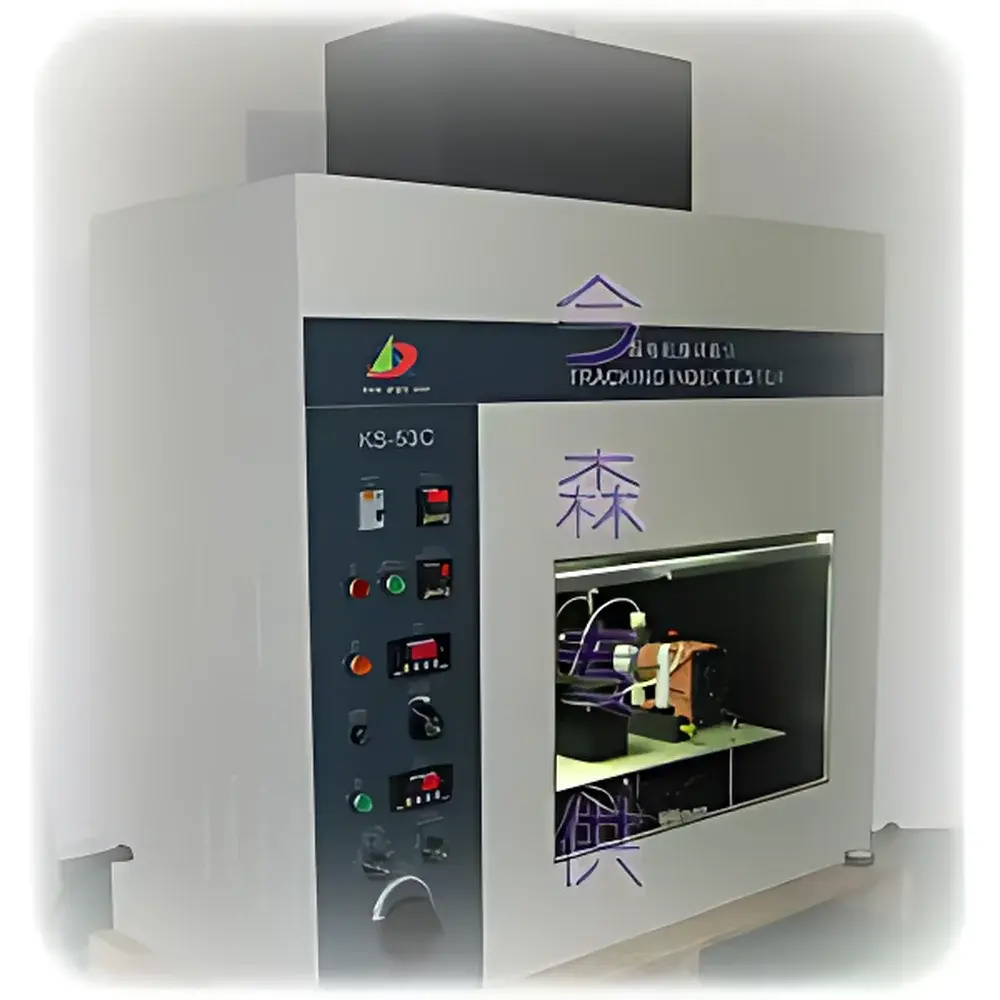
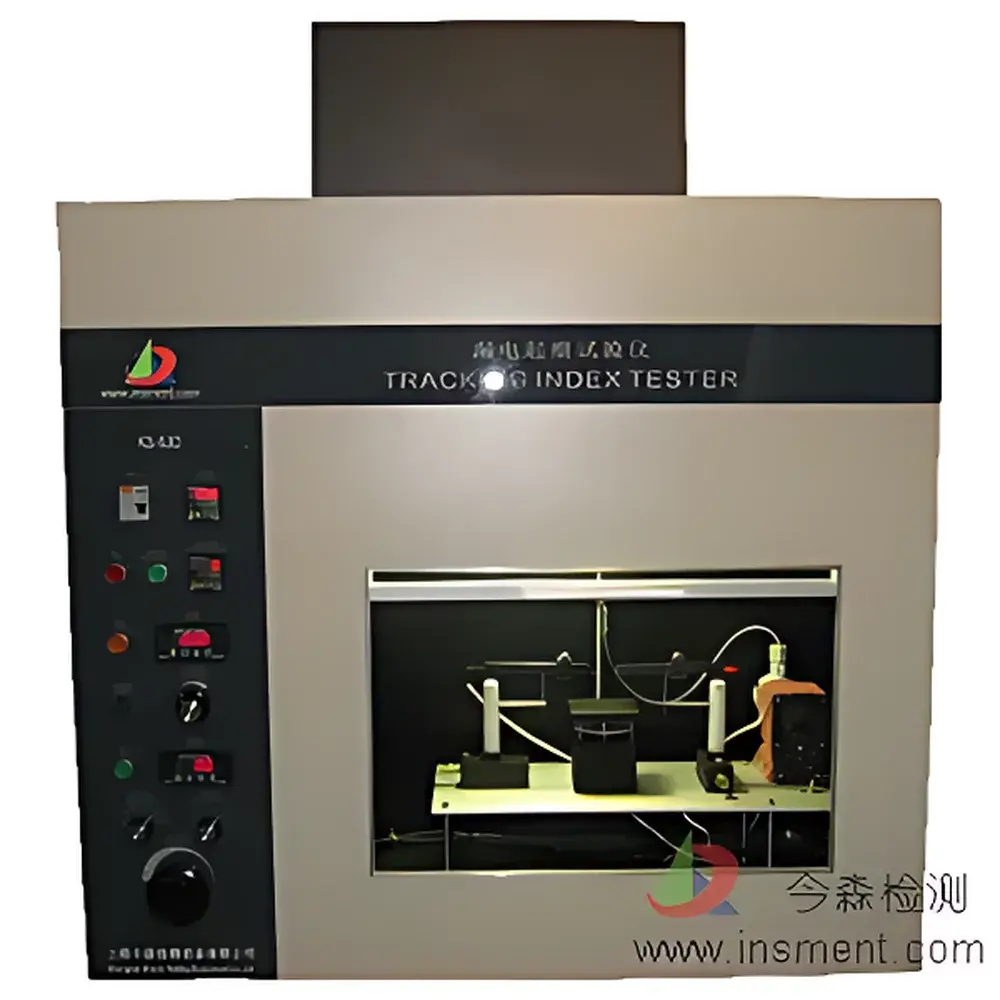
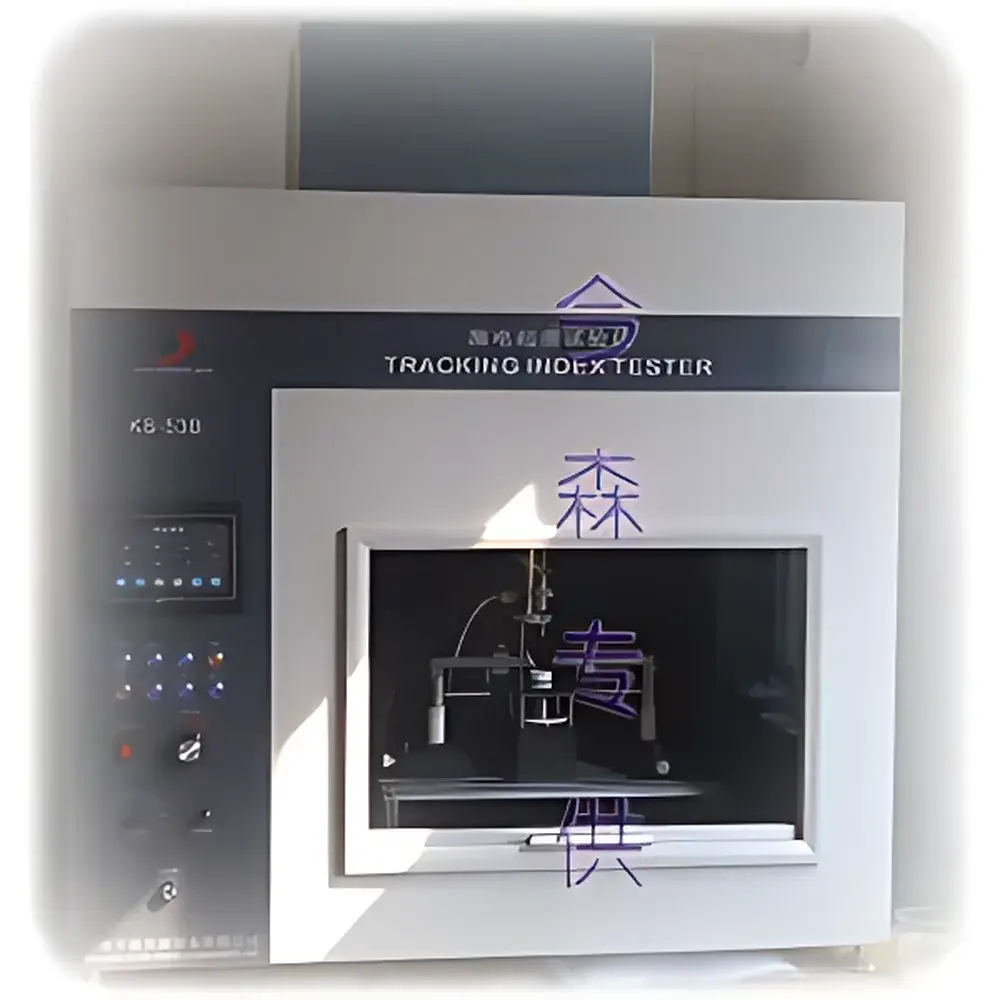
Insment KS-59D Comparative Tracking Index (CTI) and Proof Tracking Index (PTI) Tester
| Brand | Insment |
|---|---|
| Model | KS-59D |
| Origin | Shanghai, China |
| Electrode Material | Platinum (2 mm × 5 mm, ±0.1 mm) |
| Electrode Spacing | 4.0 mm ± 0.01 mm |
| Electrode Angle | 60° ± 5° |
| Electrode Force | 1.00 N ± 0.001 N |
| Test Voltage Range | 100–600 V (25 V increments) |
| Droplet Volume | 20 drops = 0.380–0.480 g |
| Droplet Height | 35 mm ± 5 mm (adjustable) |
| Droplet Interval | 30.0 s ± 0.1 s (digital preset) |
| Total Drop Count | 1–9999 (digital display & preset) |
| Test Solution Resistivity | A-solution (0.1% NH₄Cl): 3.95 ± 0.05 Ω·m |
| B-solution | 1.98 ± 0.05 Ω·m |
| Airflow Velocity | 0.2 m/s (per latest IEC/GB standards) |
| Tracking Detection Threshold | 0.50 A ± 10%, sustained for 2.00 s ± 10% |
| Power Supply | 220 V, 0.6 kVA, 50–60 Hz |
| Dimensions (W×D×H) | 1120 × 520 × 1350 mm |
| Exhaust Port Diameter | Φ100 mm |
Overview
The Insment KS-59D Comparative Tracking Index (CTI) and Proof Tracking Index (PTI) Tester is a precision-engineered instrument designed to evaluate the electrical tracking resistance of solid insulating materials under controlled electrochemical stress. It operates on the principle of simulating surface degradation caused by leakage current in the presence of conductive contaminants—specifically, standardized ammonium chloride (NH₄Cl) solution droplets applied across platinum electrodes under sustained AC voltage. This method replicates real-world failure mechanisms observed in low-voltage electrical equipment exposed to humid, polluted environments. The device conforms strictly to internationally harmonized test protocols including IEC 60112:2009, GB/T 4207–2012, GB/T 6553–2003, UL 746A, ASTM D3638–92, and DIN 53480. Its primary output metrics—CTI (Comparative Tracking Index) and PTI (Proof Tracking Index)—are critical parameters used in material qualification for insulation systems in electrical safety certification, particularly within the electronics, appliance, and industrial control sectors.
Key Features
- Precision-machined platinum electrodes (2 mm × 5 mm cross-section, ±0.1 mm tolerance) with optional 5 mm or 12 mm lengths and a calibrated 30° ± 2° bevel for consistent contact geometry.
- Mechanically stabilized electrode spacing of 4.0 mm ± 0.01 mm maintained via rigid copper or brass support rods, ensuring repeatable electric field distribution.
- Digital, microprocessor-controlled droplet delivery system with adjustable height (35 mm ± 5 mm), programmable interval (30.0 s ± 0.1 s), and precise volumetric calibration (20-drop mass: 0.380–0.480 g; 50-drop mass: 0.997–1.147 g).
- Integrated airflow regulation at 0.2 m/s—aligned with updated IEC 60112 and GB/T 4207 requirements—to mitigate thermal convection effects during extended tracking evaluation.
- High-stability AC voltage source (100–600 V, 25 V steps) with real-time current monitoring and automatic cutoff upon detection of sustained leakage current ≥0.50 A for ≥2.00 s.
- Robust enclosure (1120 × 520 × 1350 mm) featuring tempered glass viewing window, flame-retardant interior lining, and Φ100 mm exhaust port compatible with standard fume hood ducting.
Sample Compatibility & Compliance
The KS-59D accommodates flat, rigid specimens up to 15 mm thick and 100 mm × 100 mm in planar dimension, supporting standardized mounting fixtures per IEC 60112 Annex A. It is routinely deployed in laboratories conducting GLP-compliant material validation for UL, CCC, CE, and CB Scheme certifications. The instrument meets mechanical and electrical safety requirements of IEC 61010-1 for laboratory equipment and supports traceable calibration per ISO/IEC 17025–accredited procedures. Its test methodology directly informs compliance with Clause 2.10.7 of GB 4706.1–2008 (Household and Similar Electrical Appliances – Safety) and Section 12 of UL 746A (Polymeric Materials – Use in Electrical Equipment Evaluations). For quality assurance departments, it enables internal verification against CHEARI-PT003 proficiency testing criteria for CTI/PTI interlaboratory comparisons.
Software & Data Management
While the KS-59D operates as a standalone hardware platform with digital front-panel controls and LED displays for voltage, drop count, elapsed time, and event logging, its design prioritizes audit readiness. All test parameters—including voltage setpoint, droplet interval, total drop count, and pass/fail trigger conditions—are manually configured and recorded in operator logs. The system supports manual entry into LIMS or ELN platforms via standardized test report templates aligned with ASTM E1447 and ISO/IEC 17025 documentation requirements. Optional RS-232 interface (available upon request) permits basic data export for external timestamped recordkeeping. No proprietary software is bundled; this architecture ensures compatibility with FDA 21 CFR Part 11–compliant electronic signature workflows when integrated into validated QA/QC environments.
Applications
- Qualification of thermoplastics (e.g., PBT, PA66, PC/ABS blends) and thermosets (e.g., epoxy molding compounds, phenolics) used in connector housings, switch bases, and PCB substrates.
- Material screening for lighting enclosures (LED drivers, ballasts), motor terminal blocks, and power supply casings subject to IP2X–IP54 environmental ratings.
- Root-cause analysis of field failures attributed to surface tracking in consumer electronics, industrial sensors, and building automation controllers.
- Supporting comparative studies between halogen-free flame-retardant (HFFR) formulations and brominated alternatives under identical contamination exposure profiles.
- Training and technical workshops on IEC 60112 methodology, including hands-on demonstration of CTI step-down testing and PTI verification protocols.
FAQ
What standards does the KS-59D fully support?
The KS-59D implements all procedural and dimensional requirements of IEC 60112:2009, GB/T 4207–2012, GB/T 6553–2003, UL 746A, ASTM D3638–92, and DIN 53480. It also aligns with the airflow specification (0.2 m/s) introduced in the 2020 revision of GB/T 4207.
Can the instrument differentiate between CTI and PTI testing modes?
Yes. CTI determination follows the step-down voltage protocol defined in IEC 60112 Annex B, while PTI verification uses fixed-voltage endurance testing per Annex C. Both are executed using identical electrode geometry, droplet parameters, and detection logic.
Is calibration documentation provided with shipment?
Each unit ships with a factory calibration certificate covering electrode spacing, droplet mass verification, voltage output accuracy, and timing circuit fidelity—traceable to national metrology institutes per ISO/IEC 17025 guidelines.
What maintenance is required for long-term reliability?
Platinum electrodes require periodic cleaning with analytical-grade ethanol and inspection for pitting or residue buildup. The droplet nozzle must be purged weekly with deionized water to prevent NH₄Cl crystallization. Annual verification of current sensing threshold and timing stability is recommended.
Does the KS-59D meet requirements for accredited testing laboratories?
Yes. Its mechanical repeatability, parameter resolution, and adherence to standardized test sequences enable full integration into ISO/IEC 17025–accredited quality management systems, provided operators follow documented SOPs and maintain traceable calibration records.



