
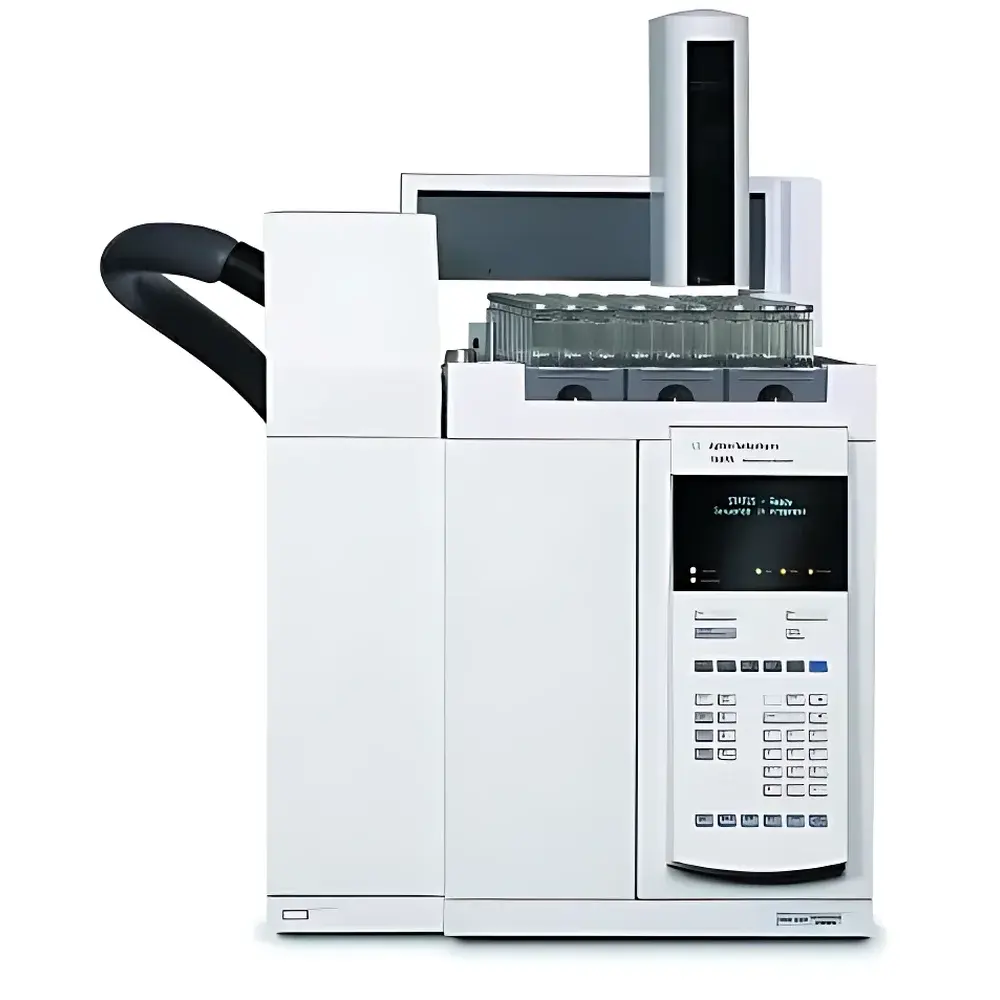
Agilent 7697A Headspace Sampler
| Brand | Agilent Technologies |
|---|---|
| Origin | USA |
| Instrument Type | Static Headspace Sampler |
| Automation Level | Fully Automated |
| Sample Vial Sizes | 10 mL, 20 mL, 22 mL |
| Sample Capacity | 111 vials (including 3 priority positions) |
| Injection Mechanism | Valve and Loop |
| EPC Integration | Full Electronic Pressure Control (independent headspace vial pressure and GC column head pressure) |
| Leak Detection | Automated real-time vial seal verification |
| Barcode Reader | Integrated for pre-heating sample tracking |
| Method Transfer | Compatible with third-party headspace methods via preloaded method development software |
| MHC Capability | Up to 100 extractions per GC run |
| Power & Gas Efficiency | Optimized for H₂ carrier gas operation |
| Software Control | Agilent OpenLAB CDS and MassHunter |
| Compliance Ready | Supports 21 CFR Part 11 audit trails, GLP/GMP workflow logging |
Overview
The Agilent 7697A Headspace Sampler is a fully automated static headspace sampling system engineered for high-throughput, regulatory-compliant gas chromatography (GC) laboratories. It operates on the principle of equilibrium partitioning—where volatile analytes in liquid or solid samples are thermally equilibrated in the vapor phase above the sample matrix (the “headspace”) prior to quantitative transfer into the GC inlet. Designed as a seamless extension of the Agilent 7890A GC platform and leveraging architecture from the 7693A Automatic Liquid Sampler (ALS), the 7697A delivers reproducible, trace-level analysis of residual solvents, environmental contaminants, flavor compounds, pharmaceutical impurities, and forensic volatiles. Its core architecture integrates precision thermal control, valve-and-loop injection, and full electronic pressure control (EPC) to ensure stoichiometric transfer and minimize carryover—critical for compliance-driven workflows in pharmaceutical, food safety, and environmental testing labs.
Key Features
- Fully automated operation with 111-position sample carousel, including three dedicated priority slots for urgent samples without interrupting ongoing sequences
- Real-time, non-invasive vial leak detection during pressurization—eliminating manual calibration and guaranteeing seal integrity before heating or injection
- Independent EPC channels for precise regulation of both headspace vial pressure and GC column head pressure, enabling backpressure-free transfer and improved peak shape reproducibility
- Integrated barcode reader for unambiguous sample identification and chain-of-custody tracking prior to thermal equilibration
- Multiple vial compatibility: accepts standard 10 mL, 20 mL, and 22 mL crimp-top or screw-cap headspace vials without adapter changes
- Hydrogen-compatible carrier gas operation—reducing analysis time and operational cost while maintaining retention time stability and detector response linearity
- Multiple Headspace Extraction (MHE) mode supports up to 100 sequential extractions from a single vial within one GC run, enhancing sensitivity for trace analytes and improving quantitative accuracy for low-partition-coefficient compounds
- Active vial depressurization post-injection prevents cross-contamination and enables safe, rapid carousel reloading during sequence execution
Sample Compatibility & Compliance
The 7697A accommodates a broad range of sample matrices—including aqueous solutions, polymers, soils, biological tissues, pharmaceutical tablets, and packaged foods—provided they remain physically stable under controlled heating conditions (up to 300 °C vial temperature). All thermal and pressure parameters are programmable per sample or group, supporting multi-method sequences within a single run. From a regulatory perspective, the system is architected for GLP and GMP environments: audit trail functionality is natively embedded in OpenLAB CDS software, meeting FDA 21 CFR Part 11 requirements for electronic records and signatures. Instrument qualification documentation (IQ/OQ/PQ) templates, preventive maintenance logs, and user-access-controlled method editing are supported out-of-the-box. The system complies with ASTM D3699 (residual solvents in ethanol), USP , ISO 11843-2 (detection limit validation), and EPA Method 502.2/8260D for volatile organic compound analysis.
Software & Data Management
Control and data acquisition are fully integrated via Agilent OpenLAB Chromatography Data System (CDS) and MassHunter Acquisition software. Methods define not only thermal ramp profiles and equilibration times but also vial pressurization rates, loop fill volumes, purge durations, and MHE iteration counts—all editable without hardware modification. Sequence templates support conditional logic (e.g., skip failed vials, rerun flagged peaks) and automatic report generation compliant with LIMS interfaces. Raw data files (.D format) include embedded metadata: timestamped pressure/temperature logs, EPC setpoint deviations, leak test outcomes, and barcode scan history. Data integrity is reinforced by role-based access control, electronic signature workflows, and immutable audit trails that record every parameter change, user login, and instrument state transition.
Applications
The 7697A serves critical roles across regulated and research-intensive domains. In pharmaceutical quality control, it quantifies Class 1–3 residual solvents per ICH Q3C guidelines in active pharmaceutical ingredients (APIs) and final dosage forms. Environmental labs use it for EPA-regulated VOC analysis in groundwater and soil extracts. Food and beverage manufacturers apply it to monitor ethanol content, off-flavor compounds (e.g., acetaldehyde in PET bottles), and packaging migrants. Forensic toxicology labs rely on its precision for blood alcohol and volatile drug screening. Additionally, polymer and coating manufacturers employ MHE mode to assess monomer residuals and extractables in medical device materials—supporting ISO 10993 biocompatibility assessments.
FAQ
Does the 7697A support method transfer from other headspace systems?
Yes—preloaded method development software allows direct import of parameters from common third-party platforms (e.g., PerkinElmer, Thermo Fisher), enabling rapid method porting with minimal revalidation.
Can the system operate with hydrogen as carrier gas without hardware modification?
Yes—the 7697A’s EPC modules and internal flow paths are certified for H₂ operation; no retrofitting or safety interlock upgrades are required.
Is real-time vial leak detection performed before or after heating?
Leak verification occurs during initial pressurization—prior to thermal equilibration—ensuring only properly sealed vials proceed to analysis.
How does the priority slot feature integrate with existing sequence methods?
Priority positions are assigned at the method level; inserting a vial into any of the three designated slots triggers immediate injection upon next available cycle, independent of sequence order.
What software licenses are required for 21 CFR Part 11 compliance?
OpenLAB CDS 2.4 or later with the Security Pack license is mandatory for electronic signature enforcement, audit trail generation, and role-based permissions management.




