
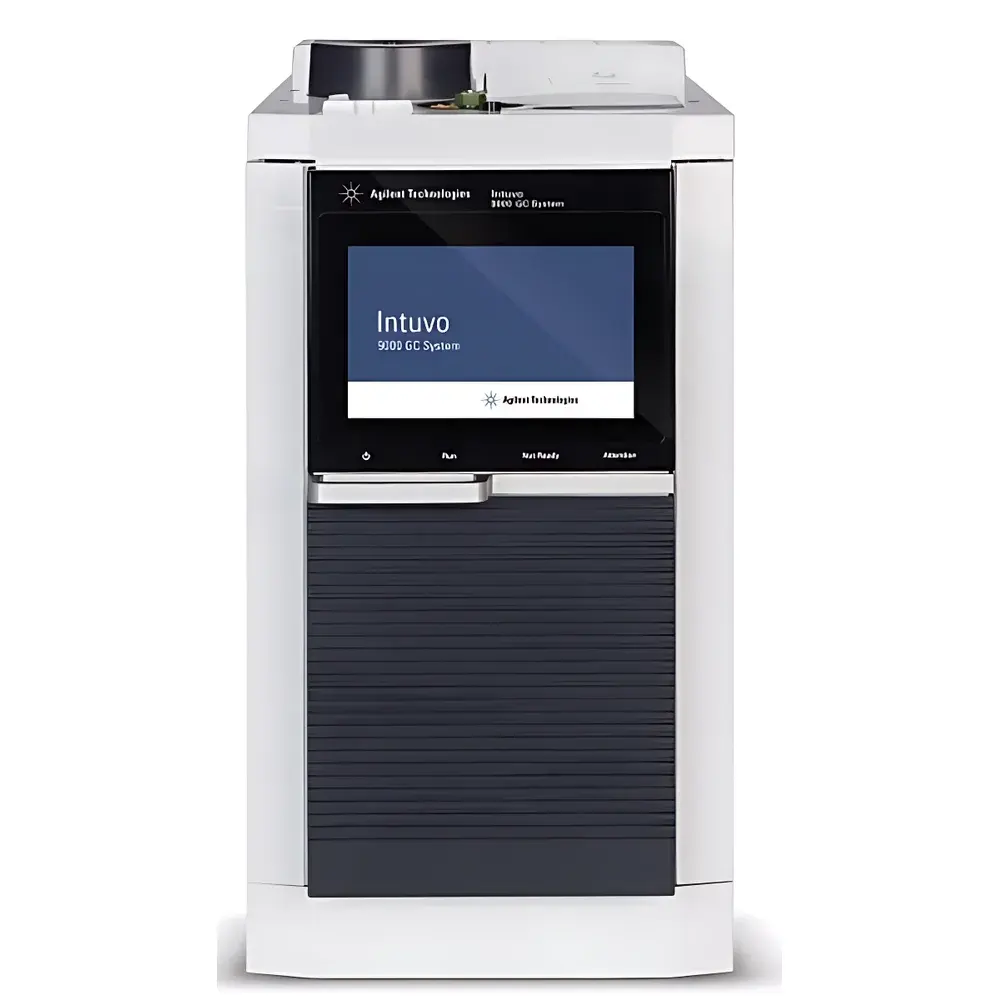
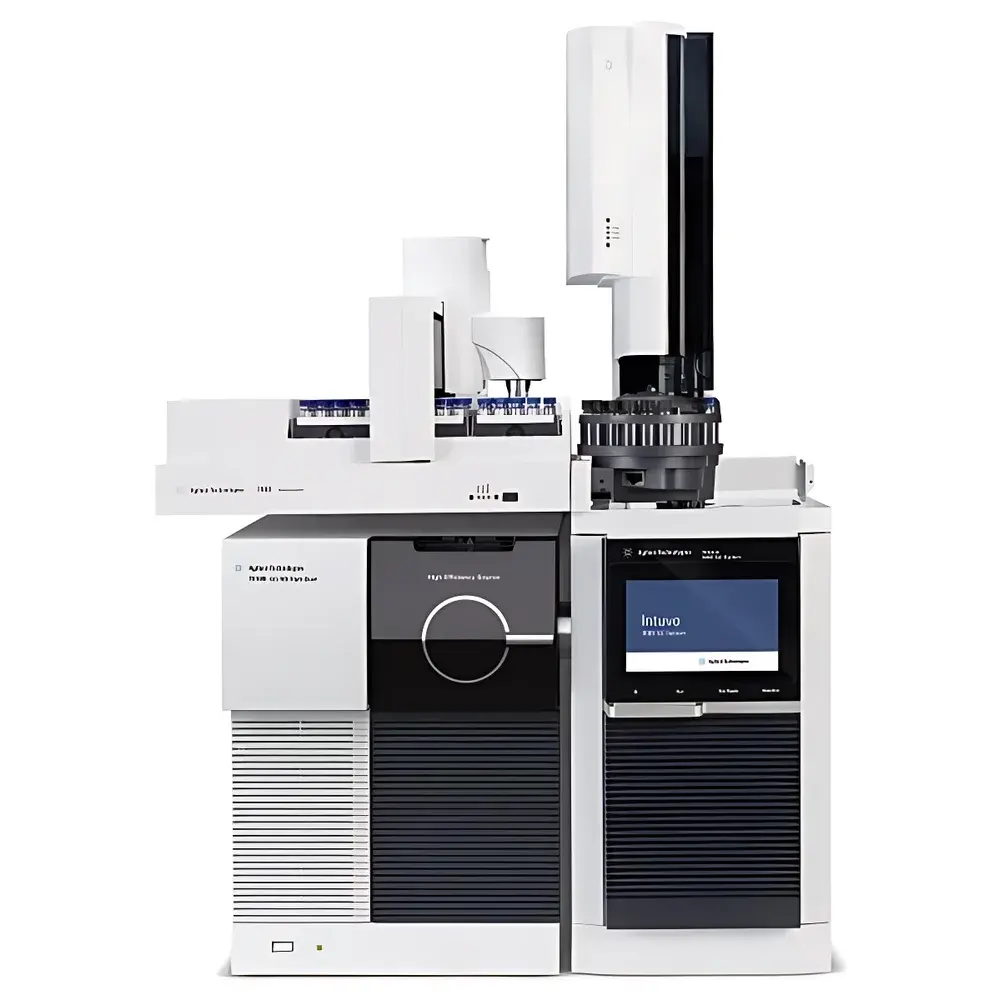
Agilent Intuvo 9000 Gas Chromatograph
| Brand | Agilent Technologies |
|---|---|
| Origin | USA |
| Model | Intuvo 9000 |
| Instrument Type | Laboratory Gas Chromatograph |
| Application Scope | General-Purpose |
| Column Oven Heating Rate | Up to 250 °C/min (30–450 °C) |
| Column Oven Cooling Rate | Fast active cooling (typical <3.5 min from 450 °C to 50 °C) |
| Carrier Gas Flow Control | Electronic Pneumatic Control (EPC) with digital precision |
| Carrier Gas Pressure Control | EPC with ±0.01 psi resolution |
| Inlet Maximum Temperature | 450 °C |
| Inlet Pressure Range | 0–100 psi |
| Inlet Total Flow Range | 0–1200 mL/min |
| Column Connection | Sealless Quick-Connect Fitting |
| Column Protection | Integrated Chip-Based Guard Column |
| Power Consumption | <500 W (vs. >1000 W for conventional GC systems) |
| Dimensions | 49 × 51 × 51 cm (W × D × H) |
| Compliance | ASTM D3606, D5186, ISO 10301, USP <621>, FDA 21 CFR Part 11 ready (with OpenLab CDS) |
Overview
The Agilent Intuvo 9000 Gas Chromatograph is an engineered platform for high-throughput and rapid gas chromatography, grounded in fundamental principles of separation science and pneumatic precision. Unlike conventional oven-based GC systems relying on convective air heating, the Intuvo 9000 employs parabolic direct column heating—where resistive heating elements are integrated into the column enclosure itself—enabling precise thermal control directly at the stationary phase. This architecture eliminates thermal lag, ensures linear and reproducible temperature programming (30–450 °C at up to 250 °C/min), and delivers exceptional retention time stability (<0.008 min RSD over 100 injections). Designed for laboratories operating under GLP, GMP, or ISO/IEC 17025 frameworks, the system integrates hardware-level traceability, audit-ready event logging, and deterministic flow/pressure control compliant with ASTM and USP method requirements.
Key Features
- Sealless quick-connect column interface: Eliminates ferrule cutting, graphite compression, and leak-prone assembly—enables full column replacement in under 60 seconds with zero operator training dependency.
- Chip-based guard column: A microfabricated, replaceable guard segment installed upstream of the analytical column; traps non-volatile residues and prevents column fouling without altering retention or peak shape.
- Direct-heated column enclosure: Delivers uniform axial thermal profile and eliminates cold spots; supports ultra-fast ramping and sub-3.5-minute cool-down from 450 °C to 50 °C via active air exchange and heat-sink modulation.
- Smart Key technology: RFID-enabled hardware identifiers embedded in inlet modules, detectors, and columns automatically load configuration parameters—including column dimensions, phase chemistry, and recommended operating limits—into OpenLab CDS upon installation.
- Intelligent diagnostics engine: Continuously monitors >100 real-time system parameters (e.g., detector baseline noise, EPC valve response latency, oven thermistor drift); generates step-by-step troubleshooting workflows with visual guidance and pass/fail validation criteria.
- Low-power architecture: Consumes <500 W peak power—compatible with standard 120 V/60 Hz outlets—reducing facility infrastructure demands and enabling deployment in satellite labs or mobile analytical units.
- Modular flow path design: Supports configurable backflush, heart-cutting, and multi-dimensional GC (GC-GC) setups via standardized pneumatic manifolds and solenoid-controlled valving—no tools or gas-line reconfiguration required.
Sample Compatibility & Compliance
The Intuvo 9000 accommodates a broad range of volatile and semi-volatile organic compounds—from C2 hydrocarbons to polyaromatics and pesticide residues—with compatibility across split/splitless, PTV, and cold-on-column injection techniques. Its EPC system meets ISO 8573-1 Class 2 compressed air purity requirements when used with certified carrier gas purification. The platform conforms to ASTM D3606 (gasoline aromatics), D5186 (diesel hydrocarbon types), and ISO 10301 (industrial solvent analysis). When paired with Agilent 5977B, 7000D, or 7010B mass spectrometers, it satisfies ICH Q2(R2) method validation criteria for specificity, linearity, and robustness. Full 21 CFR Part 11 compliance is achieved through OpenLab CDS v3.4+, including electronic signatures, role-based access control, and immutable audit trails for all instrument method changes and run logs.
Software & Data Management
Control and data acquisition are managed through Agilent OpenLab CDS, a validated chromatography data system supporting IQ/OQ/PQ documentation packages and automated report generation per LIMS integration standards (ASTM E1578, ISO/IEC 17025 Annex A.2). The system’s embedded web server enables remote monitoring and secure wireless status updates via TLS 1.2–encrypted HTTP(S) connections. All diagnostic events, calibration records, and maintenance alerts are timestamped, user-attributed, and exportable in CSV or PDF formats compatible with enterprise document management systems. Firmware updates are digitally signed and verified prior to installation to ensure integrity and regulatory continuity.
Applications
The Intuvo 9000 serves as a primary analytical tool in environmental testing (EPA Method 8260D, 8270E), petrochemical QA/QC (ASTM D5503, D6729), food safety screening (EU 2021/2077 residue monitoring), and pharmaceutical impurity profiling (ICH Q3B). Its speed and reproducibility make it especially suited for routine analysis in contract research organizations (CROs), clinical toxicology labs performing blood alcohol or drug-of-abuse testing, and manufacturing sites requiring real-time release testing (RTRT) under FDA Process Analytical Technology (PAT) guidelines.
FAQ
Does the Intuvo 9000 support method transfer from legacy Agilent GC platforms?
Yes—OpenLab CDS includes backward-compatible method conversion utilities that map legacy temperature programs, flow profiles, and detector settings to Intuvo-specific hardware parameters while preserving retention indexing and relative retention times.
Is column aging or conditioning required after installing a new column?
No—chip-based guard column protection and inert flow path materials (Siltek-treated stainless steel, Ultra Inert inlet liners) minimize adsorption artifacts, allowing immediate qualification runs without extended bake-out procedures.
Can the system operate unattended for extended periods?
Yes—the built-in self-diagnostics continuously verify pressure integrity, detector performance, and oven thermal stability; automatic shutdown triggers if critical thresholds (e.g., column bleed >5 pA, pressure deviation >±0.5 psi) exceed predefined limits.
What cybersecurity protocols are implemented in the instrument firmware?
Firmware adheres to NIST SP 800-161 controls, including secure boot, encrypted parameter storage, disabled default credentials, and configurable firewall rules for network-facing interfaces.
Is third-party detector integration supported?
Only Agilent-certified detectors (FID, TCD, NPD, ECD, MS) are fully validated for compliance-critical applications; non-Agilent detectors may be connected via analog output but lack Smart Key recognition and automated calibration linkage.






