
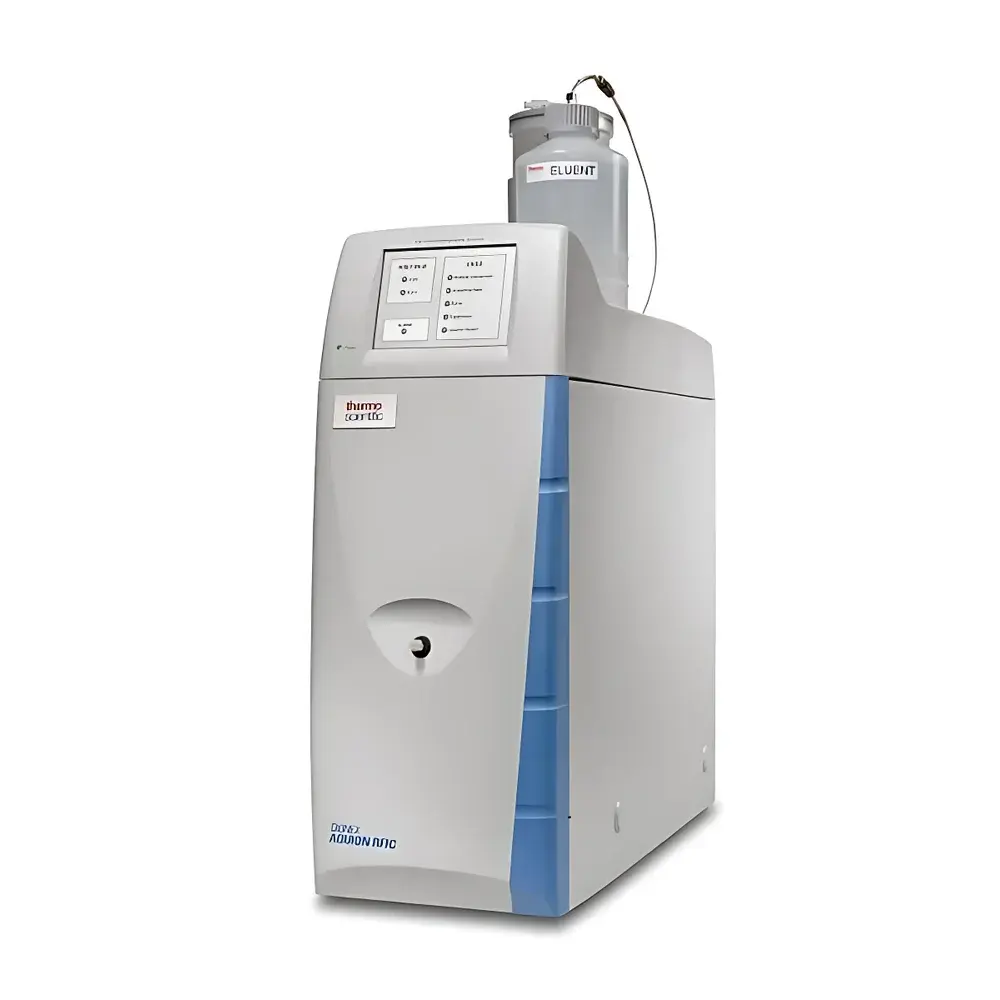
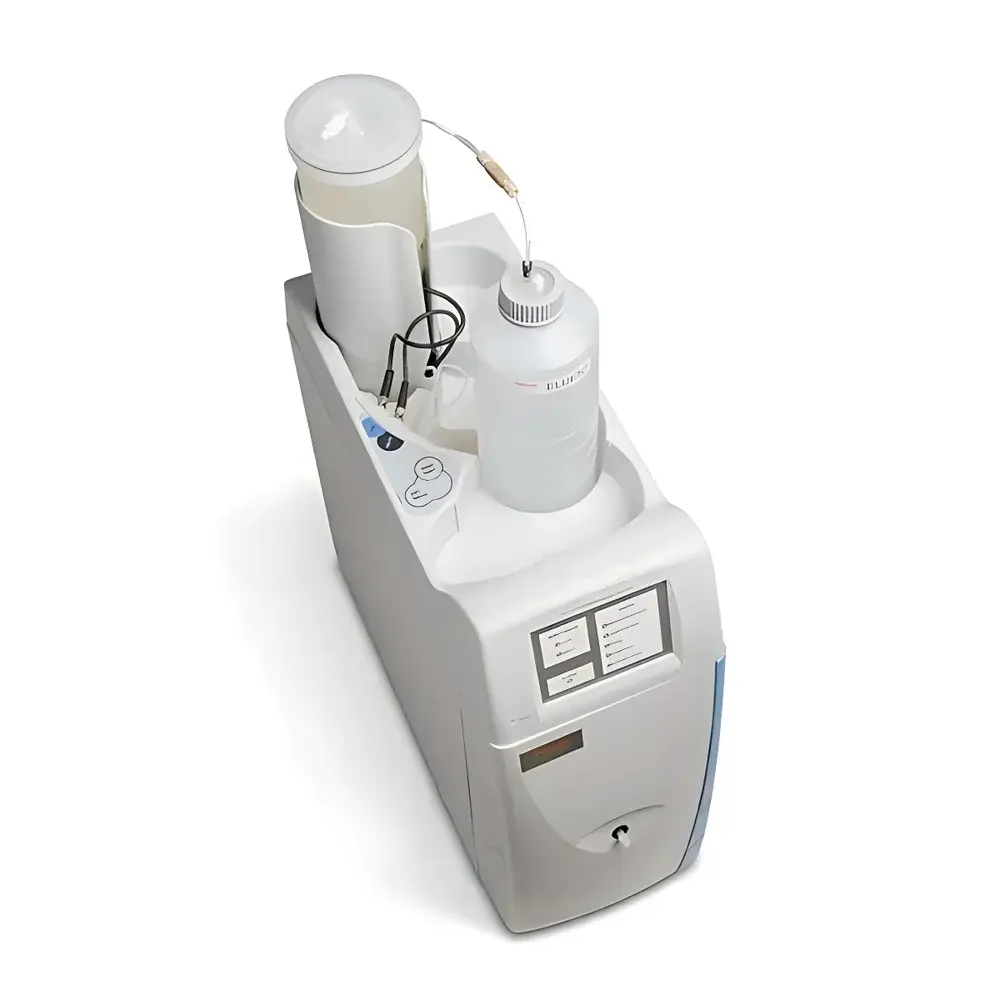
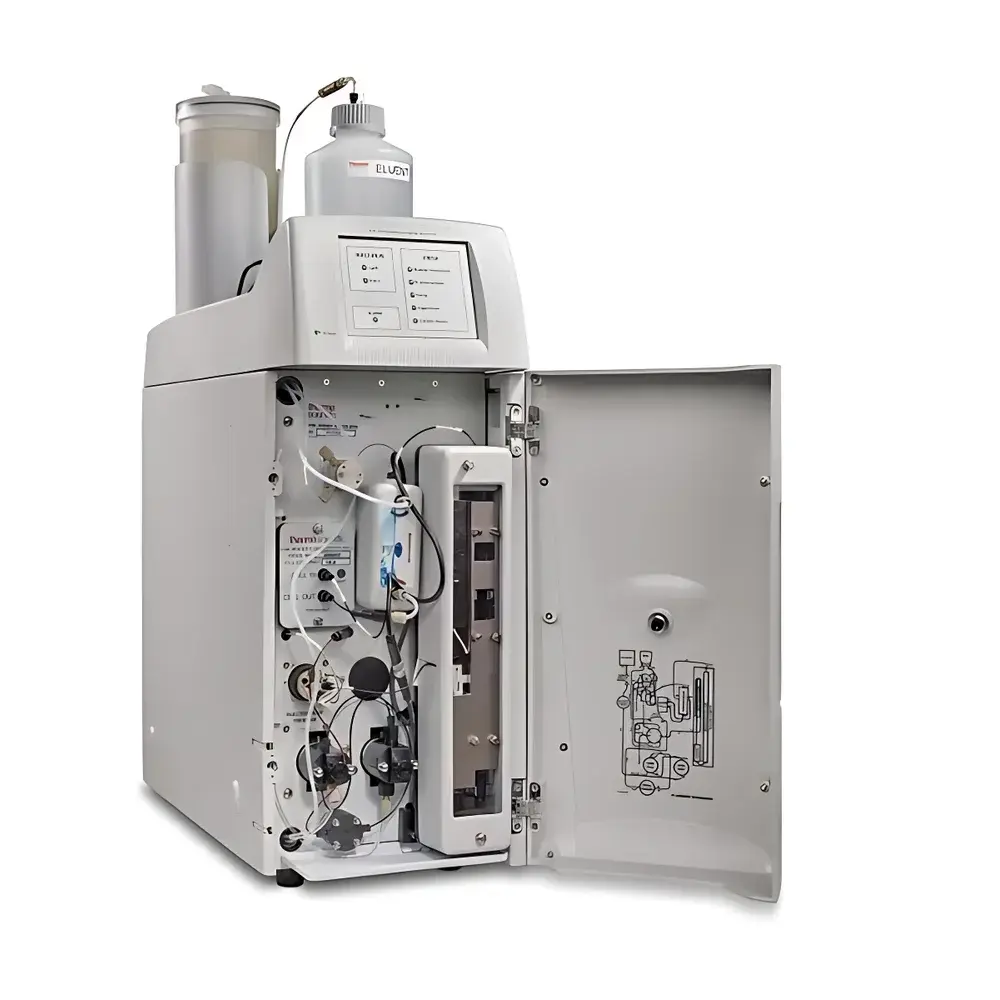
Thermo Scientific Dionex Aquion RFIC Ion Chromatograph
| Brand | Thermo Fisher |
|---|---|
| Origin | Mexico |
| Manufacturer Type | Authorized Distributor |
| Origin Category | Imported |
| Model | Aquion RFIC |
| Instrument Type | Laboratory |
| Application Scope | General-purpose |
| Maximum Pump Pressure | 5000 psi |
| Flow Rate Range | 0.00–5.00 mL/min |
| Eluent Flow Rate Range | 0.00–5.00 mL/min |
| Maximum Operating Pressure | 5000 psi |
| Operating Temperature Range | Ambient +5°C to 60°C |
| Temperature Reproducibility | ±0.05°C |
| Eluent Concentration Range | 0.1–100 mM |
Overview
The Thermo Scientific Dionex Aquion RFIC Ion Chromatograph is a fully integrated, reagent-free ion chromatography system engineered for precision, operational simplicity, and long-term analytical reliability in routine and regulated laboratory environments. Based on suppressed conductivity detection and electrolytic eluent generation (EG), the system eliminates manual eluent preparation while maintaining strict control over ionic strength, pH, and gradient fidelity—critical parameters for reproducible anion and cation separations. Its core architecture employs a dual-piston high-pressure pump with pulse-dampened flow delivery, coupled with a continuously regenerated electrolytic suppressor (ERS™) and a thermostatted digital conductivity detector. This configuration ensures baseline stability, low noise (<0.1 nS), and high sensitivity across diverse matrices—from environmental water extracts and food leachates to pharmaceutical excipient assays and battery electrolyte impurity profiling.
Key Features
- Dual-piston high-pressure pump rated to 5000 psi, delivering precise, pulse-minimized flow from 0.00 to 5.00 mL/min with <0.1% RSD over extended runs
- Electrolytic eluent generator (EG) enabling on-demand, high-purity eluent synthesis (0.1–100 mM KOH, MSA, or NaOH) without manual weighing, dilution, or degassing
- Integrated electrolytic suppressor (ERS 300 or ERS 500 series) providing >99.9% suppression efficiency and stable background conductivity for enhanced signal-to-noise ratio
- Thermostatted digital conductivity cell maintained at ±0.05°C accuracy between ambient +5°C and 60°C, minimizing thermal drift during multi-hour sequences
- Compact footprint (W × D × H: 54 × 56 × 47 cm) optimized for benchtop deployment in space-constrained QC labs or shared research facilities
- PEEK fluidic path throughout—chemically inert, low-metal-leaching, compatible with carbonate-, hydroxide-, and methanesulfonic acid-based eluents
- LED status panel offering real-time visual diagnostics for pump operation, suppressor regeneration, column temperature, and system pressure
Sample Compatibility & Compliance
The Aquion RFIC supports both standard-bore (4 mm) and microbore (2 mm) IC columns—including Thermo Scientific Dionex IonPac AS/CS, ICE-AS, and CS series—enabling method transfer from legacy systems and scalability from screening to trace quantification. It complies with key regulatory frameworks governing data integrity and instrument qualification: full audit trail support via Chromeleon CDS (21 CFR Part 11 compliant when configured with electronic signatures and role-based access), GLP/GMP-ready operational protocols, and alignment with ISO/IEC 17025 method validation requirements. Routine performance verification follows ASTM D4327 (anions in water), ISO 14911 (cation analysis), and USP (conductivity testing of purified water).
Software & Data Management
Controlled exclusively through Thermo Scientific Dionex Chromeleon Chromatography Data System (CDS) v7.3 or later, the Aquion RFIC enables method-driven acquisition, automated calibration curve generation, peak integration using adaptive baselines, and customizable reporting templates. Chromeleon provides full electronic record retention, secure user authentication, and time-stamped audit trails for all method edits, sequence changes, and result approvals. Optional modules include AutoQCheck for automatic system suitability testing (SST), PeakFind for co-elution resolution enhancement, and eWorkflow for SOP-guided operator workflows—reducing training burden and inter-analyst variability in regulated settings.
Applications
This system delivers validated performance across environmental monitoring (NO₃⁻, SO₄²⁻, F⁻, Cl⁻, PO₄³⁻ in drinking water per EPA Method 300.1; NH₄⁺, K⁺, Na⁺ in soil extracts), food safety (iodide in dairy, nitrite in cured meats, sulfite in wine), pharmaceutical quality control (counterions in APIs, residual acetate in biologics), and industrial process analytics (Cl⁻ in semiconductor rinse water, Li⁺/Na⁺ in lithium-ion battery electrolytes). Its robustness under continuous unattended operation makes it suitable for high-throughput contract laboratories performing batch release testing.
FAQ
Does the Aquion RFIC require external gas sources or chemical regenerants for suppression?
No—the system uses a continuously regenerated electrolytic suppressor (ERS) powered by DC current; no CO₂ scrubbers, sulfuric acid, or methanol required.
Can the system be upgraded to support gradient elution?
Yes—via optional dual-channel EG module (EG II), enabling linear or step gradients of hydroxide or methanesulfonic acid concentrations.
Is column heating supported as standard or optional?
Column heater is an optional accessory (Dionex CHM-1), configurable for temperatures from ambient to 80°C with ±0.1°C stability.
What maintenance intervals are recommended for the EG cartridge and suppressor?
EG cartridges typically last ≥2000 hours of operation; suppressors are rated for ≥5000 hours under normal use—both monitored via Chromeleon’s consumables tracker.
Is vacuum degassing integrated or external?
An optional inline vacuum degasser (Dionex DG-2400) is available to minimize bubble formation during low-flow or gradient analyses.
Related Products






