
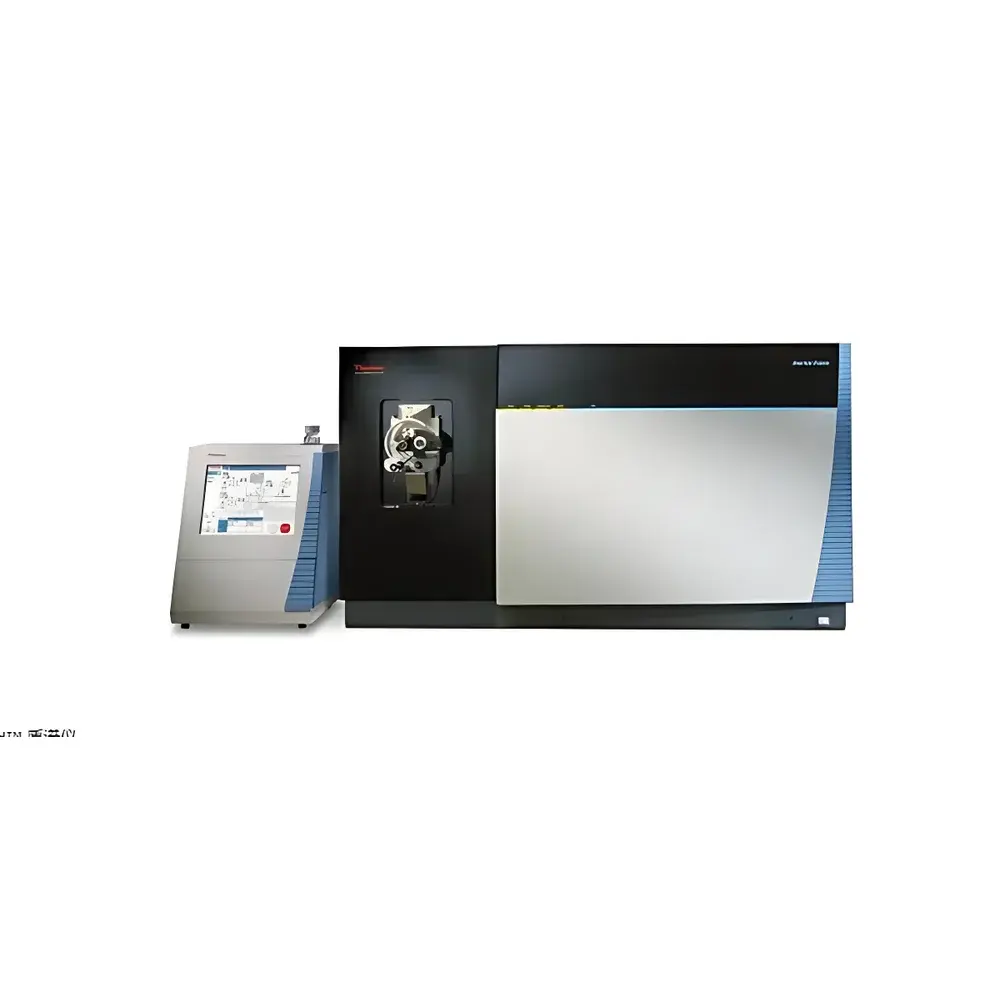
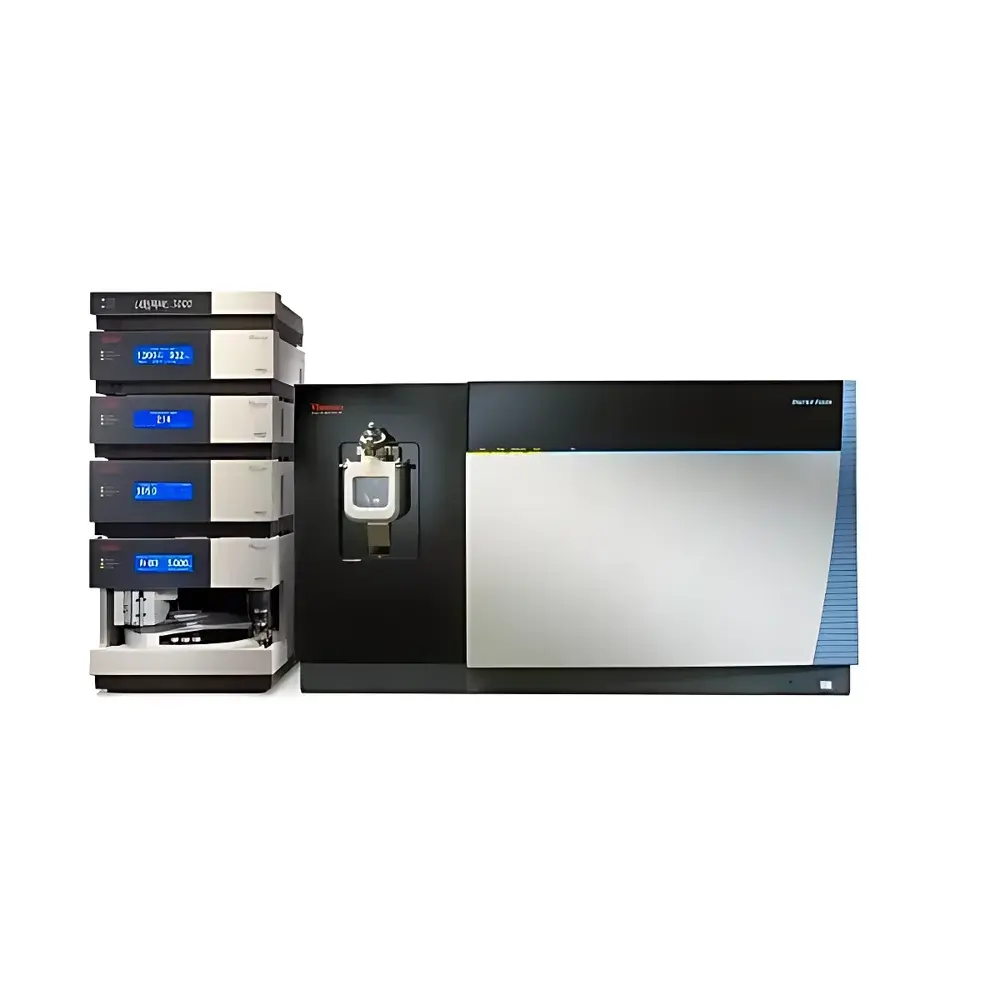
Thermo Scientific Orbitrap Fusion™ Tribrid™ Mass Spectrometer
| Brand | Thermo Fisher |
|---|---|
| Origin | USA |
| Manufacturer Type | Authorized Distributor |
| Product Category | Imported Instrument |
| Model | Orbitrap Fusion™ Tribrid™ |
| Instrument Type | Orbitrap-based Hybrid Mass Spectrometer |
| Application Scope | General-purpose Proteomics, Metabolomics, Glycomics, Intact Protein Analysis |
| Resolution | Up to 500,000 FWHM (at m/z 200) |
| Mass Accuracy | <1 ppm with internal calibration (EASY-IC™ option) |
| Scan Speed | Up to 20 Hz for MS/MS |
| Fragmentation Modes | CID, HCD, ETD (optional), and combinational MSⁿ (e.g., CID-HCD, HCD-CID, HCD-HCD) |
| Mass Range | Broad coverage from small molecules (<100 Da) to intact proteins (>50 kDa) |
| Ion Source Options | Easy-Max NG™, Ion Max NG™, Nanospray Flex NG™, EASY-ETD™ (optional), EASY-IC™ (optional) |
Overview
The Thermo Scientific Orbitrap Fusion™ Tribrid™ Mass Spectrometer is a high-performance hybrid mass spectrometry platform engineered for deep, quantitative, and structurally informative analysis across proteomics, metabolomics, glycomics, and intact biopharmaceutical characterization. Its Tribrid architecture integrates three complementary mass analyzers — a quadrupole mass filter, a linear ion trap (LTQ), and an Orbitrap mass analyzer — within a single vacuum system, enabling simultaneous or sequential operation with intelligent real-time decision-making. This architecture leverages the strengths of each component: the quadrupole provides high-resolution precursor selection; the ion trap delivers rapid, sensitive MSn with multiple dissociation techniques; and the Orbitrap delivers ultra-high mass resolution (up to 500,000 FWHM at m/z 200) and sub-ppm mass accuracy when paired with the optional EASY-IC™ internal calibration source. The instrument operates on the principle of electrostatic trapping and Fourier-transform detection in the Orbitrap cell, combined with resonant ejection and detection in the ion trap, ensuring robust reproducibility and analytical depth unmatched by single-analyzer platforms.
Key Features
- Tribrid Architecture: Concurrent use of quadrupole filtering, ion trap fragmentation/detection, and Orbitrap high-resolution detection enables flexible, multi-stage experiments without sacrificing duty cycle or sensitivity.
- Ultra-High Resolution & Mass Accuracy: Orbitrap analysis achieves ≤500,000 FWHM resolution and <1 ppm mass error with internal calibration — critical for confident identification of isobaric species, post-translational modifications (PTMs), and complex glycoforms.
- Dynamic Scan Management: Intelligent real-time control prioritizes precursor selection and fragmentation events based on signal intensity, charge state, and user-defined criteria — maximizing information content per LC peak.
- Multi-Modal Dissociation: Integrated CID, HCD, and optional ETD support comprehensive structural elucidation across diverse analyte classes; combinational MSn (e.g., HCD-CID) extends fragmentation depth for small molecules and glycans.
- High-Speed MS/MS Acquisition: Dual-pressure ion trap configuration and optimized ion optics enable up to 20 Hz MS/MS scan rates while maintaining spectral fidelity — essential for UHPLC-compatible workflows.
- Next-Generation Ion Sources: Easy-Max NG™, Nanospray Flex NG™, and optional EASY-ETD™ and EASY-IC™ sources deliver enhanced robustness, low-flow compatibility, and automated calibration — reducing method development time and operator dependency.
Sample Compatibility & Compliance
The Orbitrap Fusion™ Tribrid™ supports a broad range of sample types — from low-abundance peptides in complex biological digests to intact monoclonal antibodies (>150 kDa), synthetic metabolites, oligosaccharides, and synthetic polymers. It is routinely deployed in GLP- and GMP-regulated environments for biopharmaceutical characterization, where trace-level impurity profiling and higher-order structure assessment are required. The system complies with key regulatory expectations including FDA 21 CFR Part 11 (when used with compliant software configurations), ISO/IEC 17025 traceability requirements, and ASTM E2689–20 standards for mass spectrometric performance verification. Internal calibration via EASY-IC™ supports audit-ready mass accuracy documentation, and full electronic records (including raw data, method files, and audit trails) are retained in Thermo Scientific™ Chromeleon™ CDS and Proteome Discoverer™ environments.
Software & Data Management
The instrument is fully integrated with Thermo Scientific™ software ecosystem, including Proteome Discoverer™ 2.5+ for bottom-up and top-down proteomics, Compound Discoverer™ 3.3+ for untargeted metabolite identification, Pinpoint™ for targeted quantitation, and SIEVE™ for label-free differential expression analysis. All applications support FAIR data principles (Findable, Accessible, Interoperable, Reusable) and export standardized mzML/mzXML formats. Raw data files (.raw) are natively compatible with third-party tools such as Skyline, MaxQuant, and OpenMS. Instrument control software (Xcalibur™ 4.3+) includes built-in compliance features: electronic signatures, role-based access control, full audit trail logging, and secure data archiving — satisfying GLP/GMP documentation requirements for regulated laboratories.
Applications
- Deep shotgun proteomics with high-coverage identification and label-free or TMT/iTRAQ-based quantitation
- Intact mass analysis and subunit mapping of monoclonal antibodies and fusion proteins
- Structural characterization of N- and O-linked glycans using HCD-ETD hybrid workflows
- Metabolite identification and pathway mapping in untargeted metabolomics studies
- Top-down proteomics of histones and other PTM-rich proteins
- Impurity profiling and degradant identification in pharmaceutical stability studies
- Native MS analysis of protein complexes under non-denaturing conditions (with appropriate source tuning)
FAQ
What distinguishes the Tribrid architecture from conventional Orbitrap instruments?
The Tribrid design uniquely combines quadrupole precursor selection, ion trap MSn, and Orbitrap high-resolution detection in one platform — enabling parallel acquisition modes, real-time decision logic, and multi-modal fragmentation not possible on single-analyzer systems.
Is the system suitable for regulated bioanalysis (e.g., PK/PD studies)?
Yes — when configured with validated methods, audit-trail-enabled software (e.g., Chromeleon CDS), and documented IQ/OQ/PQ protocols, it meets FDA and EMA expectations for regulated quantitative bioanalysis.
Can it perform native mass spectrometry?
Yes — with appropriate ion source optimization (e.g., Nanospray Flex NG™ in low-energy mode) and buffer exchange, the system supports native MS of protein complexes up to ~1 MDa.
What data file formats does it generate?
Primary output is proprietary .raw format; conversion to open standards (mzML, mzXML) is supported natively in Xcalibur and via msConvert.
How is mass calibration maintained during long acquisitions?
Optional EASY-IC™ provides continuous internal calibration using lock-mass ions, ensuring <1 ppm mass accuracy over multi-hour LC-MS runs without manual recalibration.





