
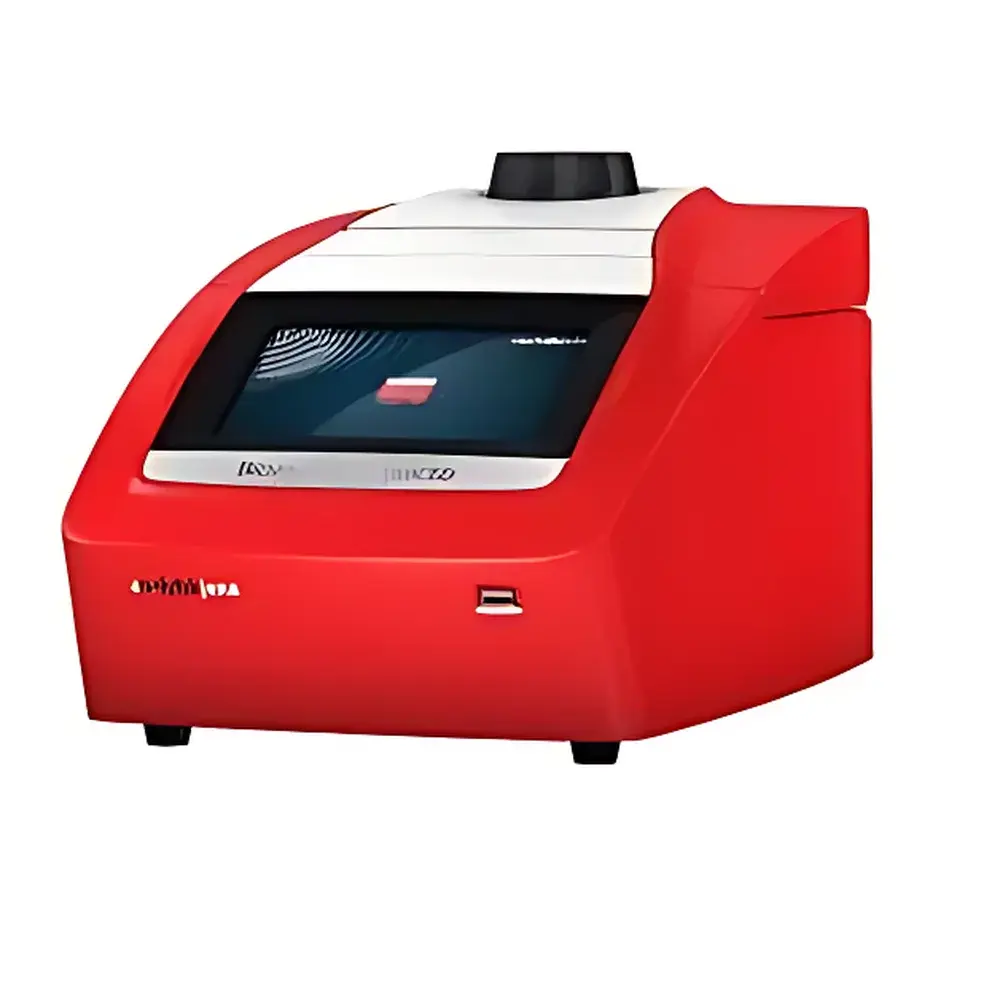
Analytik Jena Biometra TAdvanced 96 SG Gradient PCR Cycler
| Brand | Analytik Jena |
|---|---|
| Origin | Germany |
| Manufacturer Type | Authorized Distributor |
| Origin Category | Imported |
| Model | Biometra TAdvanced 96 SG |
| Instrument Type | Gradient PCR Thermal Cycler |
| Sample Capacity | 96-well format |
| Temperature Accuracy | ±0.1 °C |
| Temperature Uniformity | ±0.15 °C |
| Gradient Span | 40 °C (12-column linear or random gradient) |
| Heating/Cooling Rate | RAC-controlled ramping |
| Thermal Lid Temperature | Up to 110 °C |
| Noise Level | ≤45 dB(A) |
| Compliance | GLP-compliant logging, FDA 21 CFR Part 11-ready audit trail support (via software), ISO/IEC 17025-aligned operation |
Overview
The Analytik Jena Biometra TAdvanced 96 SG Gradient PCR Cycler is a high-precision, research-grade thermal cycler engineered for reproducible nucleic acid amplification under stringent laboratory conditions. Built upon Couette-flow–optimized aluminum heating blocks and governed by Ramping-Accuracy-Control (RAC) electronics architecture, the system delivers deterministic thermal transitions without overshoot or undershoot—ensuring consistent denaturation, annealing, and extension kinetics across all 96 wells. Its core measurement principle relies on closed-loop feedback control of Peltier-driven thermal modules, calibrated in real time via dual-point PT100 sensors with 25-year field-proven stability. Designed for molecular biology labs requiring regulatory traceability, the instrument meets foundational requirements for GLP-compliant workflows—including timestamped run logs, user-authenticated access, and non-erasable system self-test records.
Key Features
- RAC (Ramping-Accuracy-Control) thermal regulation ensures precise ramp rate modulation while maintaining ±0.1 °C absolute temperature accuracy and ±0.15 °C well-to-well uniformity across the full 96-well block.
- High-Performance Smart Lid (HPSL) with mechanical clutch mechanism applies uniform, pressure-independent sealing force—compatible with standard 0.2 mL tubes, 8-tube strips, and full-skirted 96-well plates without adapters or supports; lid temperature adjustable up to 110 °C.
- 12-column programmable gradient functionality spanning 40 °C, supporting both linear and user-defined non-linear temperature profiles per column—ideal for primer annealing optimization and multiplex assay development.
- Quick Block Exchange (QBE) enables tool-free, sub-5-second module swaps; firmware auto-detects block type (e.g., standard 96-well, dual-block configurations) and loads corresponding calibration parameters.
- Advanced User Management (AUM) enforces role-based access control with three hierarchical account tiers, individual password protection, and session-locked program visibility—each user sees only their five most recently executed protocols.
- Integrated thermal incubation mode operates continuously at user-defined temperatures (30–110 °C) for post-PCR holding, enzyme inactivation, or hybridization steps—functioning as a dedicated metal-block incubator.
- Drop-down PCR and touchdown cycling supported via cycle-dependent ramp offset programming, allowing progressive annealing temperature reduction over successive cycles.
- Preloaded template library includes optimized protocols for common applications (e.g., RT-PCR, qPCR prep, colony PCR); intelligent protocol builder accepts primer Tm, amplicon length, and cycle count to generate thermocycling schedules compliant with MIQE guidelines.
Sample Compatibility & Compliance
The TAdvanced 96 SG accommodates all ANSI/SBS-standard 96-well plates, skirted or unskirted, as well as 0.2 mL single tubes and 8-tube strips—regardless of manufacturer or wall thickness. Its HPSL design eliminates reliance on manual torque application, removing variability introduced by operator technique. From a compliance standpoint, the system supports full electronic record retention: every self-test (thermal ramp validation, lid pressure verification, gradient linearity check), run execution, and user login event is time-stamped, digitally signed, and stored in immutable internal memory. When paired with Analytik Jena’s optional CyBio Control software, the platform achieves FDA 21 CFR Part 11 readiness through electronic signatures, audit trail generation, and secure user authentication—aligning with ISO/IEC 17025 clause 5.9.1 for equipment verification and GLP Principle 5.2.2 regarding data integrity.
Software & Data Management
Instrument control and protocol management are handled via an embedded 7-inch capacitive touchscreen interface running a real-time Linux OS. Two editable view modes—tabular and graphical—are available for protocol construction, enabling rapid parameter adjustment by users preferring spreadsheet-style input or visual thermal profile visualization. All methods, results, and system diagnostics are exportable in CSV and PDF formats. Optional CyBio Control PC software extends functionality with remote monitoring, centralized fleet management, version-controlled method libraries, and automated report generation—including QC pass/fail flags based on preconfigured thermal deviation thresholds. Audit trails capture operator ID, timestamp, action type (e.g., “protocol modified”, “lid temperature changed”), and prior/post values—retained for ≥10 years per internal flash memory allocation.
Applications
This thermal cycler serves as a primary amplification platform in academic genomics cores, clinical molecular diagnostics laboratories, and pharmaceutical QC environments. Typical use cases include: optimization of multiplex PCR assays via gradient screening; high-fidelity amplification of GC-rich templates using touchdown protocols; preparation of NGS libraries requiring strict cycle number control; validation of CRISPR editing efficiency via endpoint PCR; and routine pathogen detection where thermal precision directly impacts sensitivity and specificity. Its low acoustic signature (<45 dB[A]) permits installation in shared open-lab spaces without disrupting adjacent electrophoresis or sequencing workflows.
FAQ
Does the TAdvanced 96 SG support external software integration via API or RS232/USB?
Yes—analytical software suites including CyBio Control offer COM/DCOM interfaces and RESTful endpoints for LIMS integration and automated workflow orchestration.
Can the instrument store more than five user-specific protocols?
Yes—the internal storage holds up to 1,000 protocols; the “five recent” display is UI-constrained for rapid access, not a capacity limit.
Is the PT100 sensor user-replaceable or field-calibratable?
No—sensors are factory-integrated and sealed within the aluminum block; calibration is performed during manufacturing and verified annually via certified service technicians using NIST-traceable references.
What safety certifications does the unit carry?
CE-marked per IEC 61010-1:2010, UL 61010-1, and RoHS 2011/65/EU; thermal lid conforms to EN 60335-1 mechanical safety requirements for heated surfaces.
How frequently should the self-test be performed?
Recommended before first use, after relocation, following extended idle periods (>72 hours), and prior to critical validation runs—though automated daily health checks occur at power-on.




