
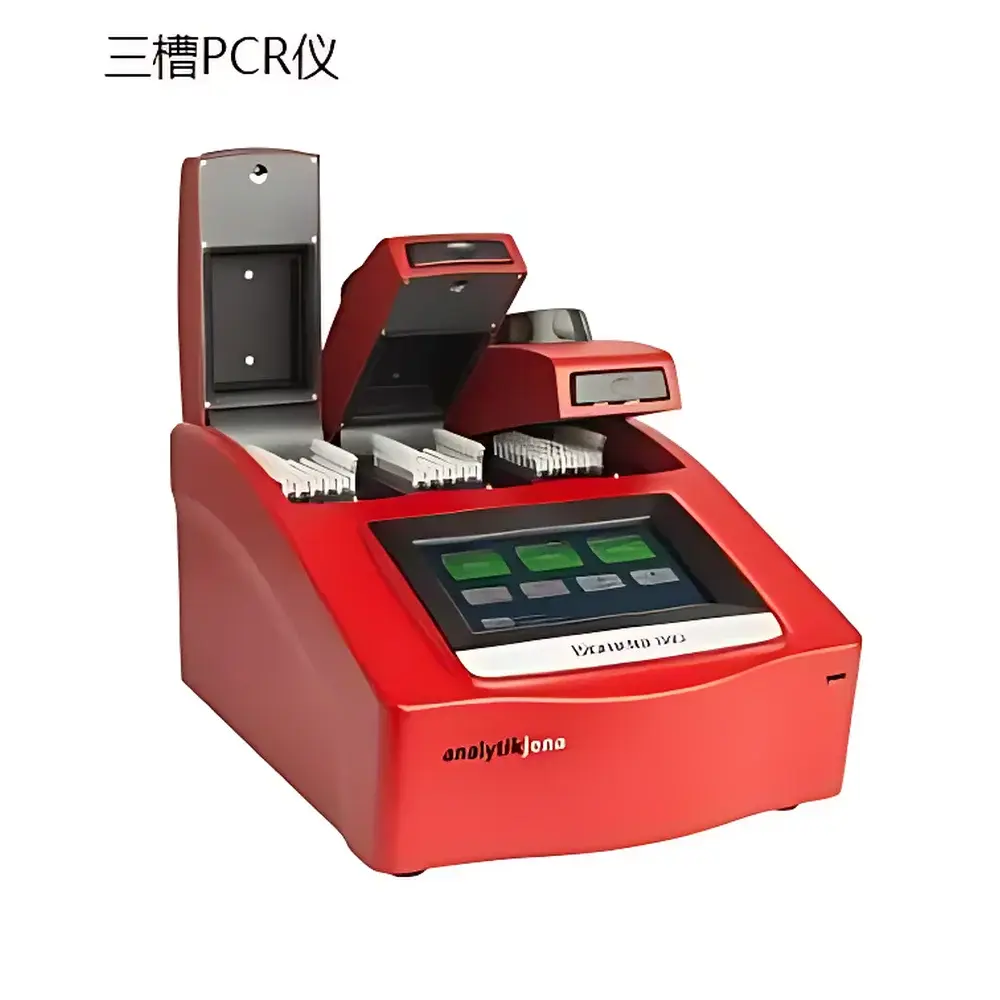
Analytik Jena TRIO Triple-Block PCR Thermocycler
| Brand | Analytik Jena |
|---|---|
| Origin | Germany |
| Model | TRIO |
| Instrument Type | Standard PCR Thermocycler |
| Sample Capacity | 144 (3 × 48-well blocks) |
| Heating Rate | 5 °C/s |
| Temperature Accuracy | ±0.1 °C |
| Block Uniformity | ±0.2 °C |
| Compatible Vessels | 48-well plates, 8-tube strips, 0.2 mL and 0.5 mL single tubes |
| Display | 7-inch capacitive color touchscreen (glove-compatible, anti-glare) |
| Noise Level | <35 dB(A) |
| Cooling/Heating Architecture | Bottom-intake, rear-exhaust airflow design |
| Power Recovery | Auto-restart after power interruption |
| Software Features | User-specific quick-start, built-in self-diagnostic, USB backup for protocols and user profiles |
| Build Heritage | Engineered with >30 years of PCR system expertise |
Overview
The Analytik Jena TRIO Triple-Block PCR Thermocycler is a high-efficiency, space-optimized thermal cycler engineered for laboratories requiring parallel amplification of nucleic acids without compromising precision or reproducibility. Unlike conventional single-block instruments, the TRIO integrates three independently controlled 48-well Peltier-based thermal blocks within a single chassis—enabling true concurrent execution of up to three distinct PCR protocols. This architecture leverages standard thermoelectric heating and cooling principles to deliver rapid, programmable thermal transitions across all blocks, supporting routine endpoint PCR, gradient optimization, and multi-target assay development. Each block operates with full thermal autonomy—allowing independent ramp rates, hold times, and cycling profiles—making the TRIO particularly suitable for labs managing diverse sample types, primer sets, or reaction conditions in a shared instrument environment.
Key Features
- Triple-Independent Thermal Blocks: Three physically separated 48-well aluminum blocks, each equipped with dedicated Peltier elements, temperature sensors, and firmware-controlled thermal regulation—eliminating cross-block thermal interference.
- Precision Thermal Performance: Achieves ±0.1 °C temperature accuracy across the full operating range (4–100 °C) and ±0.2 °C uniformity between wells within each block—validated per ISO/IEC 17025-compliant calibration procedures.
- Rapid Thermal Transitions: Maximum heating rate of 5 °C/s ensures reduced cycle times without sacrificing denaturation or annealing fidelity—critical for high-throughput screening and time-sensitive clinical workflows.
- Open-Format Consumable Compatibility: Supports standard 48-well plates, 8-tube strips, and individual 0.2 mL or 0.5 mL PCR tubes—no proprietary consumables required; compatible with both low-profile and standard-height vessels.
- Ergonomic Human-Machine Interface: 7-inch capacitive touchscreen with anti-reflective coating, optimized for glove use and ambient-lit lab environments; intuitive icon-driven navigation reduces training overhead and minimizes protocol entry errors.
- Acoustically Optimized Design: Sound-dampened enclosure and vibration-isolated thermal modules maintain operational noise below 35 dB(A)—meeting ISO 7730 guidelines for laboratory acoustic comfort.
- Robust System Integrity: Built-in hardware self-diagnostic suite performs pre-run verification of block calibration, sensor responsiveness, and power stability; auto-restart functionality preserves protocol continuity following unexpected power loss.
Sample Compatibility & Compliance
The TRIO accommodates standard nucleic acid amplification formats without mechanical adapters or software restrictions. Its open consumable policy supports legacy and third-party tubes and plates validated under ISO 13485 and ASTM E2500 for diagnostic reagent compatibility. While not an IVD device itself, the instrument meets essential requirements for GLP and GMP-aligned environments—including audit-trail-capable user session logging (via optional PC connectivity), secure user profile management, and traceable firmware versioning. It complies with EN 61000-6-3 (EMC) and EN 61000-6-2 (immunity) standards, and its electrical safety conforms to EN 61010-1 for laboratory equipment.
Software & Data Management
The onboard firmware enables local storage of ≥1,000 protocols and ≥500 user profiles. USB 2.0 ports support encrypted backup and restore of method files, user configurations, and run history logs—facilitating compliance with FDA 21 CFR Part 11 when paired with validated external LIMS integration. No cloud dependency: all critical control logic resides on-device. Optional Analytik Jena qPCR Suite (v5.x) provides extended export options (CSV, PDF, XML) and batch analysis templates aligned with MIQE reporting guidelines.
Applications
- High-throughput genotyping and SNP screening across multiple loci simultaneously
- Parallel optimization of annealing temperatures using independent gradient modes per block
- Batch processing of clinical specimens (e.g., respiratory panels, STI multiplex assays) with staggered start times
- Teaching laboratories requiring simultaneous demonstration of different PCR variables (e.g., Mg²⁺ concentration, primer Tm)
- QC/QA workflows where instrument uptime and protocol reproducibility are governed by internal SOPs referencing ISO/IEC 17025 clause 5.9
FAQ
Can the three blocks run different ramp rates within the same protocol?
Yes—each block is fully programmable with independent ramp rate settings (0.1–5.0 °C/s), hold durations, and cycle counts.
Is the TRIO compliant with FDA 21 CFR Part 11 for electronic records?
The device supports Part 11–aligned practices (audit trails, electronic signatures via external software); full compliance requires validated configuration and procedural controls implemented at the institutional level.
Does it support gradient PCR?
Yes—each block offers linear gradient capability across a 30 °C span (e.g., 50–80 °C), configurable per block.
What maintenance is required beyond routine cleaning?
No scheduled recalibration is needed; periodic verification using NIST-traceable reference standards is recommended annually per ISO/IEC 17025 Annex A.3.
Can I export raw temperature-time data for each well?
Real-time block temperature logs (per-second resolution) are exportable via USB in CSV format; well-level thermal profiling requires external thermocouple validation per ASTM E2259.





