
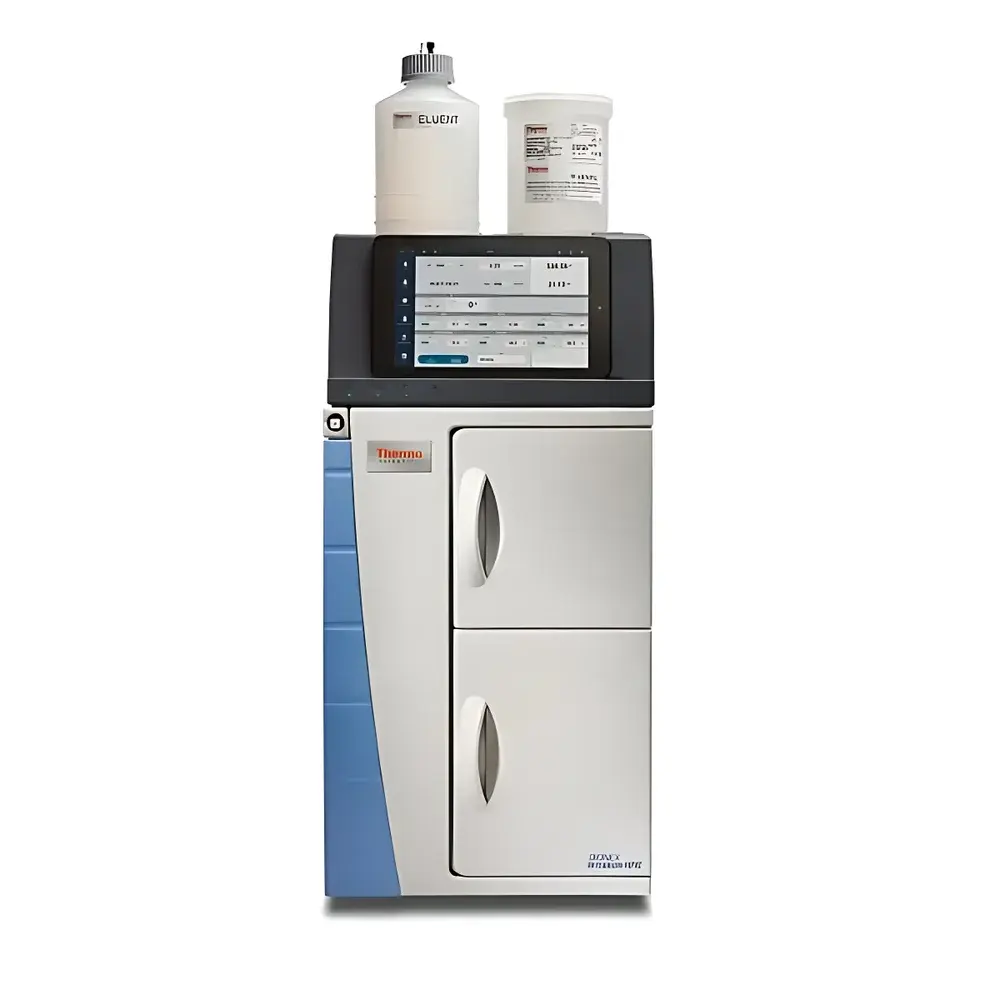
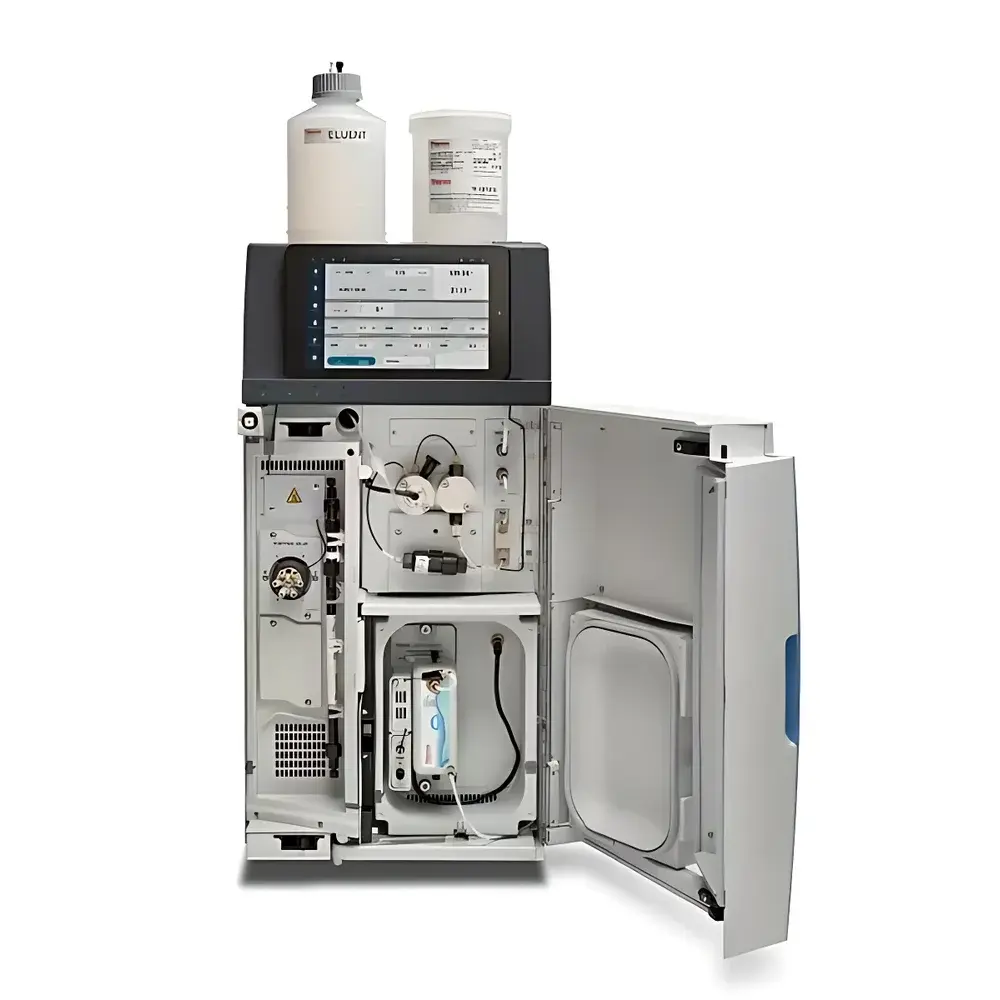
Thermo Scientific Dionex Integrion HPIC System
| Brand | Thermo Fisher |
|---|---|
| Origin | USA |
| Manufacturer Type | Authorized Distributor |
| Category | Imported Instrument |
| Model | Integrion™ HPIC™ |
| Instrument Type | Laboratory |
| Application Scope | General-Purpose |
| Pump Pressure Rating | 6000 psi |
| Flow Rate Range | 0.001–22.4 mL/min |
| Eluent Flow Rate Range | 0.001–22.4 mL/min |
| Maximum Operating Pressure | 5000 psi |
| Operating Temperature Range | Ambient +5°C to 80°C |
| Temperature Reproducibility | ±0.05°C |
| Eluent Concentration Range | 0.1–100 mM (dependent on eluent chemistry) |
Overview
The Thermo Scientific Dionex Integrion HPIC System is a high-pressure ion chromatography platform engineered for precision, robustness, and operational continuity in regulated and research laboratory environments. Based on suppressed conductivity detection and compatible with both anion- and cation-exchange chemistries, the system employs high-efficiency, low-dispersion flow paths and pressure-stable gradient delivery to support rapid, high-resolution separations of inorganic and small organic ions—including fluoride, chloride, nitrate, sulfate, phosphate, sodium, potassium, ammonium, and transition metal cations. Its 5000 psi maximum operating pressure enables use of sub-4 µm particle-packed columns—such as the Dionex IonPac AS23-4µm or CS19-4µm—delivering enhanced peak capacity, reduced analysis time, and improved sensitivity without compromising baseline stability or retention time reproducibility. The system’s architecture complies with fundamental requirements for GLP and GMP workflows, including hardware-level pressure and temperature monitoring, real-time flow verification, and integrated audit trail readiness for FDA 21 CFR Part 11–compliant data systems.
Key Features
- High-Pressure Capability: Sustains up to 5000 psi for accelerated separations using high-efficiency microbore and capillary columns; pump rated to 6000 psi for long-term reliability and safety margin.
- Automated Eluent Generation (EG): Eliminates manual eluent preparation errors by generating precise, stable gradients from high-purity reagent cartridges—ensuring method transferability and inter-laboratory reproducibility across applications such as EPA Method 300.1, ASTM D4327, and ISO 14911.
- Intelligent Consumables Monitoring: Embedded sensors track column lifetime, suppressor performance, and EG cartridge usage; logs installation dates, cumulative pressure exposure, and regeneration cycles—supporting predictive maintenance and compliance documentation.
- Thermally Controlled Detection Environment: Conductivity cell housed in a temperature-regulated chamber (±0.05°C stability) minimizes thermal noise and drift, critical for trace-level quantitation in environmental and pharmaceutical water testing.
- Modular Detector Options: Interchangeable conductivity and pulsed amperometric detection (PAD) modules allow seamless adaptation between routine anion/cation analysis and carbohydrate or amino acid profiling without hardware reconfiguration.
- Tool-Free Fluidic Interface: PEEK Viper fingertight fittings enable rapid, leak-free connections with <100 nL dead volume—reducing carryover and improving peak shape integrity during method development or multi-analyte screening.
Sample Compatibility & Compliance
The Integrion HPIC System accommodates aqueous samples across diverse matrices—including drinking water, wastewater, biological fluids (e.g., serum, urine), food extracts, and pharmaceutical excipients—following appropriate filtration (0.22 µm) and dilution protocols. It supports standard regulatory methods issued by the U.S. EPA, ASTM International, ISO, and the European Pharmacopoeia. Column oven temperature control (ambient +5°C to 80°C, ±0.05°C) ensures retention time stability required for validated methods under ICH Q2(R2) and USP . All system firmware and software modules are designed to interface with LIMS and electronic lab notebook (ELN) platforms compliant with 21 CFR Part 11 when deployed with appropriate access controls and electronic signature configurations.
Software & Data Management
Controlled via Chromeleon Chromatography Data System (CDS) v7.3 or later, the Integrion HPIC integrates full audit trail logging, user role-based permissions, electronic signature capture, and raw data integrity safeguards. Method templates include pre-configured sequences for common applications (e.g., anion analysis per EPA 300.1, organic acid profiling in fermentation broths). Real-time health diagnostics—accessible via the detachable tablet interface—display pressure profiles, flow accuracy deviations, detector baseline noise metrics, and consumables remaining life. All instrument parameters, sequence logs, and calibration records are stored in encrypted, timestamped binary format with SHA-256 checksum validation to ensure ALCOA+ (Attributable, Legible, Contemporaneous, Original, Accurate, Complete, Consistent, Enduring, Available) data governance.
Applications
- Environmental monitoring: Quantification of regulated anions (Cl⁻, NO₃⁻, SO₄²⁻) and cations (Na⁺, NH₄⁺, Ca²⁺) in surface water, groundwater, and wastewater per EPA Methods 300.0, 300.1, and 316.0.
- Pharmaceutical quality control: Testing of counterions in active pharmaceutical ingredients (APIs), residual acetate or chloride in biologics formulations, and ionic impurities per ICH Q3D and USP /.
- Food and beverage safety: Nitrate/nitrite determination in processed meats, sulfite analysis in wines, and organic acid profiling (lactic, citric, malic) in dairy and fruit products.
- Electrolyte and battery material analysis: Li⁺, PF₆⁻, and TFSI⁻ quantification in lithium-ion electrolyte solutions; trace metal cation contamination in cathode slurries.
- Research applications: Speciation studies of redox-active ions (e.g., Cr(III)/Cr(VI), As(III)/As(V)), coupled with post-column reaction and UV/Vis detection.
FAQ
What is the maximum recommended operating pressure for routine use?
The system is rated for continuous operation at up to 5000 psi; the pump itself is rated to 6000 psi for transient pressure spikes and extended service life.
Can the Integrion HPIC be used with non-suppressed detection modes?
Yes—while optimized for suppressed conductivity detection, it supports non-suppressed configurations using high-capacity, low-noise conductivity cells and compatible eluents (e.g., benzoic acid for cation analysis).
Is Chromeleon CDS validation support available for regulated labs?
Thermo Fisher provides IQ/OQ documentation packages, 21 CFR Part 11 configuration guides, and third-party validation assistance through certified partners.
How does the Eluent Generator handle carbonate/bicarbonate eluents?
The EG module supports KOH, methanesulfonic acid (MSA), and NaOH-based eluents; carbonate/bicarbonate gradients require external eluent reservoirs and are not generated in situ.
What column dimensions and chemistries are validated for use at 5000 psi?
All Dionex IonPac columns with 4 µm particle size—including AS23-4µm, CS19-4µm, AS18-4µm, and CS16-4µm—are fully qualified for operation at full system pressure with appropriate guard column pairing and flow rate optimization.






