
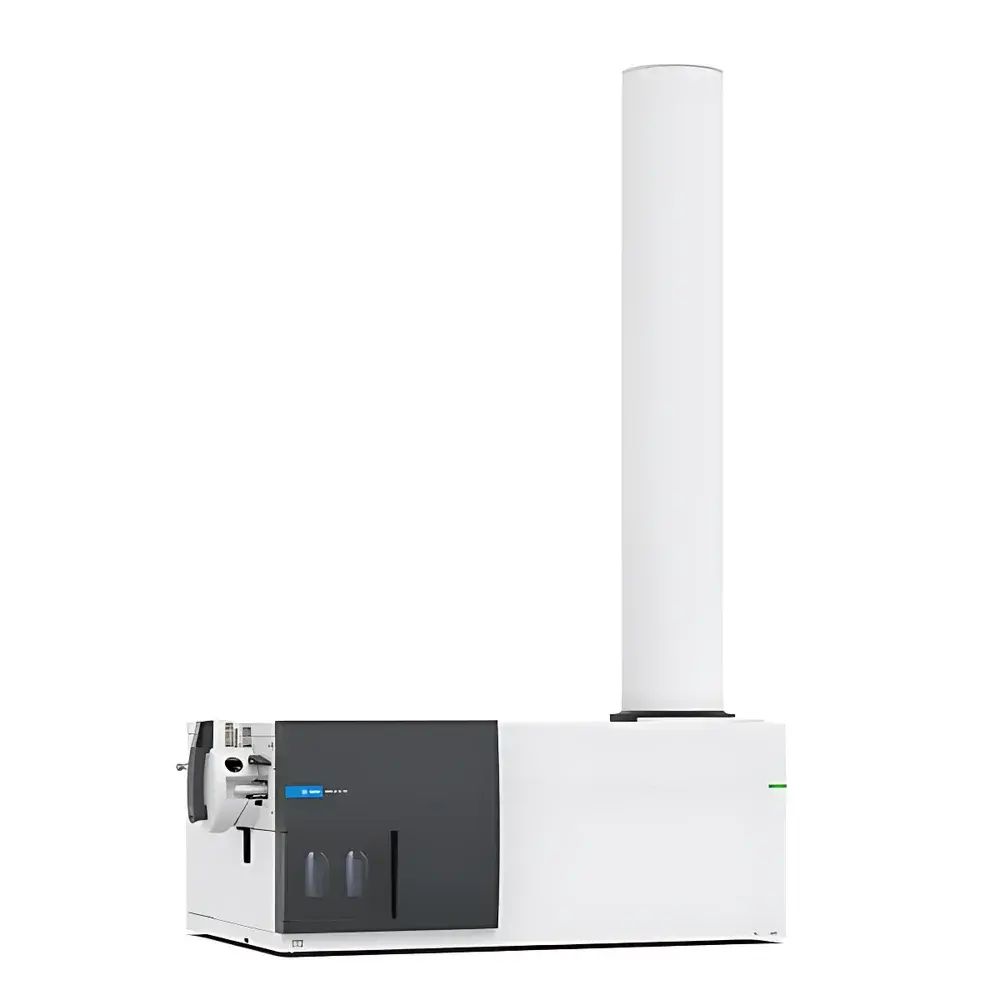
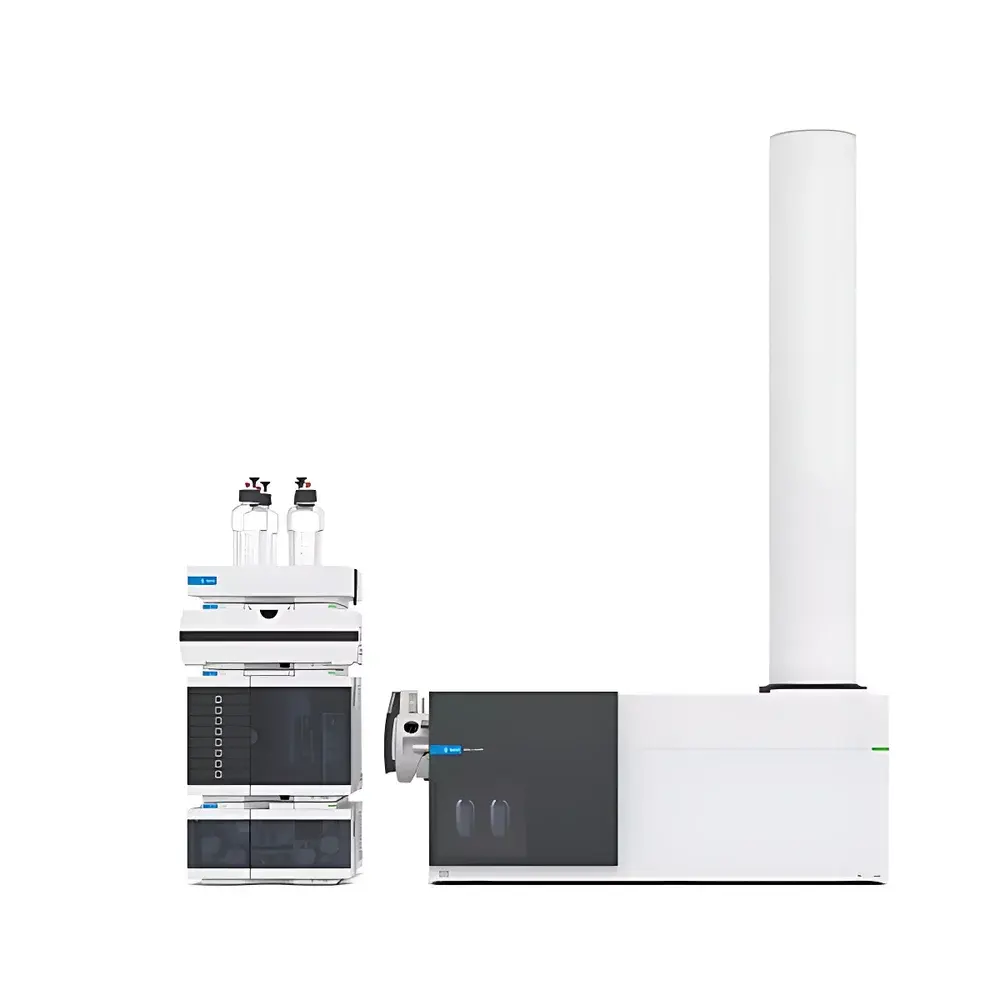
Agilent 6546 Q-TOF Liquid Chromatography Quadrupole Time-of-Flight Mass Spectrometer
| Brand | Agilent Technologies |
|---|---|
| Origin | Singapore |
| Instrument Type | Quadrupole-Time-of-Flight (Q-TOF) |
| Application Scope | Universal LC-MS Platform for Untargeted and Targeted Screening |
| Mass Range | Consult factory specification |
| Sensitivity | Consult factory specification |
| Resolution | >60,000 (high m/z), >30,000 (low m/z) |
| Mass Accuracy | <1 ppm (internal calibration), <2 ppm (external calibration) |
| Isotopic Fidelity | ±5% |
| Pressure Range | Consult factory specification |
Overview
The Agilent 6546 Q-TOF Liquid Chromatography Mass Spectrometer is a high-performance quadrupole-time-of-flight (Q-TOF) platform engineered for precision untargeted and targeted analysis across diverse application domains—including metabolomics, food authenticity verification, environmental contaminant screening, and food safety monitoring. Its hybrid architecture integrates a high-transmission RF-only quadrupole with a reflectron-based orthogonal acceleration time-of-flight mass analyzer, enabling simultaneous acquisition of full-scan MS and MS/MS spectra at high resolution and sub-ppm mass accuracy without compromising duty cycle or sensitivity. The system operates under vacuum conditions maintained by a dual-stage turbomolecular pumping system, ensuring stable ion transmission and long-term spectral reproducibility. Designed for compatibility with standard UHPLC systems—including Agilent 1290 Infinity II—the 6546 delivers robust chromatographic separation coupled with high-fidelity mass spectral data suitable for retrospective data mining and structural elucidation.
Key Features
- Mass resolution exceeding 60,000 (at m/z 1,222) and >30,000 (at m/z 200), supporting confident compound identification in complex matrices;
- Internal mass calibration accuracy better than 1 ppm RMS and external calibration accuracy below 2 ppm—enabling reliable elemental composition assignment;
- Isotopic fidelity within ±5% deviation from theoretical distributions, critical for distinguishing isobaric interferences and validating molecular formulae;
- In-source collision-induced dissociation (CID) and quadrupole-resolved all-ion (Q-RAI) acquisition modes for concurrent targeted and suspect-screening workflows;
- Modular ion source design permitting rapid exchange of ESI, APCI, and multimode configurations without venting the mass spectrometer;
- Integrated SmartTune automation for real-time optimization of ion optics, collision energy, and detector gain—minimizing manual method development effort;
- High-dynamic-range detection spanning five orders of magnitude in a single acquisition, preserving low-abundance analytes alongside dominant matrix components.
Sample Compatibility & Compliance
The 6546 Q-TOF accommodates liquid samples introduced via standard LC interfaces, including reversed-phase, HILIC, and ion-pairing chromatography. It supports both positive- and negative-ion mode operation, facilitating broad-spectrum coverage of polar and nonpolar metabolites, lipids, peptides, and small-molecule contaminants. The instrument complies with key regulatory frameworks governing analytical instrumentation in regulated environments: data integrity features align with FDA 21 CFR Part 11 requirements, including electronic signature support, audit trail logging, and user-access controls. System validation documentation adheres to ICH Q2(R2) guidelines for method performance characterization and supports GLP/GMP-compliant laboratory operations. Routine operation meets ISO/IEC 17025 criteria for testing laboratories when deployed with validated SOPs and calibrated reference standards.
Software & Data Management
Data acquisition and processing are managed through Agilent MassHunter Workstation software (version B.09.00 or later), offering integrated tools for peak detection, alignment, deconvolution, and statistical analysis. The platform includes dedicated workflows for untargeted metabolomics (Metabolite ID Browser), lipidomics (LipidBuilder), and food authenticity (FoodScreener), each preconfigured with curated exact-mass spectral libraries—such as pesticide, mycotoxin, veterinary drug, extractable/leachable, and water pollutant databases. All raw data files (.d format) are stored in vendor-neutral, open-format archives compatible with third-party informatics platforms (e.g., Compound Discoverer, XCMS Online, Skyline). Audit trails record every processing step—including parameter changes, peak integration edits, and library search events—to satisfy traceability requirements in regulated settings.
Applications
- Metabolomics & Lipidomics: High-resolution, accurate-mass profiling of endogenous metabolites and lipid species in biological fluids, tissues, and cell lysates;
- Food Safety & Authenticity: Multi-residue screening of pesticides, antibiotics, and adulterants; origin verification using stable-isotope-ratio-informed metabolic fingerprinting;
- Environmental Monitoring: Detection and structural confirmation of emerging contaminants—including PFAS, pharmaceutical residues, and microplastic leachates—in wastewater, soil extracts, and biota;
- Pharmaceutical Development: Impurity profiling, degradation product identification, and biotransformation studies during preclinical ADME assessment;
- Clinical Research: Biomarker discovery in plasma, urine, and CSF using differential expression analysis combined with in silico fragmentation prediction.
FAQ
What ionization sources are supported on the 6546 Q-TOF?
The system ships standard with electrospray ionization (ESI); optional configurations include atmospheric pressure chemical ionization (APCI) and multimode (ESI/APCI) sources.
Can the 6546 be used for quantitative analysis?
Yes—when operated in targeted MS/MS mode with scheduled MRM-like acquisition (e.g., using MassHunter Quantitative Analysis software), it supports semi-quantitative and validated quantitative workflows with appropriate internal standards.
Is remote system monitoring available?
Agilent’s OpenLab CDS and MassHunter Remote Access modules enable secure off-site instrument control, status reporting, and real-time data review via web browser or mobile interface.
How is mass calibration performed?
Calibration can be executed internally using a dual-standard infusion (e.g., tune mix), externally via continuous flow introduction, or dynamically during acquisition using lock-mass correction with a co-eluting reference compound.
Does the system support automated method development?
SmartTune functionality enables automated optimization of fragmentor voltage, collision energy, and skimmer settings based on user-defined compound classes and retention time windows.






