
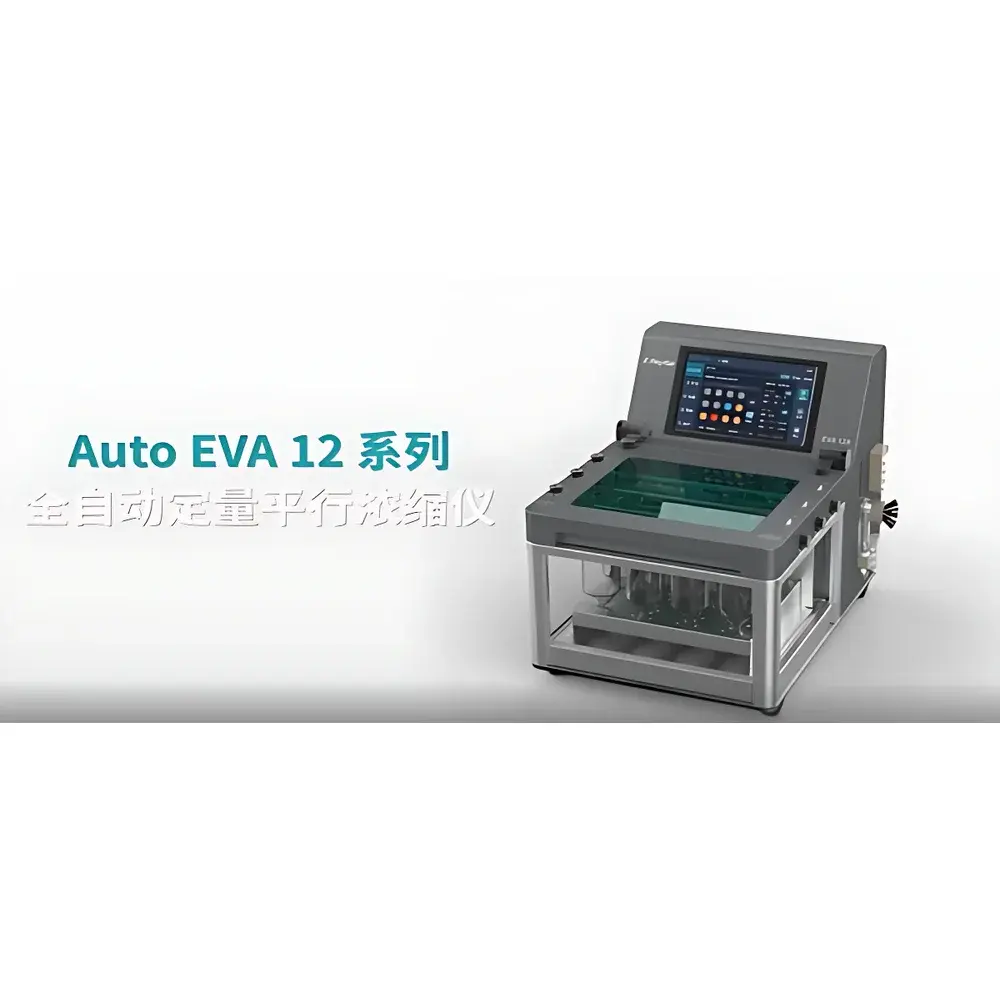
Ruike Auto EVA 12 Automated Quantitative Parallel Evaporator
| Origin | Fujian, China |
|---|---|
| Manufacturer Type | Authorized Distributor |
| Origin Category | Domestic (PRC) |
| Model | Auto EVA 12 |
| Instrument Type | Automated Quantitative Nitrogen Evaporation System |
| Sample Capacity | 12 positions |
| Temperature Control | Water-bath heating with uniform thermal distribution |
| Concentration Endpoint Detection | Optical liquid-level sensing in sample tail tubes |
| Endpoint Volumes | 0.5 mL or 1.0 mL (user-selectable) |
| Gas Flow Control | Adjustable single-channel and gradient nitrogen flow |
| Sample Tube Compatibility | 65 mL and 260 mL tubes (angle- and height-adjustable nitrogen needles) |
| User Interface | 10-inch capacitive touchscreen with integrated control logic |
| Auxiliary Functions | Auto drain/fill for water bath, integrated LED illumination, triple-side transparent viewing window |
| Compliance | Designed to support GLP-compliant workflows |
Overview
The Ruike Auto EVA 12 is an automated quantitative parallel evaporator engineered for reproducible, unattended solvent removal from liquid samples under controlled nitrogen gas flow and uniform water-bath heating. It operates on the principle of combined convective gas stripping and conductive thermal transfer: nitrogen gas is delivered via precision-positioned, angle-adjustable nozzles in a fixed-angle oblique orientation—generating a controlled vortex at the liquid surface. This turbulent interfacial flow reduces local vapor-phase partial pressure, thereby enhancing evaporation kinetics without inducing splashing or cross-contamination. Simultaneously, the thermostatically regulated water bath ensures homogeneous heat delivery across all 12 sample positions, minimizing inter-channel temperature gradients that compromise quantitative accuracy. Unlike open-air rotary evaporation or passive air-drying methods, the Auto EVA 12 maintains closed-system integrity during operation, mitigating analyte loss, oxidation, and environmental contamination—critical for trace-level analysis in regulated environments.
Key Features
- Optical endpoint detection system: Non-contact infrared or photoelectric sensors monitor liquid meniscus position within sample tail tubes, enabling precise termination at user-defined volumes (0.5 mL or 1.0 mL).
- Independent channel nitrogen flow regulation: Each of the 12 channels supports real-time, stepwise, or gradient gas flow programming—adapting dynamically as sample volume decreases to maintain consistent evaporation rates.
- Modular nozzle assembly: Nitrogen needles are vertically and angularly adjustable to accommodate varying tube geometries—including standard 65 mL and large-format 260 mL collection tubes—without hardware modification.
- Triple-sided transparent acrylic chamber: Provides full visual access to all sample tubes during operation, facilitating manual verification of meniscus stability, foam formation, or unexpected precipitation.
- Integrated water-bath management: Programmable auto-fill and auto-drain functions reduce operator intervention between runs; embedded LED lighting enhances visibility under low-ambient conditions.
- 10-inch industrial-grade touchscreen HMI: Hosts an embedded control firmware supporting simultaneous configuration of bath temperature setpoint, gas flow profiles, endpoint criteria, and alarm thresholds—all without external PC dependency.
Sample Compatibility & Compliance
The Auto EVA 12 accepts standard borosilicate glass test tubes and tapered collection vials conforming to common laboratory dimensions (e.g., 16 × 100 mm, 18 × 150 mm). Its mechanical design accommodates both narrow-neck and wide-mouth formats through adjustable needle positioning. The system does not require consumable cartridges or proprietary vessels, ensuring compatibility with existing labware inventories. From a regulatory perspective, the instrument’s deterministic endpoint logic, parameter logging capability, and alarm-triggered event recording align with core expectations of Good Laboratory Practice (GLP) and analytical method validation frameworks (e.g., ICH Q2(R2)). While the device itself is not FDA 21 CFR Part 11 certified out-of-the-box, its operational logs—including timestamped temperature, flow, and endpoint events—can be exported in CSV format for integration into validated electronic lab notebook (ELN) or LIMS platforms supporting audit-trail requirements.
Software & Data Management
The onboard firmware implements a deterministic state-machine architecture: all critical parameters—including bath temperature, per-channel nitrogen flow rate, elapsed time, and optical sensor status—are logged at 1-second intervals and stored internally for up to 1,000 complete run records. Data export is supported via USB flash drive in comma-separated values (CSV) format, with column headers compliant with ISO/IEC 17025 documentation standards (e.g., “Run_ID”, “Start_Timestamp”, “Endpoint_Volume_mL”, “Final_Temp_C”, “Channel_1_Flow_sccm”). No cloud connectivity or remote telemetry is implemented, preserving data sovereignty and eliminating cybersecurity exposure vectors common in networked lab instruments. Firmware updates are performed offline via signed binary files loaded from authenticated USB media.
Applications
The Auto EVA 12 serves as a front-end sample preparation tool across disciplines requiring quantitative solvent removal prior to instrumental analysis. In food safety laboratories, it enables high-throughput concentration of pesticide residues extracted from fruit homogenates prior to GC-MS/MS analysis. Environmental testing labs utilize it for pre-concentration of trace pharmaceuticals and endocrine disruptors from wastewater influent—where preservation of thermolabile compounds necessitates gentle, non-boiling evaporation. In pharmaceutical QC, the system supports residual solvent removal from API intermediates per ICH Q3C guidelines, with endpoint precision critical for accurate %w/w calculations. Academic research groups apply it to metabolite enrichment in untargeted LC-HRMS workflows, where inter-run consistency directly impacts multivariate statistical power. Its 12-channel parallelism significantly reduces batch processing time compared to sequential single-tube evaporators—particularly valuable in method development and validation studies demanding triplicate or quadruplicate replicates.
FAQ
What types of solvents are compatible with the Auto EVA 12?
The system is validated for use with common low-boiling organic solvents (e.g., hexane, ethyl acetate, dichloromethane, acetonitrile) and aqueous mixtures. High-boiling solvents (e.g., DMSO, glycerol) or viscous matrices require method-specific optimization of gas flow and bath temperature.
Can the instrument be integrated into a robotic liquid handling workflow?
It features standard 3U rack-mount dimensions and dry-contact I/O ports (start/stop, alarm output), enabling synchronization with third-party automation controllers—but lacks native API or Ethernet-based command protocols.
Is calibration of the optical endpoint sensor required?
The sensor is factory-calibrated against NIST-traceable volumetric standards; users may perform periodic verification using certified pipette tips filled to target volumes (0.5 mL or 1.0 mL) inserted into empty sample tubes.
Does the water bath support refrigerated cooling?
No—the system relies exclusively on resistive heating elements; ambient cooling occurs passively after shutdown. For thermally labile analytes, users must select appropriate bath temperatures (typically 30–60 °C) and optimize nitrogen flow to avoid localized overheating.
How is maintenance performed on the nitrogen delivery system?
Each channel includes a replaceable stainless-steel needle and inline particulate filter; annual inspection of O-rings and gas manifold seals is recommended per manufacturer’s preventive maintenance schedule.



