
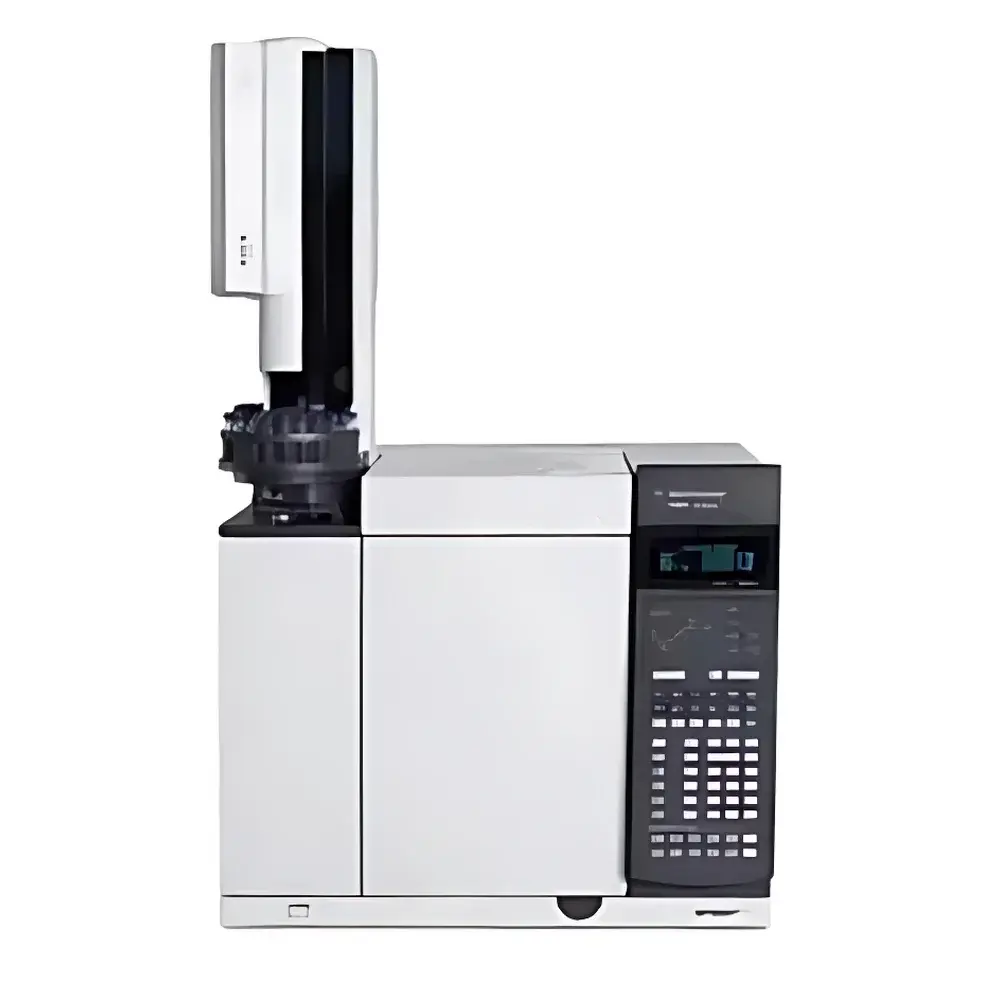
Agilent 7890B Gas Chromatograph System
| Brand | Agilent Technologies |
|---|---|
| Origin | USA |
| Model | 7890B |
| Instrument Type | Laboratory Gas Chromatograph |
| Application Scope | General-Purpose |
| Temperature Control Accuracy | ±0.01 °C |
| Electronic Pressure Control (EPC) Resolution | 0.001 psi |
| Inlet Operating Temperature Range | Up to 450 °C |
| Oven Temperature Range | 35 °C to 450 °C |
| Maximum Ramp Rate | 120 °C/min |
| Column Cooling Rate (to 50 °C) | <3.5 min |
| Carrier Gas Options | Helium, Hydrogen, Nitrogen, Argon |
| EPC Pressure Range | 0–100 psi (helium/hydrogen), 0–150 psi (nitrogen/argon) |
| Total Flow Range | 0–1200 mL/min |
| Detection Limits | FID – 1.8 pg C/s (n-decane) |
Overview
The Agilent 7890B Gas Chromatograph System is a high-performance, modular laboratory GC platform engineered for precision, robustness, and method transferability across diverse analytical environments. Based on proven capillary gas chromatography principles, it separates volatile and semi-volatile compounds via differential partitioning between a mobile phase (inert carrier gas) and a stationary phase (coated capillary column), with detection achieved through selective physicochemical responses. Its architecture integrates advanced thermal management, real-time electronic gas control, and hardware-level reproducibility features—making it suitable for regulated QC laboratories, environmental testing facilities, petrochemical R&D, food safety screening, and forensic toxicology workflows where retention time stability, peak shape fidelity, and inter-laboratory comparability are critical.
Key Features
- Electronic Pressure Control (EPC) Architecture: Delivers sub-millibar pressure resolution and drift-compensated flow regulation across all inlets and detectors, ensuring consistent retention time (<0.02 min RSD) and peak area reproducibility (<1.0% RSD) over extended sequences.
- Retention Time Locking (RTL): A software-hardware synchronization protocol that enables precise retention time alignment across instruments, columns, and laboratories—validated per ASTM D7213 and ISO 16000-6 for environmental VOC analysis.
- Cryogenic Flow Technology (CFT): Supports true multidimensional configurations including GC-GC with Deans switching, comprehensive two-dimensional GC (GC×GC) with thermal or flow modulators, and programmable column backflush—enhancing peak capacity and co-elution resolution without hardware modification.
- Low Thermal Mass (LTM) Column Modules: Up to four independently controlled LTM modules can be installed simultaneously, reducing column heating/cooling cycles by >70% versus conventional ovens—enabling rapid method development and high-throughput screening under GLP-compliant conditions.
- Multi-Mode Inlet (MMI): Configurable as split/splitless, cool-on-column, or programmed temperature vaporizing (PTV) inlet—optimized for trace-level analysis of thermally labile or high-boiling compounds while minimizing degradation artifacts.
- Inert Flow Path Technology: Siltek-treated liners, deactivated transfer lines, and ultra-low-bleed columns minimize adsorption and catalytic decomposition—critical for accurate quantitation of active analytes such as organic acids, amines, and organophosphates.
Sample Compatibility & Compliance
The 7890B accommodates liquid, gaseous, and headspace samples across matrices including water, soil extracts, polymer leachates, biological fluids, and refinery streams. It complies with key regulatory frameworks including USP , EPA Methods 502.2, 524.2, 8021B, and 8260D; ISO 17025-accredited labs routinely deploy it for accredited testing. All EPC modules support 21 CFR Part 11–compliant audit trails when paired with OpenLab CDS software, enabling full traceability of method parameters, calibration events, and user actions during GMP audits.
Software & Data Management
Controlled via Agilent OpenLab CDS (ChemStation Edition or EZChrom Edition), the system supports automated sequence execution, real-time diagnostics, and integrated calibration curve generation. Raw data files (.D format) are stored with embedded metadata—including instrument configuration, column history, and environmental logs—for long-term archival and reprocessing. The software includes built-in tools for peak integration validation (per ICH Q2(R2)), system suitability assessment (tailing factor, resolution, %RSD), and report templating aligned with LIMS export requirements.
Applications
- Environmental monitoring: Pesticide residues (EPA 8081B), PAHs (EPA 8270D), BTEX in groundwater (EPA 8260D)
- Petrochemical analysis: Hydrocarbon group typing (ASTM D5186), gasoline oxygenates (ASTM D4815)
- Pharmaceutical impurity profiling: Residual solvents (ICH Q3C), genotoxic impurities (ICH M7)
- Food & flavor chemistry: Volatile aroma compounds, lipid oxidation products, adulterant screening
- Forensic toxicology: Blood alcohol quantitation (ASTM E2901), drug metabolite identification
FAQ
Does the 7890B support hydrogen as a carrier gas?
Yes—its EPC system is fully validated for hydrogen operation with integrated hydrogen sensor alarms and automatic shutdown protocols compliant with NFPA 55 and OSHA guidelines.
Can RTL be applied across different Agilent GC models?
Yes—RTL is interoperable between 6890, 7890, and 8890 series instruments when using identical column dimensions and temperature programs.
Is OpenLab CDS required for 21 CFR Part 11 compliance?
Yes—only OpenLab CDS with enabled electronic signatures, audit trail logging, and role-based access control meets FDA’s technical requirements for electronic records and signatures.
What maintenance intervals are recommended for EPC modules?
Agilent recommends quarterly verification of pressure calibration against NIST-traceable standards and annual replacement of EPC internal seals per preventive maintenance schedule PM-7890B-01.
How does the large valve oven (LVO) improve method flexibility?
The LVO maintains precise temperature control (±0.1 °C) over multi-valve manifolds and auxiliary devices—enabling synchronized actuation of up to six pneumatic valves for complex heart-cutting or parallel column methods without external heating enclosures.
Related Products





