
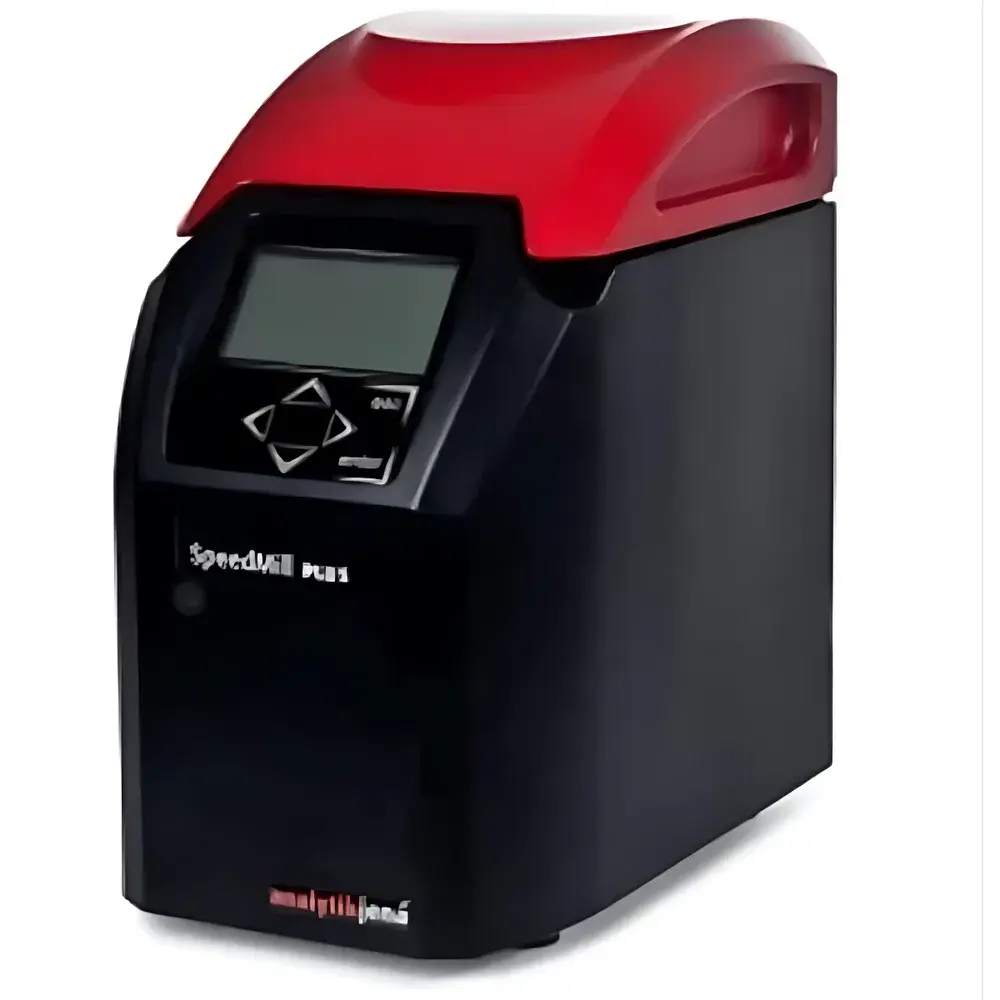
analytikjena SpeedMill Plus Benchtop High-Throughput Bead Mill Homogenizer
| Brand | analytikjena |
|---|---|
| Origin | Germany |
| Model | SpeedMill Plus |
| Instrument Type | Benchtop Homogenizer |
| Instrument Subtype | Tissue Disruption Homogenizer |
| Sample Throughput | 20 samples per run |
| Cooling Method | Pre-chilled sample holders (e.g., -80 °C) |
| Operating Principle | Vertical bead-beating with high-frequency oscillation |
Overview
The analytikjena SpeedMill Plus is a benchtop high-throughput bead mill homogenizer engineered for rapid, reproducible, and temperature-controlled mechanical lysis of biological samples. It operates on the principle of high-frequency vertical oscillation, driving inert grinding beads within sealed sample tubes to deliver controlled impact energy to cellular structures. Unlike rotor-stator or probe-based systems, this design eliminates shear-induced heating and cross-contamination risks while maintaining sample integrity—particularly critical for downstream applications requiring native conformation of nucleic acids, proteins, enzymes, or metabolites. The instrument is optimized for laboratories performing routine extraction workflows in genomics, proteomics, microbiome research, and environmental sample analysis where throughput, consistency, and biomolecular stability are non-negotiable.
Key Features
- High-throughput parallel processing: Simultaneous homogenization of up to 20 samples in standard 2 mL or 7 mL tubes, enabling scalable workflow integration without manual intervention between runs.
- Thermal management by design: Sample holders are compatible with pre-cooling at temperatures as low as –80 °C; no liquid nitrogen or dry ice required during operation, minimizing operational complexity and safety hazards.
- Gentle yet effective lysis: Optimized oscillation frequency and amplitude ensure efficient disruption of tough matrices—including Gram-positive bacteria, fungal cell walls, plant cellulose, and fibrous animal tissues—while limiting thermal denaturation and enzymatic degradation.
- Modular tube compatibility: Supports a wide range of commercially available lysing matrix tubes (e.g., silica/zirconia beads, stainless steel beads), allowing method optimization for specific sample types and downstream assays.
- Robust architecture and user safety: Constructed with precision-machined aluminum housing, vibration-dampening feet, and an interlocked lid mechanism that halts operation upon opening—compliant with IEC 61010-1 for laboratory equipment safety.
Sample Compatibility & Compliance
The SpeedMill Plus accommodates diverse biological and environmental matrices: mammalian and avian tissues, plant leaves and roots, soil suspensions, fecal pellets, bacterial cultures (including Bacillus and Mycobacterium spp.), yeasts, and filamentous fungi. Its closed-tube system prevents aerosol generation and meets biosafety level 2 (BSL-2) containment requirements when used with appropriate tube sealing. For regulated environments, the device supports GLP-compliant documentation through external logging of run parameters (time, frequency, cooling status); while not intrinsically 21 CFR Part 11–certified, it integrates seamlessly with validated LIMS or ELN platforms for audit-trail generation.
Software & Data Management
The SpeedMill Plus operates via an intuitive front-panel interface with programmable presets for time (10 s–5 min), frequency (10–30 Hz), and pause intervals. All settings are retained after power cycling. No proprietary software is required for basic operation; however, optional RS-232 or USB connectivity enables remote parameter control and run log export (CSV format) for traceability. Laboratories implementing ISO/IEC 17025 or CAP-accredited workflows may configure external data acquisition systems to record timestamped operational metadata aligned with sample IDs.
Applications
- High-yield genomic DNA and total RNA isolation from challenging tissues (e.g., liver, spleen, brain) and microbial biofilms.
- Preparation of whole-cell lysates for native PAGE, co-immunoprecipitation, or enzyme activity assays.
- Routine microbiome profiling via 16S rRNA or ITS amplicon sequencing—especially for low-biomass samples like soil or air filters.
- Extraction of intracellular metabolites under quenching conditions for untargeted metabolomics.
- Standardized sample preparation in QC/QA labs supporting pharmacopeial methods (e.g., USP <2021> for microbial enumeration in pharmaceuticals).
FAQ
What types of grinding beads are recommended for different sample classes?
Zirconium oxide beads (0.1–0.5 mm) are optimal for soft tissues and cultured cells; stainless steel beads (2–3 mm) enhance lysis efficiency for spores, yeast, and Gram-positive bacteria.
Can the SpeedMill Plus be used for protein extraction without denaturation?
Yes—when combined with chilled buffers and pre-cooled holders, it preserves epitope integrity and enzymatic function better than sonication or French press methods.
Is validation support available for GMP environments?
analytikjena provides IQ/OQ documentation templates and performance qualification protocols aligned with ASTM E2500 and ISO 13485 frameworks.
How does the vertical oscillation mechanism differ from horizontal shaker mills?
Vertical motion ensures uniform bead trajectory and consistent energy transfer across all tube positions—reducing inter-sample variability and improving reproducibility in multi-well formats.
What maintenance is required for long-term reliability?
Routine inspection of the rubber damping gasket and periodic calibration of the oscillation frequency sensor using supplied test weights—no lubrication or internal servicing needed.



