
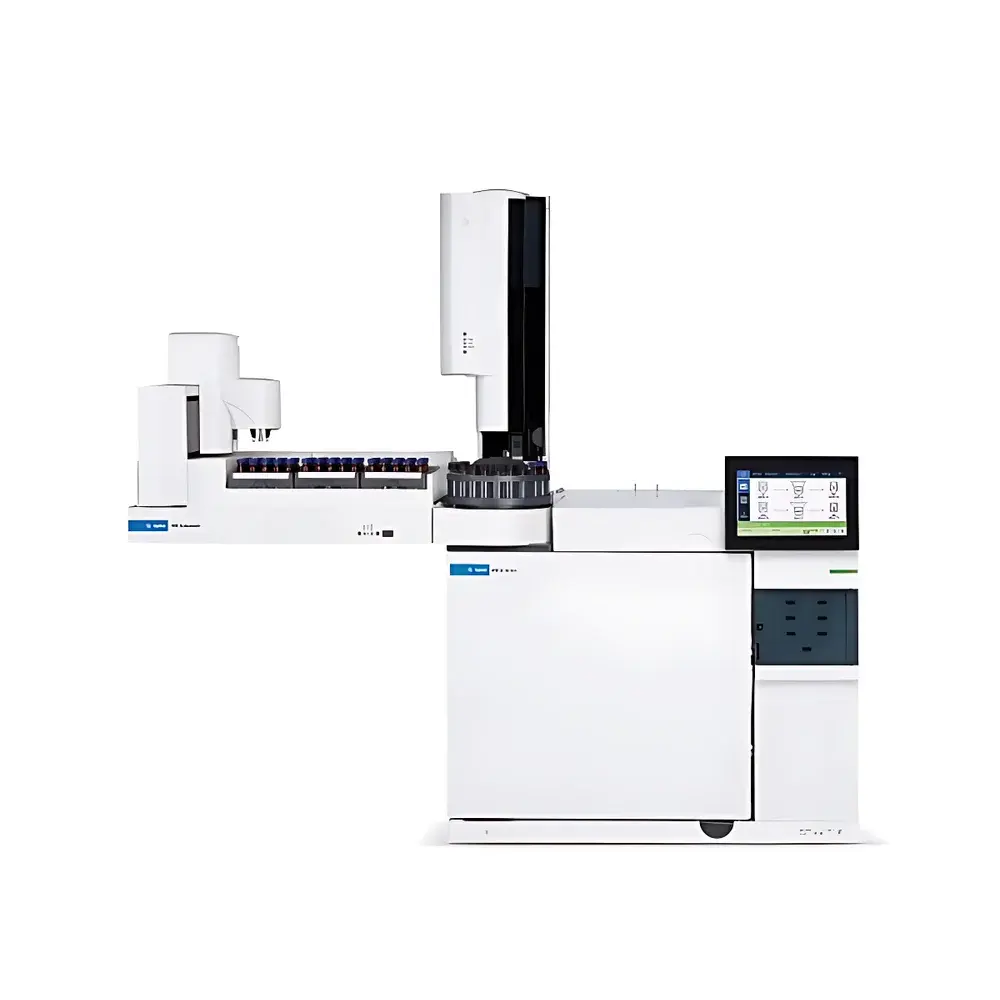
Agilent 8860 Gas Chromatograph System
| Brand | Agilent Technologies |
|---|---|
| Origin | USA |
| Instrument Type | Laboratory Gas Chromatograph |
| Application Scope | General-Purpose |
| Temperature Control Range | Not Specified |
| Ramp Rate | Not Specified |
| Cool-down Rate | Not Specified |
| Carrier Gas Flow Range & Control | Not Specified |
| Carrier Gas Pressure Range & Control | Not Specified |
| Injector Maximum Operating Temperature | Not Specified |
| Injector Pressure Setpoint Range | Not Specified |
| Injector Total Flow Setpoint Range | Not Specified |
Overview
The Agilent 8860 Gas Chromatograph System is a robust, modular laboratory GC platform engineered for precision, operational continuity, and method transferability in routine analytical environments. Built upon Agilent’s sixth-generation microfluidic electronic pressure control (EPC) architecture, the system employs gas-phase separation principles—where analytes are volatilized, partitioned between a mobile phase (inert carrier gas) and stationary phase (capillary column), and differentially eluted based on polarity, boiling point, and molecular interaction kinetics. Designed for compliance-ready workflows, the 8860 supports regulated environments requiring traceable instrument operation, audit-ready data handling, and consistent retention time performance across instruments and laboratories.
Key Features
- Sixth-generation microfluidic EPC architecture—resistant to particulate, moisture, and hydrocarbon contamination—ensures long-term pneumatic stability and extended service intervals.
- Full electronic pressure and flow control across all inlets and detectors, delivering <0.01 psi pressure resolution and sub-1% RSD for retention time and peak area reproducibility.
- Integrated intelligent diagnostics: automated baseline anomaly detection (e.g., drift, ghost peaks, elevated noise), detector verification with calibration standard evaluation, and real-time status reporting via embedded firmware.
- 10.1-inch full-color capacitive touchscreen interface providing direct access to method parameters, real-time chromatograms, hardware configuration maps, and system health dashboards.
- Browser-based remote user interface compatible with Windows, macOS, and iOS/Android tablets—enabling method editing, sequence management, diagnostic execution, and instrument monitoring from any network-accessible location.
- Environmental compensation algorithms for ambient temperature and barometric pressure—minimizing retention time variability and baseline instability without manual recalibration.
- Helium conservation module and integrated hydrogen sensor support safe, flexible alternative carrier gas deployment—including hydrogen leak detection and automatic shutdown protocols per IEC 61000-6-4 and OSHA 1910.103.
- Flame Ionization Detector (FID) with auto-ranging gain control and 10⁷ linear dynamic range, enabling accurate quantitation across concentration orders of magnitude without dilution or re-injection.
- Single-filament Thermal Conductivity Detector (TCD) with zero-reference design—eliminating need for reference gas supply or manual bridge balance adjustment, ensuring drift-free baselines over extended runs.
Sample Compatibility & Compliance
The Agilent 8860 accommodates a broad spectrum of volatile and semi-volatile organic compounds—including hydrocarbons, pesticides, residual solvents, environmental pollutants (e.g., PAHs, PCBs), and pharmaceutical impurities—when paired with appropriate capillary columns (e.g., 5%-phenyl methylpolysiloxane, polyethylene glycol). It meets essential regulatory expectations for GLP and GMP-aligned laboratories: full support for 21 CFR Part 11-compliant electronic signatures and audit trails when used with Agilent OpenLab CDS; alignment with ISO/IEC 17025 method validation requirements; and compatibility with ASTM D3606, USP , and EPA Method 8260/8270 workflows. All firmware updates and diagnostic logs are timestamped, user-attributed, and exportable in CSV or PDF formats for internal quality review.
Software & Data Management
The system operates natively with Agilent OpenLab CDS (ChemStation Edition or EZChrom Edition), offering full method development, sequence scheduling, peak integration, calibration curve generation, and report templating. For labs requiring streamlined analysis without full compliance functionality, the optional DA Express software provides intuitive integration, area normalization, external standard calibration, and customizable reporting—while maintaining raw data integrity in native .D format. All EPC/EPR pressure and flow values are logged at 100-ms intervals and embedded within acquisition files, supporting retrospective troubleshooting and method robustness assessment. Data backups, user role assignment, and secure LDAP/Active Directory integration are configurable through OpenLab’s centralized administration console.
Applications
The Agilent 8860 serves as a primary analytical tool across multiple sectors: quality control of petrochemical feedstocks and finished fuels (ASTM D1319, D5599); residual solvent testing in APIs per ICH Q3C guidelines; environmental analysis of soil/water extracts (EPA SW-846 Methods); flavor and fragrance profiling in food matrices; and forensic toxicology screening of volatiles in biological specimens. Its dual-inlet, triple-detector, and triple-valve expandability enables simultaneous analysis of complex samples using heart-cutting or comprehensive two-dimensional GC (GC×GC) configurations—without hardware modification or vendor-specific add-ons.
FAQ
Does the 8860 support 21 CFR Part 11 compliance?
Yes—when deployed with Agilent OpenLab CDS and properly configured user roles, electronic signatures, and audit trail settings.
Can retention times be locked across different Agilent GC systems?
Yes—the built-in Retention Time Locking (RTL) feature ensures ±0.02 min reproducibility across instruments running identical methods and columns.
Is helium the only supported carrier gas?
No—the system supports helium, hydrogen, nitrogen, and argon; hydrogen operation includes integrated safety interlocks and real-time leak monitoring.
What level of maintenance is required for the sixth-generation EPC module?
No routine recalibration is needed; the microfluidic design eliminates mechanical wear, and preventive maintenance is limited to inlet liner replacement, septum change, and column trimming per standard GC practice.
Can the touchscreen interface be disabled for security reasons?
Yes—touchscreen access can be restricted via user-level permissions in OpenLab CDS; all critical functions remain available through the browser UI or API-driven automation.
Related Products






