
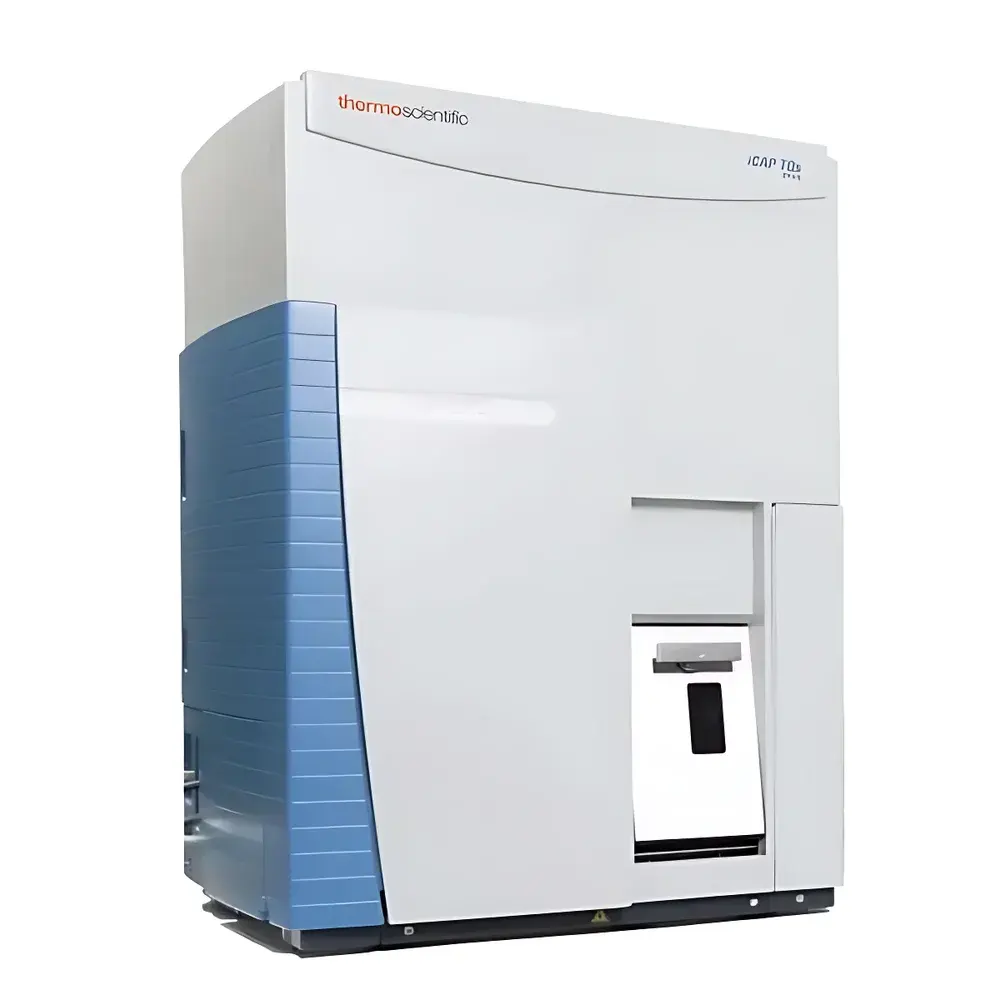
Thermo Scientific iCAP™ TQ ICP-MS Inductively Coupled Plasma Triple Quadrupole Mass Spectrometer
| Brand | Thermo Fisher |
|---|---|
| Origin | USA |
| Model | iCAP™ TQ ICP-MS |
| Instrument Type | Triple Quadrupole ICP-MS |
| Application Environment | Laboratory |
| Mass Range (amu) | Available upon consultation |
| Unit Mass Resolution (amu) | Available upon consultation |
| Detection Limit (ng·L⁻¹) | Available upon consultation |
| Sensitivity (Mcps / mg·L⁻¹) | Available upon consultation |
| Short-term Stability (RSD) | Available upon consultation |
| Long-term Stability (RSD) | Available upon consultation |
Overview
The Thermo Scientific iCAP™ TQ ICP-MS is a high-performance triple quadrupole inductively coupled plasma mass spectrometer engineered for uncompromised interference removal, ultra-trace elemental quantification, and robust operation in regulated laboratory environments. Unlike conventional single-quadrupole or magnetic sector ICP-MS systems, the iCAP TQ employs a true triple quadrupole configuration—comprising Q1 (mass filter), Q2 (collision/reaction cell), and Q3 (mass analyzer)—to enable selective mass-to-charge filtering before and after gas-phase reactions. This architecture delivers deterministic control over polyatomic interferences (e.g., 40Ar16O+, 40Ar40Ar+, 140Ce16O+) through on-mass or mass-shift reaction pathways using reactive gases such as O2, NH3, or H2. Designed for laboratories requiring compliance with ISO/IEC 17025, ASTM D5673, USP , and EPA Method 200.8, the system supports trace metal analysis in semiconductor-grade chemicals, high-purity reagents, geological digests, environmental waters, and biological matrices where spectral overlap and matrix-induced signal suppression are critical constraints.
Key Features
- Triple quadrupole mass filtering architecture enabling precise precursor ion selection (Q1), controlled reaction chemistry in pressurized Q2 cell, and product ion detection (Q3) for unambiguous interference elimination
- Integrated Reaction Finder software module that recommends optimal reaction gases, cell parameters, and mass transitions based on analyte–interference thermodynamics and kinetic data—reducing method development time by up to 70% compared to manual optimization
- Dry scroll vacuum pump system for Q0 and Q1 stages, eliminating oil backstreaming and minimizing maintenance intervals while maintaining stable base pressure (<1×10⁻⁷ mbar)
- Qtegra ISDS software with full 21 CFR Part 11 compliance support, including electronic signatures, audit trail logging, role-based access control, and secure data archiving
- Automated sample introduction with optional integrated dilution, laser ablation coupling (via NWR or UP series), and hyphenated speciation modules (HPLC-ICP-MS, CE-ICP-MS)
- Robust RF plasma interface with auto-tuned matching network and real-time plasma monitoring via auxiliary detector signals
Sample Compatibility & Compliance
The iCAP TQ ICP-MS accommodates liquid samples (aqueous acids, organic solvents, HF-containing digests), laser-ablated solids, and vaporized species from hyphenated separation techniques. It meets stringent requirements for GLP/GMP-regulated workflows through hardware-level security features—including tamper-evident firmware signing—and software-enforced procedural controls. The system complies with ISO 17025:2017 clause 7.7 (ensuring measurement traceability), ASTM D5673-22 (for ultratrace metals in water), and EU Directive 2009/48/EC (toy safety testing). All calibration, QC, and sample run records are stored in immutable format within Qtegra ISDS, supporting FDA inspection readiness and internal quality audits.
Software & Data Management
Qtegra Intelligent Scientific Data Solution (ISDS) serves as the unified platform for instrument control, data acquisition, processing, and reporting. Its modular architecture includes dedicated plugins for automated standard addition, isotope ratio calculation (with dead-time correction and mass bias modeling), nanoparticle size distribution analysis (using time-resolved LA-ICP-MS), and redox speciation (e.g., As(III)/As(V), Cr(III)/Cr(VI)). Raw data files (.raw) are stored in vendor-neutral HDF5 format with embedded metadata (instrument settings, gas flows, dwell times, integration windows). Audit trails record all user actions—including parameter edits, calibration updates, and report exports—with timestamps, operator IDs, and IP addresses. Data export options include CSV, PDF, XML, and direct LIMS integration via ASTM E1384-compliant interfaces.
Applications
- Semiconductor manufacturing: Quantification of sub-pg/g contaminants (e.g., Fe, Cu, Ni, Na) in ultrapure water, photoresists, and etchants per SEMI C1–C36 standards
- Geochemistry: High-precision isotope ratio measurements (e.g., 87Sr/86Sr, 143Nd/144Nd) with interference-free monitoring of isobaric overlaps
- Environmental monitoring: Multi-element analysis of drinking water per EPA 200.8 revision 5.1, including U, Th, and actinides at sub-ng/L levels
- Pharmaceutical QA/QC: Elemental impurity screening per ICH Q3D guidelines, particularly for catalyst residues (Pd, Pt, Rh) in active pharmaceutical ingredients
- Food safety: Detection of toxic elements (Cd, Pb, As, Hg) in infant formula and dietary supplements aligned with FDA Guidance for Industry (2022)
FAQ
What distinguishes triple quadrupole ICP-MS from single quadrupole or sector-field instruments?
Triple quadrupole ICP-MS provides deterministic interference removal through two-stage mass selection—unlike single quadrupole systems relying solely on collision/reaction cell chemistry without precursor filtering, or sector-field instruments limited to fixed resolution modes.
Does the iCAP TQ support isotopic ratio measurements for geochemical applications?
Yes—the system enables high-precision isotope ratio analysis with stability suitable for long-duration runs; optional multi-collector upgrade available for enhanced precision.
Can the Reaction Finder tool be used with custom reaction gases not listed in the default database?
Yes—users may define new reaction pathways and thermodynamic parameters via the Advanced Reaction Editor, subject to validation per ISO/IEC 17025 method verification requirements.
Is remote monitoring and diagnostics supported?
Qtegra ISDS includes secure web-based remote access with TLS 1.3 encryption, allowing real-time status checks, log review, and limited parameter adjustments under defined administrative permissions.
How is instrument performance verified during routine operation?
Daily performance checks include tuning solution (e.g., 1 µg/L Li/Y/Ce/Tl) assessment for sensitivity, oxide formation rate (<2%), and doubly charged ion ratio (<3%), all logged automatically in the audit trail.
Related Products







