
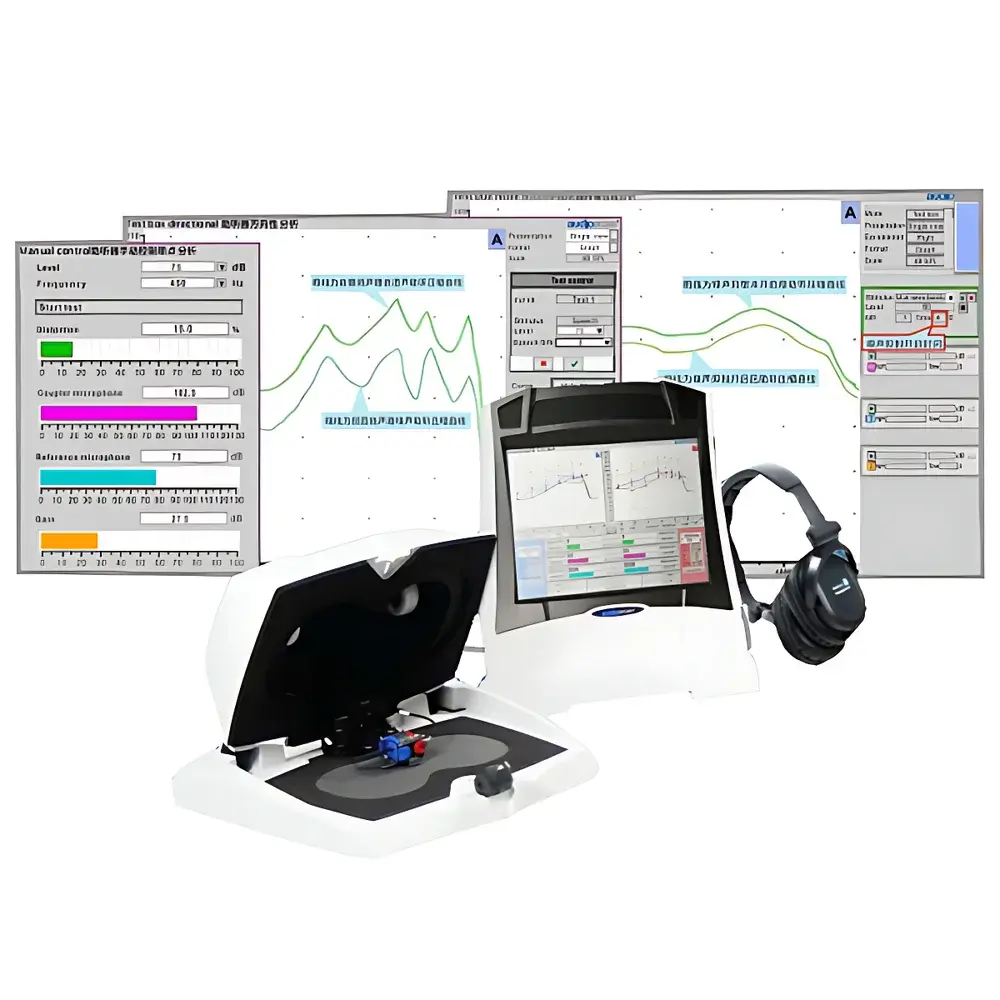
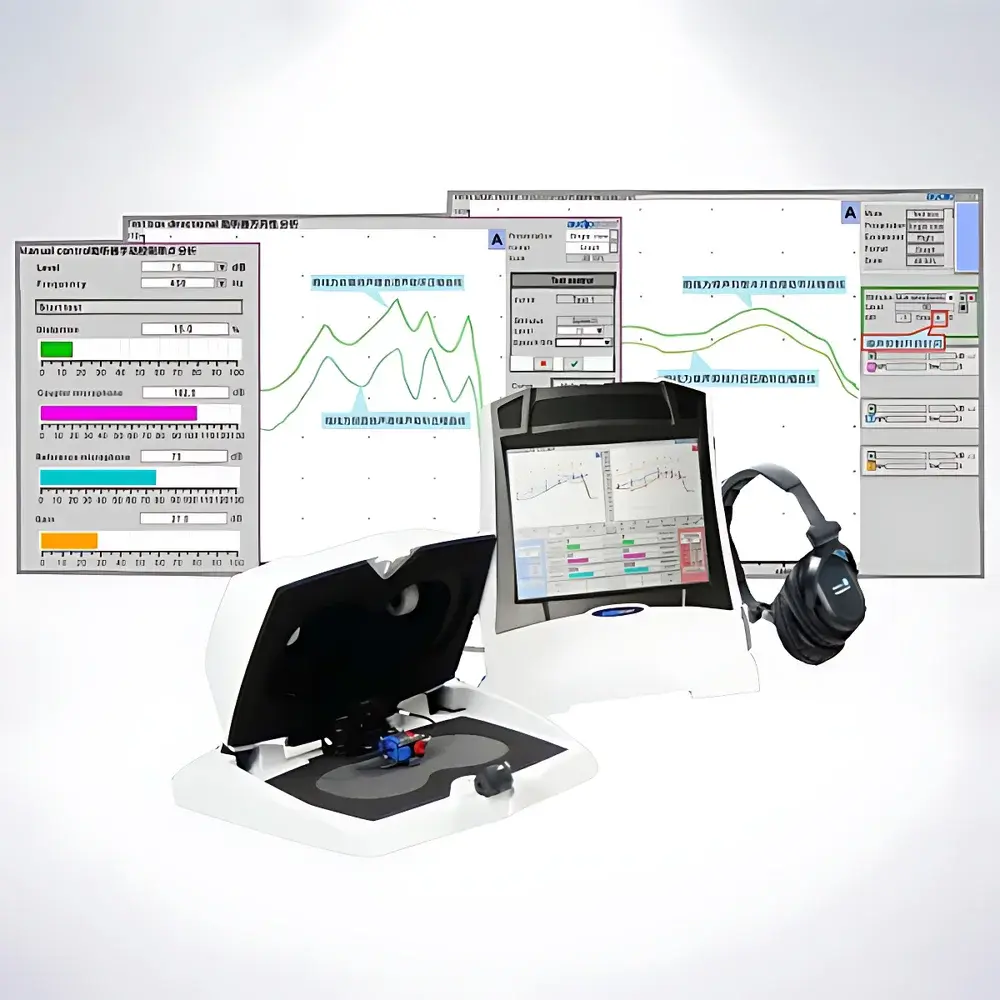
Drick Verifit 2 Hearing Aid Test System
| Brand | Drick |
|---|---|
| Origin | Shandong, China |
| Manufacturer Type | Manufacturer |
| Product Origin | Domestic (China) |
| Model | Verifit 2 |
| Price | USD 28,000 (approx.) |
Overview
The Drick Verifit 2 Hearing Aid Test System is a clinical-grade electroacoustic verification platform engineered for objective, real-time assessment of hearing aid performance in audiology laboratories, hearing centers, and rehabilitation clinics. Unlike general-purpose audio analyzers, the Verifit 2 implements ANSI S3.46-2013 and IEC 60118-15:2020 compliant measurement protocols to quantify critical electroacoustic parameters—including frequency response, gain compression, harmonic distortion, equivalent input noise, saturation sound pressure level (SSPL), and directional microphone directivity index—under standardized coupler and ear-simulating conditions. Its dual-channel architecture enables simultaneous bilateral verification, supporting binaural fitting workflows and cross-ear comparative analysis without manual reconfiguration. The system integrates a calibrated 2cc coupler, precision Class 1 microphone, programmable acoustic stimulus generator, and real-time signal processing engine to deliver traceable, repeatable measurements aligned with international audiological practice standards.
Key Features
- Dual-channel real-time verification: Simultaneous measurement of left and right hearing aids using independent stimulus generation and signal acquisition paths.
- Speechmap™ visual interface: Real-time display of speech-weighted frequency response overlaid with prescriptive targets (e.g., NAL-NL2, DSL v5.0, CAMEQ2-HF), enabling immediate visual alignment during fitting.
- Objective speech intelligibility metrics: Integrated calculation of Speech Intelligibility Index (SII) and Articulation Index (AI) pre- and post-fitting, referenced to ANSI S3.5-1997.
- Multifunctional stimulus library: Preconfigured signals including warble tones, swept sine, modulated noise, IEC 60118-0 speech-shaped noise, and FM radio test carriers for wireless system validation.
- MOAF (Maximum Output at Frequency) visualization: Dynamic highlighting of output-limited frequency bands to guide safe gain adjustment and prevent over-amplification.
- VerifitLink™ automated target matching: Bidirectional communication with major hearing aid manufacturers’ programming software to import verified prescriptive targets and export measured responses.
- Bone conduction verification support: DSL-BCD v5.0 target application and coupler-based validation for bone-anchored hearing aids (BAHA) and transcranial devices.
- Extended bandwidth analysis: Full-frequency characterization from 100 Hz to 16.0 kHz with ±0.5 dB amplitude linearity and <0.1% THD across the operational range.
Sample Compatibility & Compliance
The Verifit 2 supports all major hearing aid form factors—including BTE, RIC, ITE, CIC, and bone conduction devices—as well as assistive listening systems (ALS), FM receivers, and telecoil-enabled instruments. It complies with ANSI S3.22-2022 (Hearing Aid Performance Measurement Procedures), IEC 60118-0:2023 (Electroacoustics – Hearing Aids – Part 0: Measurement Methods), and ISO 8253-2:2021 (Audiometric equipment – Part 2: Equipment for the measurement of hearing aid characteristics). All calibration routines follow traceable NIST-equivalent reference standards, and measurement uncertainty budgets are documented per ISO/IEC 17025 requirements for accredited audiology labs.
Software & Data Management
The embedded Verifit OS provides audit-trail–enabled data logging with timestamped session records, user authentication, and configurable report templates (PDF/CSV). Software supports HIPAA-compliant data encryption, role-based access control, and export of raw FFT spectra, SPL vs. frequency plots, and SII summary tables. Optional integration with clinic management systems via HL7 v2.5 or FHIR APIs enables seamless EHR synchronization. All firmware updates and calibration certificates are digitally signed and version-controlled to ensure regulatory readiness for GLP/GMP-aligned clinical validation studies.
Applications
- Clinical verification of first-fit and fine-tuned hearing aid prescriptions
- Validation of directional microphone functionality and noise reduction algorithms
- Quantitative assessment of feedback cancellation system stability margins
- FM system carrier-to-noise ratio (CNR) and modulation depth testing
- Telecoil (T-coil) sensitivity and magnetic field coupling efficiency evaluation
- Post-repair electroacoustic diagnostics and failure mode analysis
- Research-grade characterization of novel signal processing architectures
- Training and competency assessment for audiology students and technicians
FAQ
Does the Verifit 2 support real-time bilateral speech mapping during live voice stimulation?
Yes—the system includes a calibrated external microphone input and adaptive noise cancellation to enable real-time Speechmap™ overlay during live voice or recorded speech stimuli, with latency under 15 ms.
Can it verify hearing aids programmed with proprietary manufacturer software?
Yes—VerifitLink™ ensures bidirectional compatibility with GN ReSound, Oticon, Phonak, Starkey, Widex, and Signia programming platforms via standardized HL7 and proprietary SDK integrations.
Is calibration traceable to national metrology institutes?
All factory calibrations are traceable to CNAS-accredited laboratories with documented uncertainty budgets; annual recalibration services include ISO/IEC 17025-compliant certificates.
What coupler types are supported for different hearing aid styles?
Standard 2cc HA-1 coupler for BTE/RIC devices; optional Zwislock™ couplers for ITE/CIC verification; bone conduction adapters compliant with ANSI S3.46 Annex D.
Related Products





