
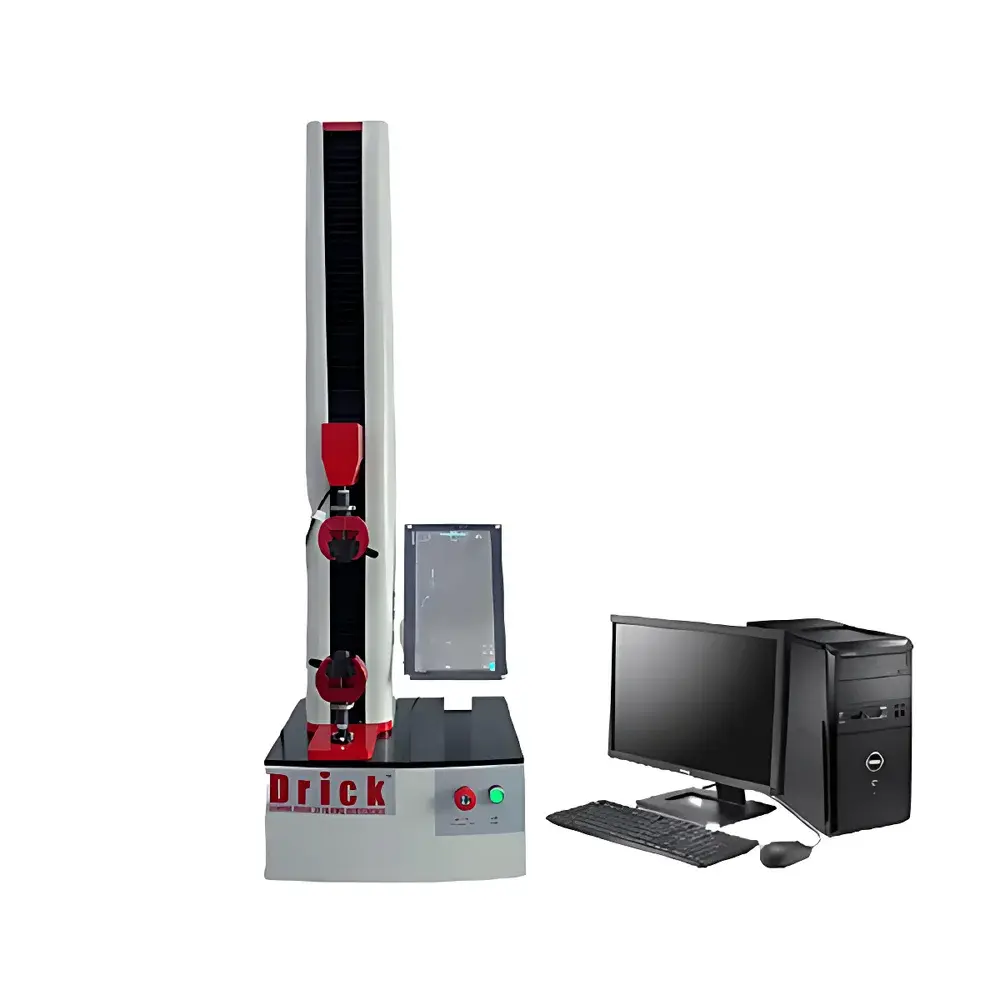
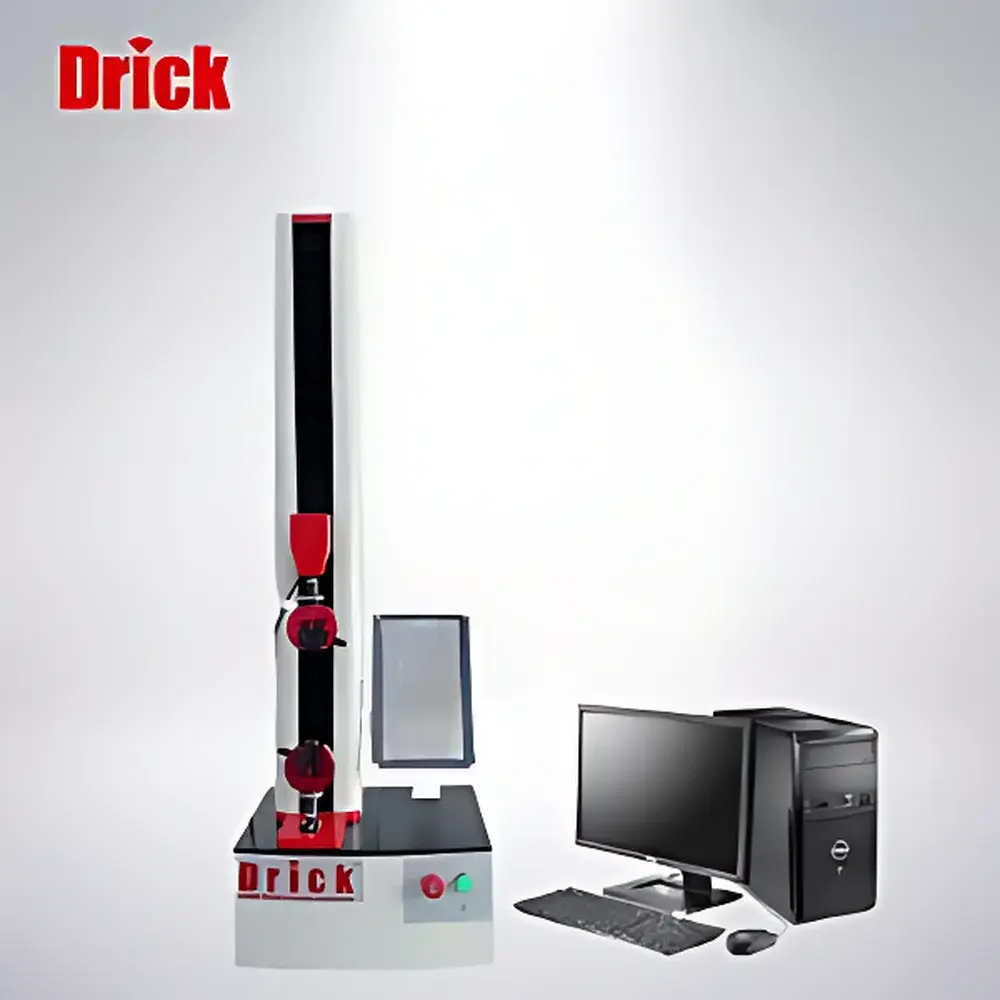
Drick DRK101 High-Speed Electromechanical Tensile Testing Machine for Metals, Non-Metals and Composites
| Brand | Drick |
|---|---|
| Origin | Shandong, China |
| Manufacturer Type | Direct Manufacturer |
| Model | DRK101 |
| Instrument Type | Electromechanical Tensile Testing Machine |
| Maximum Test Force | 1 kN |
| Force Range (FS) | 200 N (Standard), Optional: 50 N / 100 N / 500 N / 1000 N |
| Force Accuracy | Better than Class 0.5 |
| Test Stroke | 700 mm (Standard), Optional: 400 mm / 1000 mm |
| Displacement Resolution | 0.001 mm |
| Speed Range | 0.01–2000 mm/min (Infinitely Variable) |
| Force Resolution | 0.1 N |
| Standard Grip Width | 30 mm, Optional: 50 mm |
| Clamping Method | Manual (Pneumatic Upgrade Available) |
| Protection | Dual-Level (Programmable + Mechanical) Overload & Travel Limit Protection |
Overview
The Drick DRK101 is a high-speed, microprocessor-controlled electromechanical tensile testing machine engineered for precision mechanical characterization of metals, non-metals, polymers, composites, textiles, films, foils, and elastomers. It operates on the principle of controlled uniaxial force application via an AC servo motor coupled with a high-rigidity load frame and precision ball-screw transmission system. The system implements closed-loop digital control of load, displacement, and strain—enabling full compliance with static mechanical test protocols defined in ISO 6892-1, ASTM E8/E21, GB/T 228.1, JIS Z 2241, and DIN 50125. Designed for laboratory and quality control environments requiring reproducible, traceable, and auditable test results, the DRK101 supports both routine compliance testing and advanced material behavior analysis—including yield point detection, tensile strength evaluation, modulus calculation, and elongation-at-break quantification.
Key Features
- High-fidelity force measurement using dual-range, temperature-compensated load cells with better-than-Class-0.5 accuracy per ISO 376 and verified traceability to national standards.
- Infinitely variable crosshead speed control from 0.01 mm/min to 2000 mm/min, enabling quasi-static, dynamic, and high-rate tensile testing within a single platform.
- Dual-control architecture: independent operation via integrated industrial touchscreen HMI and Windows-based PC software—both synchronized in real time with identical data acquisition and control logic.
- Automated test sequencing with programmable test profiles, including multi-stage ramp-hold cycles, stress-relaxation, and creep protocols.
- Real-time auto-calibration capability for force and displacement channels, supporting periodic verification without external calibration hardware.
- Robust mechanical design featuring hardened steel guide columns, preloaded linear bearings, and reinforced U-frame construction for minimal deflection under load.
- Comprehensive safety architecture: dual-limit travel protection (software-defined soft limits + physical end-stop switches) and overload cutoff at 3–5% above selected capacity range.
- Modular grip configuration—standard manual wedge grips (30 mm width) with optional pneumatic or hydraulic actuation and extended-width (50 mm) configurations for heterogeneous or wide-section specimens.
Sample Compatibility & Compliance
The DRK101 accommodates a broad spectrum of specimen geometries and material classes, including metallic wires, rods, and sheets; polymer films and molded parts; fiber-reinforced laminates; geotextiles; paperboard; rubber compounds; and biomedical tubing. Specimen thickness up to 15 mm and width up to 50 mm are supported under standard configurations. All test routines adhere to internationally recognized standards for mechanical testing—including ISO 527 (plastics), ISO 1924 (paper), ASTM D638 (tensile properties of plastics), ASTM D882 (thin plastic sheeting), and ISO 13934-1 (textiles). The system architecture is compatible with GLP and GMP documentation workflows, supporting user-defined audit trails, electronic signatures, and 21 CFR Part 11–compliant data integrity features when deployed with validated software modules.
Software & Data Management
The DRK101 is supplied with DrickTest™ v4.x—a Windows-native, bilingual (English/Chinese) test control and analysis suite built on a modular, event-driven architecture. It provides real-time visualization of force-displacement, stress-strain, and time-based curves with adjustable scaling and overlay capabilities. Data export conforms to ASTM E1434 and ISO/IEC 17025 requirements: raw ASCII (.txt), CSV, XML, and PDF report formats are natively supported. Advanced curve analysis includes automatic yield point identification (0.2% offset method), tangent modulus calculation, post-yield strain hardening coefficient derivation, and fracture energy integration. All test parameters—including operator ID, environmental conditions (optional sensor inputs), calibration timestamps, and instrument configuration—are embedded in metadata and preserved with each dataset. Local database storage ensures version-controlled archival, while network-enabled deployment allows centralized data aggregation across multiple instruments.
Applications
- Quality assurance of incoming raw materials (e.g., aluminum alloy strips, stainless steel wire, carbon fiber prepreg)
- Mechanical validation of thermoplastic injection-molded components per automotive OEM specifications (e.g., VW TL 52202, GMW15635)
- Package integrity testing of pharmaceutical blister foils and medical device pouch seals (ASTM F88/F1140)
- Performance benchmarking of composite laminates used in wind turbine blade cores and aerospace secondary structures
- Research-grade tensile fatigue precursor studies on elastomeric sealants and hydrogel membranes
- Regulatory submission support for FDA 510(k) or CE Mark dossiers requiring standardized mechanical property evidence
- Educational use in university materials science laboratories for hands-on instruction in solid mechanics fundamentals
FAQ
What international standards does the DRK101 support out-of-the-box?
The system includes preconfigured test methods aligned with ISO 6892-1, ASTM E8, GB/T 228.1, and JIS Z 2241. Additional standards can be implemented via custom protocol definition in DrickTest™.
Is the force transducer calibrated to national metrological standards?
Yes—each load cell is supplied with a factory calibration certificate traceable to CNAS-accredited reference standards (equivalent to ISO/IEC 17025). On-site recalibration kits and procedures are available.
Can the DRK101 perform compression or flexural tests?
With optional accessories—including compression platens, three-point bending fixtures, and universal joint adapters—the DRK101 supports ASTM D695, D790, and ISO 604/178 test modes.
How is data integrity ensured during long-duration tests?
All acquired data streams are written continuously to non-volatile memory with timestamped checksums. Power-loss recovery preserves partial test records, and automatic backup to network drives is configurable.
Does the system meet FDA 21 CFR Part 11 requirements?
When operated with the validated DrickTest™ Part 11 Edition—including role-based access control, electronic signature capture, and immutable audit logs—the system satisfies predicate rule requirements for regulated environments.



