
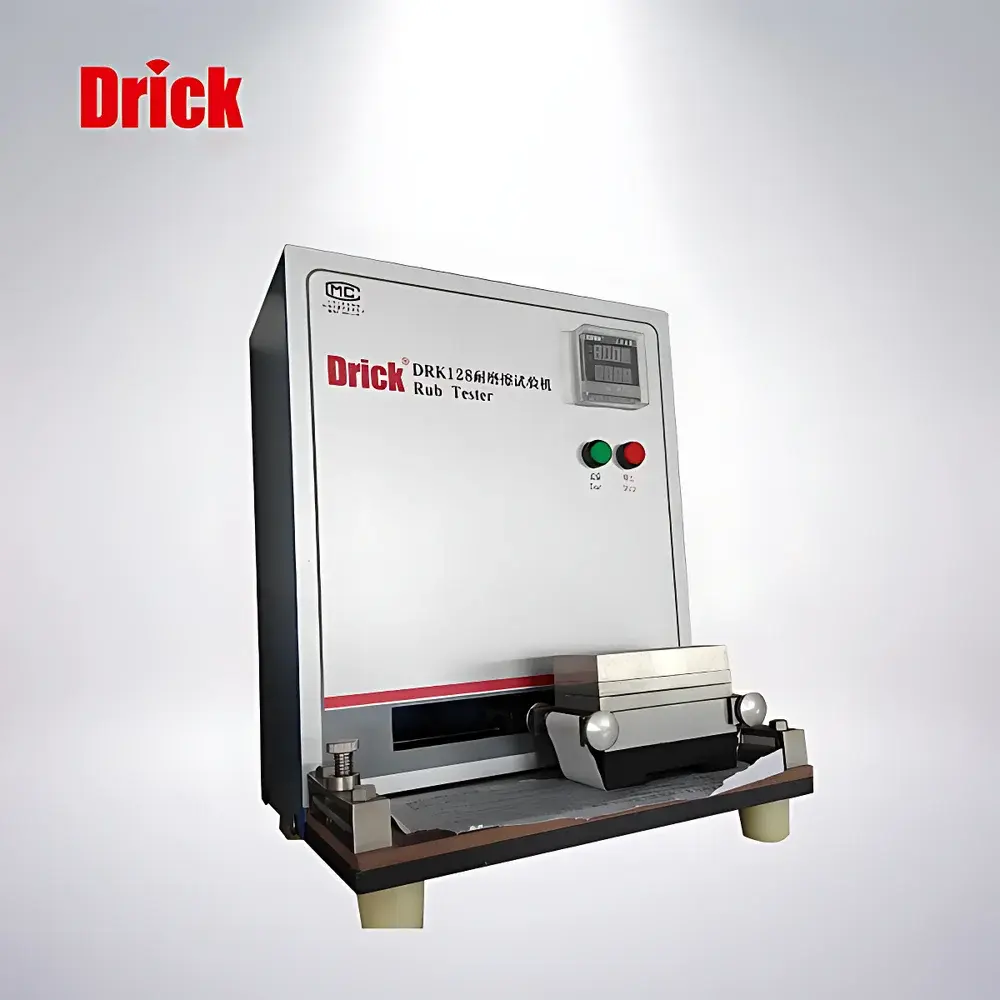
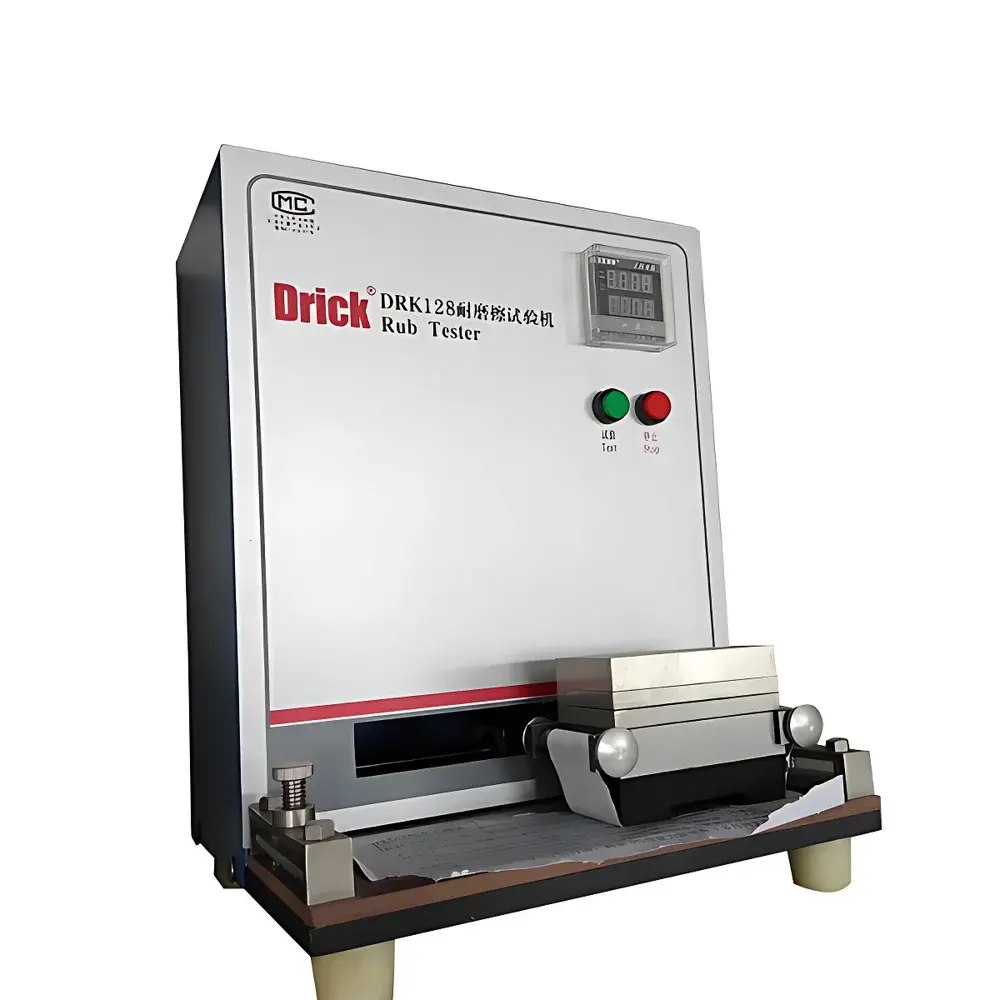
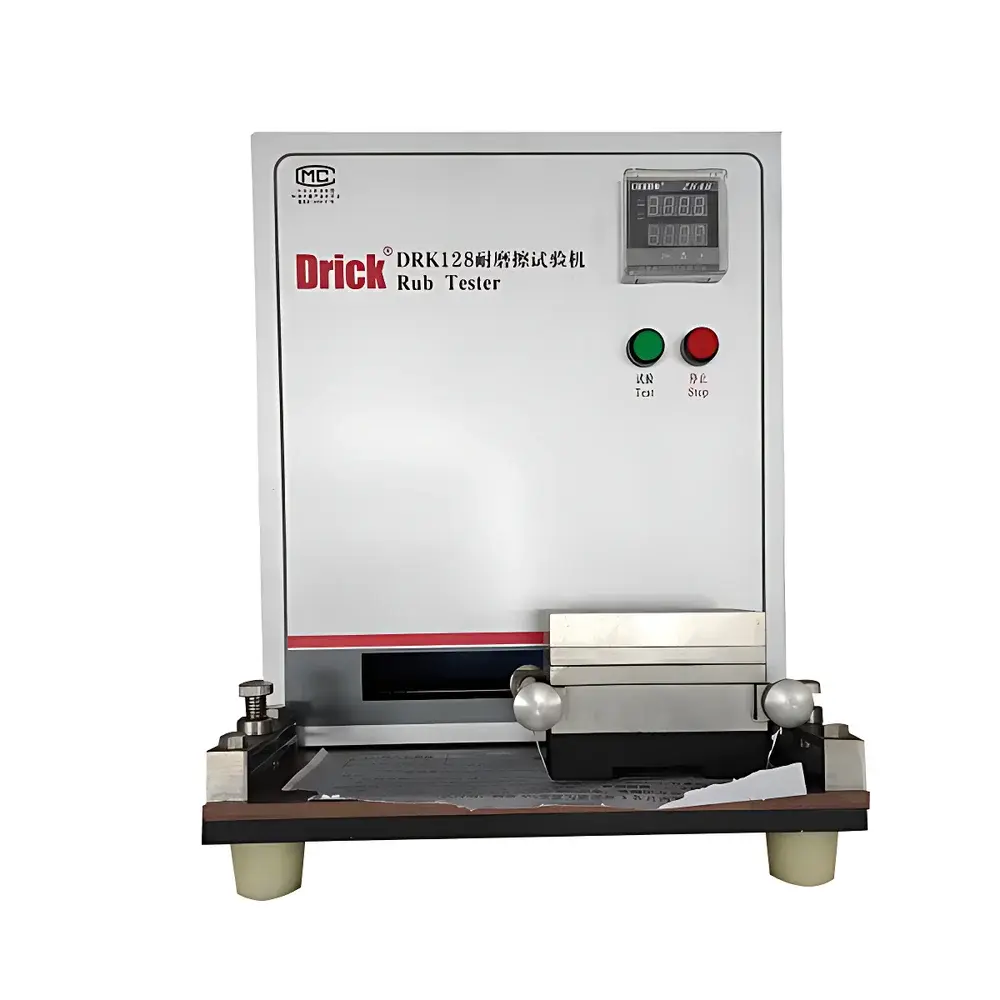

Drick DRK128 GB/T 7706 Ink Rub Resistance Tester
| Brand | Drick |
|---|---|
| Origin | Shandong, China |
| Manufacturer Type | OEM/ODM Manufacturer |
| Country of Origin | China |
| Model | DRK128 |
| Operating Pressure | 20 ± 0.2 N |
| Oscillation Frequency | 43 cycles per minute (cpm) |
| Rubbing Area | 155 mm (L) × 50 mm (W) |
| Adjustable Rub Cycles | 1–9999 |
| Specimen Size | 230 mm (L) × 50 mm (W) |
| Power Supply | AC 220 V, 50 Hz |
| Dimensions (W×D×H) | 260 × 245 × 340 mm |
| Net Weight | 17 kg |
| Compliance | GB/T 7706, ASTM D5264, JIS K5701, TAPPI T458 |
Overview
The Drick DRK128 GB/T 7706 Ink Rub Resistance Tester is a precision-engineered mechanical abrasion instrument designed for quantitative evaluation of surface coating durability in packaging and print quality assurance workflows. It operates on the principle of controlled reciprocating linear friction—applying a standardized normal force (20 ± 0.2 N) at a fixed oscillation frequency (43 cpm) across a defined contact area (155 × 50 mm)—to simulate real-world handling, stacking, and transport-induced wear on printed substrates. Unlike generic coefficient-of-friction testers, the DRK128 is purpose-built to assess ink adhesion integrity, photopolymer layer cohesion (e.g., PS plate emulsion), and functional coating hardness under repeatable mechanical stress. Its design directly implements the test methodology specified in GB/T 7706—China’s national standard for gravure and flexographic ink rub resistance—and maintains technical equivalence with internationally recognized protocols including ASTM D5264 (Standard Test Method for Abrasion Resistance of Printed Materials), JIS K5701 (Japanese Industrial Standard for Printing Ink Rub Resistance), and TAPPI T458 (Rub Resistance of Printing Inks). This ensures data interoperability across global supply chains and regulatory submissions.
Key Features
- Compliance-driven mechanical architecture: Fully aligned with GB/T 7706 dimensional tolerances, load calibration, and motion kinematics—enabling direct traceability to certified reference materials and inter-laboratory round-robin validation.
- Embedded friction stage with hardened stainless-steel contact surface: Ensures uniform pressure distribution and eliminates edge-effect artifacts during repeated cycling; friction path remains acoustically damped (<45 dB(A)) for ISO 140-4-compliant lab environments.
- Non-volatile cycle memory: Preserves user-defined test parameters—including target rub count, dwell time, and post-test hold state—even during unexpected power interruption, supporting GLP-aligned procedural continuity.
- Digital counter with auto-termination logic: Accurately logs cumulative oscillations from 1 to 9999 with ±1-cycle resolution; automatically halts actuation upon reaching setpoint to prevent over-stressing specimens or damaging the drive mechanism.
- Modular specimen clamping system: Accommodates standard 230 × 50 mm strips without trimming or adhesive aids; accommodates both rigid (e.g., metal PS plates) and flexible (e.g., BOPP film, coated paperboard) substrates via adjustable tension retention.
Sample Compatibility & Compliance
The DRK128 accepts flat, planar specimens up to 230 mm in length and 50 mm in width, with thicknesses ranging from 0.05 mm (thin polyester films) to 3.2 mm (rigid aluminum PS printing plates). It supports dry-rub, wet-rub (using standardized solvent-dampened cotton swabs per GB/T 7706 Annex A), and pigment-transfer quantification via grayscale densitometry or ΔE*ab colorimetric analysis. All mechanical components are constructed from corrosion-resistant alloys compliant with ISO 9001:2015 manufacturing controls. The instrument meets electromagnetic compatibility requirements per IEC 61326-1 and safety standards per IEC 61010-1. Calibration documentation includes traceable force verification against NIST-traceable deadweight standards and frequency calibration using optical tachometry.
Software & Data Management
While the DRK128 operates as a standalone electromechanical tester, its digital control board features an RS-232 serial interface (optional USB-to-serial adapter available) for integration into LIMS or MES platforms. Raw cycle counts, elapsed time, and fault codes (e.g., motor stall, sensor timeout) can be exported as ASCII-formatted .csv files. When used in conjunction with third-party image analysis software (e.g., ImageJ with ISO 13660-compliant line-scan modules), users may correlate rub-induced optical density loss with standardized pass/fail thresholds defined in ISO 12647-2 (process control for offset lithography) or ASTM F1945 (rub resistance of medical device labels). Audit trails comply with FDA 21 CFR Part 11 requirements when paired with validated electronic record systems.
Applications
- Quantitative assessment of gravure/flexo ink adhesion on laminated pouches, cartons, and shrink sleeves—supporting root-cause analysis of field failures related to scuffing or smearing.
- Evaluation of photopolymer emulsion durability on pre-sensitized (PS) offset printing plates—correlating rub cycles to predicted press runs (e.g., ≥50,000 impressions).
- Validation of UV-curable coating hardness on pharmaceutical blister foil or child-resistant packaging—per USP extractables and leachables qualification protocols.
- Comparative testing of anti-blocking agents in polyolefin films under accelerated abrasion conditions—aligned with ASTM D1894 coefficient-of-friction correlation studies.
- Process capability studies for inline corona treatment or plasma activation systems—measuring post-treatment bond strength retention after simulated logistics stress.
FAQ
Does the DRK128 support automated data logging without external PC connection?
No—it requires optional serial communication hardware and host software for persistent data capture; onboard memory retains only the last executed cycle count and settings.
Can the 20 N load be adjusted for non-standard test methods?
No—the load is mechanically fixed via calibrated spring assembly per GB/T 7706 Clause 5.3; modification voids compliance certification.
Is calibration certification included with shipment?
Yes—a factory-issued calibration report (traceable to CNAS-accredited metrology lab) is supplied with each unit, covering force verification and timing accuracy.
What maintenance intervals are recommended for long-term repeatability?
Lubrication of linear guide rails every 6 months and annual verification of solenoid actuator stroke tolerance (±0.1 mm) per maintenance manual Section 7.2.
Does the instrument meet CE marking requirements for EU export?
It complies with EMC Directive 2014/30/EU and Low Voltage Directive 2014/35/EU; CE declaration is provided upon request for shipments to EEA countries.






